
Choosing between a 12m and 15m flatbed is not simply a question of buying the longer trailer. The right choice depends on cargo length, loading method, turning space, axle configuration, route restrictions and how the trailer will be used day to day.
Understanding flatbed trailer dimensions is especially important for UAE operators carrying steel, pipes, precast materials, machinery and industrial cargo between ports, yards, construction sites and project locations. A 15m deck gives more loading length, but a 12m trailer can be easier to maneuver and may already be sufficient for many standard loads.
This guide compares 12m and 15m flatbeds from a practical operating perspective so buyers can choose the length that matches the cargo rather than simply selecting the biggest option.
Table of Contents
- What dimensions matter on a flatbed trailer?
- 12m vs 15m flatbed at a glance
- When a 12m flatbed makes sense
- When a 15m flatbed makes sense
- Cargo length and usable deck space
- Maneuverability and turning space
- Payload, axle loads and weight distribution
- Loading and unloading
- UAE road and dimension requirements
- Which size suits different industries?
- Questions to ask before ordering
- FAQs
What Flatbed Trailer Dimensions Actually Matter?
Flatbed trailer dimensions involve more than deck length.
A buyer should confirm:
- Overall trailer length
- Usable deck length
- Overall width
- Deck height
- Kingpin position
- Axle position
- Axle spacing
- Rear overhang
- Suspension arrangement
- Permitted payload
- Gross and axle-weight limits for the intended operation
The quoted 12m or 15m figure usually describes the nominal trailer or deck length offered by a manufacturer, but the exact usable loading area can depend on frame design and specification.
That is why a technical drawing matters more than a product name. Two trailers described as 12m flatbeds can still differ in kingpin position, axle layout, rear structure and usable cargo space.
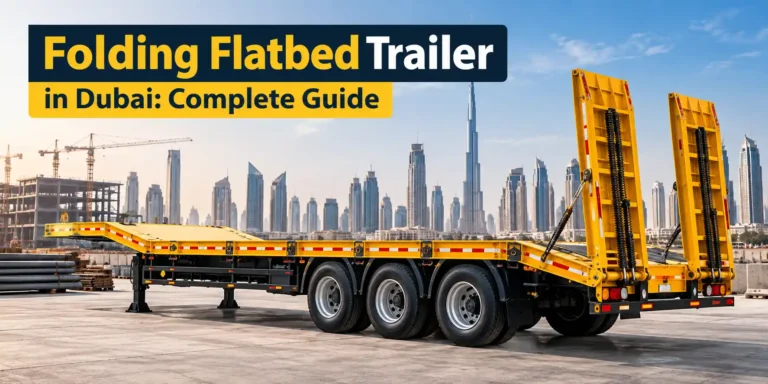
Golden Space currently manufactures flatbeds in 12m, 15m and custom lengths, with different axle options available depending on the application.
12m vs 15m Flatbed Trailer: Quick Comparison
| Factor | 12m Flatbed | 15m Flatbed |
|---|---|---|
| Nominal length | 12m | 15m |
| Extra deck length | Baseline | 3m additional nominal length |
| Best suited to | Standard cargo and mixed work | Longer cargo and loads needing more deck space |
| Maneuverability | Generally easier | Requires more turning and yard space |
| Tight-site access | Usually easier | Needs more access planning |
| Long steel and pipe | Suitable when cargo fits | Better suited to consistently longer cargo |
| Payload | Depends on engineering | Depends on engineering |
| Axle selection | Must suit the load | Must suit the load |
| Route planning | Usually simpler | Requires greater attention to overall combination length |
The important point is that a 15m trailer is not automatically heavier-duty than a 12m trailer.
Length, payload and structural capacity are separate specifications.
When Does a 12m Flatbed Trailer Make More Sense?
A 12m flatbed trailer is a practical choice when the normal cargo fits comfortably within the usable deck and the operation values maneuverability.
Common applications can include:
- Construction materials
- Palletized industrial cargo
- Standard-length steel products
- Machinery that fits correctly on the deck
- Site equipment
- General logistics cargo
- Mixed loads that do not need additional length
For operators regularly entering industrial yards, construction compounds and tighter sites, the shorter trailer can be easier to position and reverse.
It can also be the more efficient fleet choice where the additional 3m of a 15m trailer would remain unused on most trips.
Buying more deck length than the operation actually needs does not automatically improve productivity.
When Does a 15m Flatbed Trailer Make More Sense?
A 15m flatbed becomes more useful when cargo length is the main constraint.
Typical cargo can include:
- Long steel sections
- Pipes
- Structural members
- Precast components
- Long fabrication assemblies
- Multiple cargo units requiring more deck space
- Industrial cargo where additional supported length is useful
The additional deck length can reduce the pressure to fit long cargo onto a shorter platform and can provide more flexibility in arranging multiple items.
However, a longer trailer should only be selected if the business can actually use the extra deck space.
Before choosing 15m, check:
- Normal cargo lengths
- Yard size
- Gate access
- Turning space
- Loading-bay dimensions
- Tractor compatibility
- Axle arrangement
- Route restrictions
- Complete combination dimensions
The 15m configuration is useful when its additional length solves a real transport problem.
Cargo Length vs Usable Deck Length
One of the most important flatbed trailer dimensions is the usable deck length.
Do not assume the advertised trailer length and available cargo-supporting surface are always identical.
Before ordering, check the technical drawing and confirm:
- Exact usable deck length
- Front structure or headboard position
- Rear structure
- Kingpin position
- Axle position
- Load support points
- Tie-down locations
This distinction becomes particularly important with long steel, pipe and fabrication loads.
A cargo item may physically fit onto the trailer but still be poorly positioned for:
- Axle loading
- Securement
- Centre of gravity
- Support
- Legal overhang
- Turning clearance
Golden Space’s existing guide to 40 ft flatbed trailer dimensions explains this distinction in more detail. A nominal 40 ft length equals approximately 12.192 metres, which is why buyers should not automatically treat “40 ft” and “12m” as identical measurements.
How Does Flatbed Trailer Length Affect Maneuverability?
Flatbed trailer length directly affects the space needed to maneuver.
A 15m trailer generally requires more room during:
- Tight turns
- Reversing
- Yard positioning
- Gate entry
- Roundabouts
- Industrial-site access
- Loading-bay alignment
This does not make 15m trailers impractical. It simply changes the operating environment they are best suited to.
A 12m trailer can be more convenient where the fleet frequently enters smaller yards or congested project sites.
A 15m trailer can make more sense where the work is concentrated around:
- Large industrial yards
- Ports
- Steel facilities
- Open construction sites
- Major logistics routes
The correct comparison therefore considers the complete journey from loading point to unloading point.
Does a 15m Flatbed Carry More Weight Than a 12m Flatbed?
Not necessarily.
This is one of the most important misconceptions when comparing flatbed trailer dimensions.
A longer deck does not automatically mean a greater payload.
Actual carrying capability depends on factors including:
- Main frame design
- Structural steel specification
- Cross-member design
- Axle type
- Number of axles
- Suspension
- Tyre ratings
- Kingpin load
- Axle spacing
- Load position
- Gross vehicle limits
Golden Space, for example, lists both 12m and 15m flatbeds while separately specifying BP 16-ton and bogie 32-ton axle options.
That illustrates the key principle:
Length tells you how much deck space is available. It does not, by itself, tell you how much weight the trailer can carry.
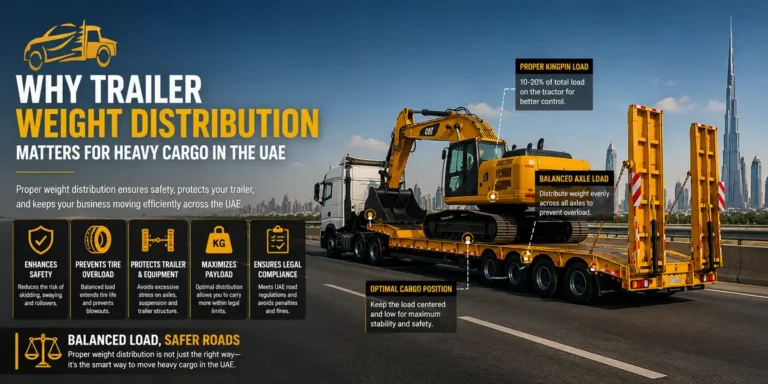
Weight Distribution Matters on Both Trailer Lengths
A longer trailer provides more possible cargo positions.
That can be useful, but it can also make incorrect positioning easier.
The load must remain within acceptable:
- Tractor axle loads
- Kingpin load
- Trailer axle-group loads
- Tyre ratings
- Suspension limits
- Structural limits
Placing a concentrated load too far forward can transfer too much weight toward the tractor.
Placing the same load too far rearward can increase the load on the trailer axle group.
A 15m deck therefore does not remove the need for load calculations.
It simply gives planners more deck length within which the cargo can potentially be positioned.
For deeper guidance on this subject, see the article on trailer weight distribution.
How Do 12m and 15m Flatbeds Differ During Loading?
Flatbed trailers are useful because their open deck allows cargo to be loaded from the:
- Side
- Rear
- Top using a crane
Trailer size can influence how easy that process is.
Loading a 12m Flatbed
A shorter trailer can be easier to position:
- Under a crane
- Beside a loading platform
- Inside a smaller yard
- Near forklifts
- At tighter construction sites
For standard-size loads, this can improve day-to-day practicality.
Loading a 15m Flatbed
A longer deck can provide more room for:
- Long materials
- Multiple load units
- Extended steel sections
- Long pipes
- Precast elements
However, loading teams should also consider crane reach, forklift access, load sequence and final weight distribution.
More deck length only helps if the cargo can still be positioned and secured correctly.
UAE Rules: Trailer Length Is Not the Same as Legal Combination Length
When discussing standard flatbed trailer dimensions, the trailer itself must not be confused with the complete heavy vehicle.
UAE Cabinet Resolution No. 138 of 2023 is currently listed as active and effective from 1 February 2024.
Under the federal table, the standard maximum dimensions for a truck head and semi-trailer are:
| Dimension | Federal Maximum |
|---|---|
| Overall length | 21m |
| Overall width | 2.6m |
| Overall height | 4.6m |
The same framework sets gross-weight limits according to the number of vehicle axles, up to 65 tonnes for six axles or more under the published federal table.
These limits apply to the complete vehicle configuration described in the legislation.
A 15m semi-trailer should therefore not be assessed simply by saying:
“15m is below 21m, so it is legal.”
That reasoning is wrong.
The tractor, kingpin position, front and rear overhang, coupling geometry and full combination length must be considered.
What About Dubai?
Dubai RTA also publishes technical requirements for locally manufactured and imported trailers and semi-trailers, including dimensional requirements.
Because federal rules and local registration or road requirements can interact, operators should verify the specification against the competent authority for the actual vehicle, emirate and intended route rather than relying on a generic dimension table alone.
Exceptional or oversized movements can also require additional authorization.
Which Flatbed Length Is Better for Construction?
A 12m trailer can suit many construction operations carrying:
- Formwork
- Scaffolding
- Packaged materials
- Machinery
- Standard steel
- Site equipment
Its more compact footprint can also help where construction entrances or internal site roads are tight.
A 15m trailer becomes more useful where contractors repeatedly transport long structural elements or need additional supported deck length.
The correct choice depends on the contractor’s recurring cargo rather than the industry label alone.
Which Size Is Better for Steel Transport?
Steel transport is one of the strongest reasons to compare 12m with 15m.
A 12m flatbed can work well for standard-length steel products that fit correctly within the usable loading area.
A 15m trailer can provide greater flexibility for:
- Long beams
- Structural steel
- Fabricated sections
- Pipes
- Extended industrial components
However, longer cargo still requires attention to:
- Support locations
- Cargo restraint
- Axle loads
- Overhang
- Turning clearance
- Route geometry
Deck length alone does not solve those issues.
Which Size Is Better for Pipe Transport?
Pipe transport depends heavily on actual pipe length and bundle configuration.
If the business frequently handles pipes approaching or exceeding the usable deck length of its existing trailer, additional deck length may improve support and positioning.
A 15m trailer can therefore make sense for operations where longer pipes are common.
If most pipe loads already fit securely on a 12m deck, moving to 15m may provide little benefit while increasing the trailer’s overall footprint.
Which Size Is Better for Machinery?
For machinery, a longer trailer is not automatically preferable.
The machine’s:
- Transport length
- Weight
- Centre of gravity
- Attachment position
- Tie-down locations
- Axle-load effect
all matter.
If machinery fits correctly on a 12m deck while producing acceptable weight distribution, there may be no need to move to 15m.
A 15m configuration becomes more relevant where the machinery is unusually long or the extra deck space is required to position the centre of gravity correctly.
12m vs 15m Flatbed: Which Is Better for UAE Operations?
There is no universal winner.
Choose 12m when:
- Normal cargo already fits
- Tight access is common
- Maneuverability matters
- Extra deck space would rarely be used
- The fleet carries varied standard-length cargo
Choose 15m when:
- Long cargo is routine
- Extra supported deck length solves a recurring problem
- Large yards and routes can accommodate the trailer
- Long steel, pipe or structural cargo forms a major part of the workload
- Additional deck space improves practical load planning
The right decision should come from actual transport records.
Review the longest loads the fleet carries regularly, how often cargo exceeds the available deck, which sites are difficult to access and whether additional length would materially improve operations.
What Should You Ask Before Ordering a Flatbed Trailer?
Before choosing between 12m and 15m, ask:
- What is the exact usable deck length?
- What is the complete trailer length?
- What is the trailer width?
- What is the deck height?
- Which axle configuration suits my normal cargo?
- What payload is this exact build engineered for?
- Where is the kingpin positioned?
- Where are the axles positioned?
- What suspension options are available?
- Where are the tie-down points?
- Can the frame be designed around a recurring cargo type?
- What will the complete tractor and semi-trailer length be?
These questions are more useful than asking only whether a 12m or 15m trailer is better.
Frequently Asked Questions
What Are Typical Flatbed Trailer Dimensions?
There is no single universal specification that applies to all markets and applications.
Flatbeds vary in length, width, deck height, axle configuration and structural design. Golden Space currently manufactures 12m, 15m and custom-length flatbeds for UAE operations.
Is a 15m Flatbed Better Than a 12m Flatbed?
Not automatically.
A 15m trailer provides more deck length, while a 12m trailer can offer easier maneuverability and enough space for many standard loads.
The better size is the one that matches the actual cargo and operating environment.
How Much Longer Is a 15m Flatbed?
A nominal 15m trailer provides 3m more length than a nominal 12m trailer.
The exact difference in usable loading space should still be confirmed from the manufacturer’s technical drawing.
Does a Longer Flatbed Carry More Weight?
No. Payload depends on structural engineering, axles, suspension, tyres, kingpin loading, load distribution and applicable weight limits.
Is 12m the Same as a 40 ft Flatbed?
No. Forty feet is approximately 12.192m.
A buyer should therefore check the exact deck measurement rather than treating 12m and 40 ft as interchangeable specifications.
What Are Flatbed Semi Trailer Dimensions in the UAE?
Flatbed semi trailer dimensions vary by design and application.
For road compliance, operators must also consider the dimensions of the complete tractor and semi-trailer combination. Under the federal rules, the published standard maximum for a truck head and semi-trailer is 21m overall length, 2.6m width and 4.6m height.