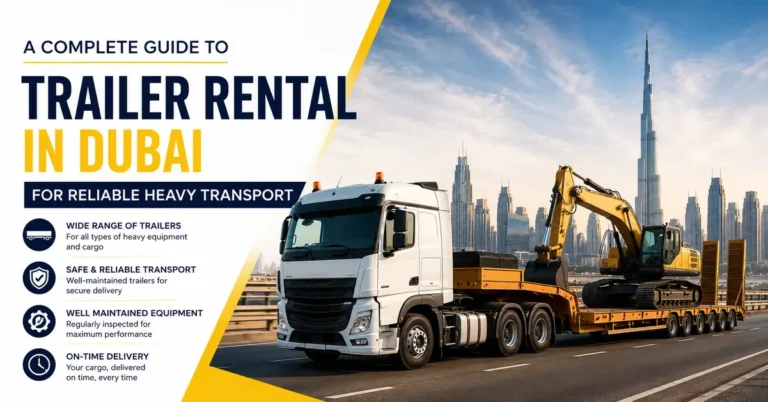
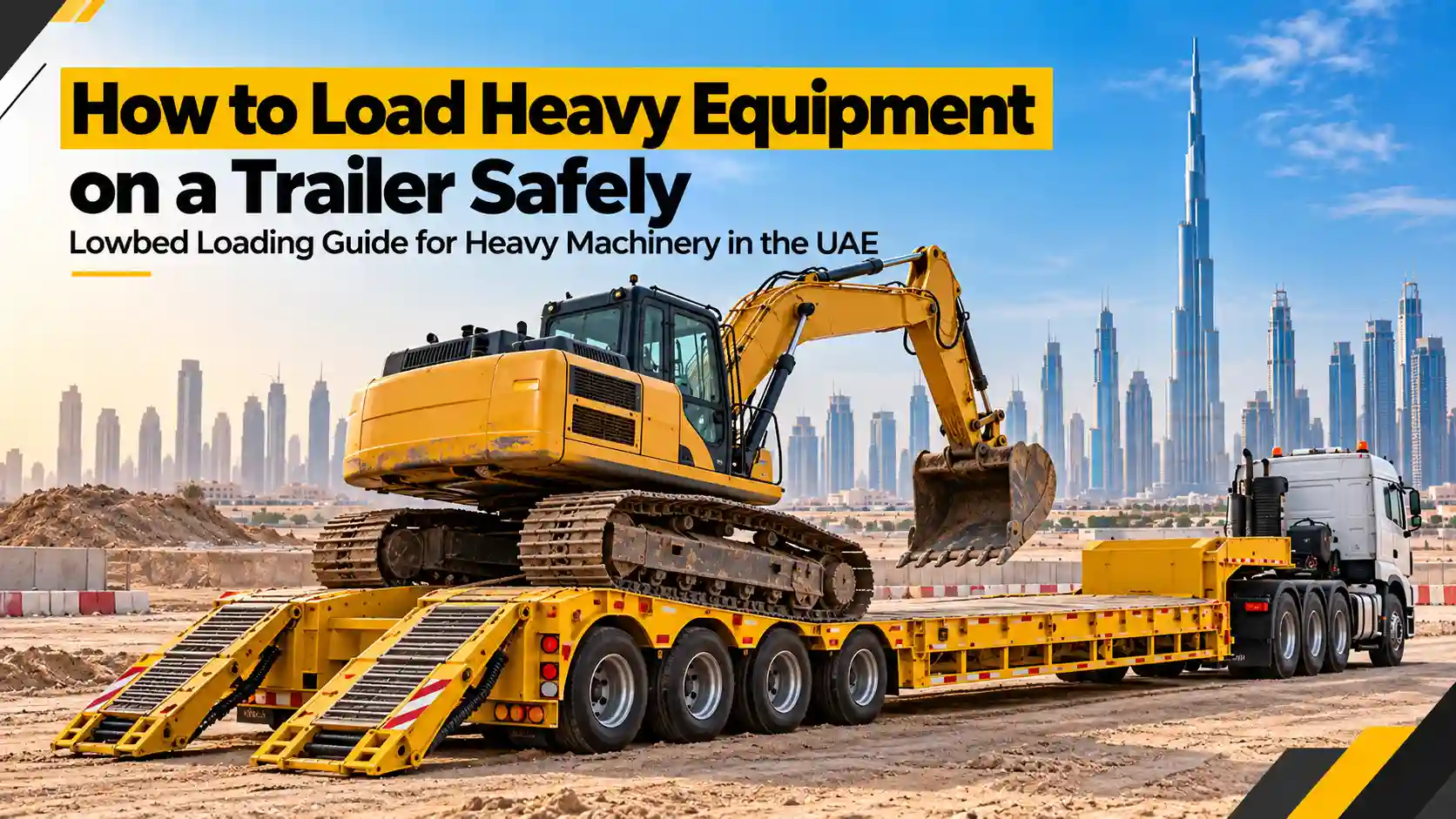
Knowing how to load heavy equipment on a trailer safely starts before the machine reaches the ramps. The trailer must match the equipment’s actual transport weight and dimensions, the loading area must be stable, the loading method must suit the machine, and the final deck position must allow correct weight distribution and securement.
For lowbed operations, a loading mistake can create several problems at once. The machine may become unstable on the ramps, overload an axle group, sit too high for the planned route or end up in a position that makes proper securement difficult.
This guide explains the complete loading process for excavators, wheel loaders, bulldozers, rollers, generators and other heavy machinery, with particular attention to lowbed trailers and UAE operating conditions.
Table of Contents
- What to check before loading
- Choosing the right trailer
- Preparing the loading area
- Inspecting the trailer and machinery
- Choosing ramps, cranes or other loading methods
- Loading self-propelled equipment
- Positioning machinery on the deck
- Loading non-self-propelled machinery
- Securing the equipment
- Checking dimensions and UAE requirements
- Final inspection before departure
- Common loading mistakes
- Loading checklist
- FAQs
What Should You Check Before Loading Heavy Equipment?
The first step in how to load heavy equipment on a trailer is verifying the machine rather than relying on its model name or an estimated weight.
Record the equipment in its actual transport configuration:
- Operating or shipping weight
- Overall transport length
- Width at the widest point
- Transport height
- Track width or tyre width
- Ground clearance
- Centre of gravity where available
- Attachment weight
- Manufacturer-designated lifting points
- Manufacturer-designated tie-down points
Attachments matter. A bucket, breaker, blade, counterweight, drilling component or other accessory can change total weight, balance and final transport dimensions.
Where manufacturer transport instructions are available, use them to confirm the approved machine position, ramp-loading procedure, lifting points and securement locations.
Choose the Right Lowbed Trailer First
The trailer must suit both the machinery and the loading method.
A lowbed is commonly used for tall and heavy construction machinery because its lower deck reduces the height added beneath the load. However, low deck height alone does not make a trailer suitable.
Check:
- Rated payload
- Usable deck length
- Deck width
- Deck height
- Axle configuration
- Concentrated load capability
- Ramp capacity
- Ramp width
- Tie-down points
- Tractor and fifth-wheel loading
- Final loaded dimensions
A machine may remain below the trailer’s stated payload capacity and still create excessive point loading or overload one axle group.
Trailer selection should therefore be based on the complete transport configuration.
For the measurements that affect machinery fit, see the lowbed trailer dimensions guide.
Operators comparing trailer specifications can also review the lowbed trailer configurations available for different heavy-equipment applications.
Prepare a Safe Loading Area
A stable loading area is essential when learning how to load heavy equipment on a trailer.
The UK’s Health and Safety Executive recommends carrying out loading and unloading on firm, level ground, keeping unnecessary pedestrians and traffic outside the work area, checking for overhead hazards and making the trailer as stable as possible.
Before loading:
- Position the tractor and trailer on firm, level ground.
- Keep the tractor and trailer straight where practical.
- Apply the parking brake.
- Use stabilisers or manufacturer-specified supports where required.
- Remove mud, oil, stones and loose debris from the deck and ramps.
- Keep unnecessary personnel outside the loading area.
- Check for overhead cables, structures and other hazards.
- Confirm adequate lighting and visibility.
- Establish communication between the operator and spotter.
The approach area must also provide enough distance for self-propelled machinery to line up with the ramps before climbing.
Inspect the Trailer Before Loading
Do not begin heavy equipment loading until the trailer has been inspected.
Check the:
- Trailer frame
- Deck
- Ramp structure
- Ramp hinges
- Ramp locks
- Hydraulic system where fitted
- Mechanical or spring-assisted ramp components
- Tyres
- Wheels
- Suspension
- Brakes
- Kingpin and coupling
- Lights
- Anchor points
A damaged hinge, leaking hydraulic cylinder, cracked structural member or defective locking mechanism should be investigated before machinery enters the trailer.
Ramp Capacity Is Not the Same as Trailer Payload
This distinction matters.
A trailer may be capable of carrying a particular machine once it is positioned on the deck, while its ramps may not be designed for the same load concentration during loading.
The ramp manufacturer or trailer specification should confirm the allowable loading capacity.
Inspect the Machinery Before Loading
The equipment itself should also receive a transport inspection.
Check for:
- Fluid leaks
- Loose parts
- Damaged tyres or tracks
- Loose doors or panels
- Unsecured tools
- Hydraulic components that could move unexpectedly
- Steering condition
- Braking condition
- Adequate fuel for loading and unloading
- Correct transport configuration
If the machine cannot move reliably under its own power, do not improvise a drive-on procedure.
Use an appropriate winch, crane, gantry or other engineered loading method.
Choose the Correct Loading Method
There is no single answer to how to load heavy equipment on a trailer because the right method depends on the machinery.
Heavy Equipment Loading Ramps
Rear ramps are commonly used for self-propelled equipment such as:
- Excavators
- Bulldozers
- Wheel loaders
- Rollers
- Skid steers
- Backhoe loaders
Important ramp variables include:
- Load capacity
- Width
- Spacing
- Length
- Surface traction
- Ramp angle
- Machine approach angle
- Machine ground clearance
- Breakover angle
A ramp can have enough structural capacity and still be unsuitable because its angle is too steep.
Longer ramps generally produce a shallower loading angle, although the actual geometry depends on deck height and ramp design.
Hydraulic and Mechanical Ramps
Hydraulic ramps reduce the manual effort required to deploy and raise heavy ramp sections.
Mechanical ramps normally use manual or spring-assisted operation and have fewer hydraulic components.
Neither system automatically makes loading safer. Ramp strength, angle, traction, width and correct operation matter more than whether the ramp is hydraulic or mechanical.
Detachable Gooseneck
Some heavy or low-clearance machinery is easier to load from the front of the main deck through a detachable gooseneck arrangement.
This can reduce the loading angle compared with some rear-ramp configurations.
The correct choice depends on machinery dimensions, weight, ground clearance and operating requirements.
Crane Loading
Generators, transformers, industrial machines and equipment that cannot drive onto the trailer may need to be lifted.
A lifting plan should establish:
- Verified load weight
- Crane capacity at the working radius
- Approved lifting points
- Rigging capacity
- Centre of gravity
- Ground bearing conditions
- Clearance around the lift
- Final trailer position
Winch Loading
A correctly specified winch may be used for equipment designed or approved to be pulled onto the trailer.
Winch capacity, cable or rope rating, anchor position, machine rolling resistance and ramp geometry all need to be considered.
How to Load Self-Propelled Heavy Equipment on a Lowbed
The physical climb onto the trailer should be slow and controlled.
1. Align the Machine With the Ramps
Approach the trailer in a straight line wherever practical.
Tyres or tracks should be centred on the ramps before the machine starts climbing.
Avoid sharp steering corrections while part of the machine is supported by the ramps. Turning can introduce lateral forces and increase the risk of slipping from the loading surface.
2. Use Low Speed
Load at a controlled speed.
Do not rely on momentum to overcome a steep ramp or poor breakover angle.
If the machine cannot climb the ramp under controlled operation, stop and determine why.
3. Use a Spotter When Visibility Is Limited
OSHA guidance for equipment transportation identifies a safely positioned spotter as a control when equipment could slip from a trailer or ramp.
The spotter should remain visible to the operator while staying away from:
- Trailer edges
- Ramp sides
- Machine tracks or tyres
- Articulation points
- Crush zones
Clear hand signals or another agreed communication method should be established before movement begins.
4. Follow Machine-Specific Loading Instructions
One procedure should not be applied to every type of machinery.
An excavator, loader, bulldozer and roller have different centres of gravity, controls, attachments and undercarriage geometry.
For excavators specifically, use the separate guide on how to transport an excavator on a lowbed trailer.
Keeping excavator-specific instructions on that page avoids confusing a general machinery guide with model-specific procedures.
5. Watch the Ramp-to-Deck Transition
The transition from the ramp onto the lowbed deck is critical for machines with limited ground clearance or a long wheelbase or track base.
Watch for contact between the machine and:
- Ramp crest
- Trailer rear structure
- Deck
- Undercarriage
- Attachments
If the machine starts to bottom out, stop.
Using additional speed to force equipment over an unsuitable breakover angle creates additional risk and does not correct the loading geometry.
Position the Machinery Correctly on the Trailer
Understanding how to load heavy equipment on a trailer also means understanding where the machine should stop.
Do not simply park machinery where it appears visually centred.
Its position affects:
- Trailer axle loads
- Tractor drive-axle load
- Fifth-wheel load
- Overall centre of gravity
- Left-to-right balance
- Tie-down angles
- Transport height
- Vehicle handling
For a semi-trailer, moving a heavy machine forward generally transfers more weight toward the tractor and kingpin. Moving it rearward places more load toward the trailer axle group.
Either extreme can create an overload even if total cargo weight is within the trailer’s rated payload.
Use calculated load distribution rather than visual judgement for heavy machinery.
The trailer weight distribution guide explains axle loading, centre-of-mass placement and why gross payload alone does not determine whether a trailer is correctly loaded.
Keep Heavy Equipment Centred Side to Side
Front-to-rear positioning gets most of the attention, but lateral balance also matters.
Unless the engineered transport plan specifies otherwise, equipment should generally be positioned so its centre of gravity remains close to the trailer’s longitudinal centreline.
An off-centre heavy load can affect:
- Left-to-right axle loading
- Suspension loading
- Tyre loading
- Frame torsion
- Cornering stability
Some machinery is asymmetric.
The physical centre of the machine may therefore not be the same as its centre of gravity.
For such machinery, use manufacturer information or engineered calculations rather than simply aligning the bodywork with the middle of the trailer.
Loading Different Types of Heavy Machinery
The principles of loading heavy equipment remain similar, but each machine introduces different considerations.
Excavators
Excavators combine concentrated track loads with a counterweight, rotating upper structure, boom and attachment.
Boom position, bucket position and counterweight orientation can materially affect dimensions and balance.
Use the machine manufacturer’s loading guidance rather than applying one orientation to every excavator.
Wheel Loaders
Wheel loaders place substantial loads through a relatively small tyre contact area.
Check:
- Ramp capacity
- Tyre alignment
- Deck point loading
- Bucket position
- Machine articulation
Avoid unnecessary articulation while the machine is climbing the ramps.
Bulldozers
Bulldozers require ramps wide enough and strong enough for their tracks.
Blade position, track width, ground clearance and traction all affect the loading process.
Road Rollers
Rollers can create high concentrated loads through steel drums or tyres.
Ramp and deck structural capacity should therefore be checked carefully.
A roller that falls below the total trailer payload rating can still impose significant local loads on ramps and deck surfaces.
Backhoe Loaders
Backhoe loaders have attachments at both ends and an uneven mass distribution.
The loader bucket and backhoe should be placed in their approved transport positions before final securement.
How to Load Non-Self-Propelled Equipment
Not every heavy load can drive onto a trailer.
Generators, transformers, industrial machines and similar cargo may require cranes, hydraulic gantries, jacking systems or other lifting equipment.
For these loads, how to load heavy equipment on a trailer becomes a lifting and placement operation rather than a drive-on procedure.
The loading plan should determine:
- Exact load weight
- Load dimensions
- Centre of gravity
- Approved lifting points
- Crane or gantry capacity
- Rigging configuration
- Trailer support points
- Deck point loads
- Final orientation
- Tie-down arrangement
The machine should ideally be lowered directly into the planned transport position.
Do not assume heavy industrial machinery can be dragged across a trailer deck after placement unless the equipment, trailer and method have been specifically designed for it.
Secure the Equipment After Loading
Correct positioning is only part of the process.
Before road movement:
- Place the machinery in the approved transport configuration.
- Lower attachments where required.
- Apply parking brakes or machine transport locks.
- Shut the machine down.
- Secure or remove loose components.
- Identify manufacturer-approved tie-down points.
- Use appropriately rated chains, binders, straps or engineered restraints.
- Connect restraints to suitable trailer anchor points.
- Secure attachments separately where necessary.
- Protect restraints from sharp edges and moving components.
Do not attach chains to convenient hydraulic cylinders, pipework, guards or other components unless they are approved tie-down locations.
Measure the Complete Loaded Vehicle
After loading, measure the actual transport configuration.
Confirm:
- Overall height
- Overall width
- Overall length
- Gross vehicle or combination weight
- Individual or grouped axle loads
The UAE Ministry of Energy and Infrastructure publishes federal maximum heavy-vehicle dimensions and weight limits.
For a truck head and semi-trailer, the federal table specifies standard maximum dimensions of:
| Measurement | Federal Standard Maximum |
|---|---|
| Overall length | 21 m |
| Overall width | 2.6 m |
| Overall height | 4.6 m |
Certain non-divisible loads can exceed normal limits when the required special transportation approval is obtained and applicable conditions are met.
Check Dubai Permit Requirements Where Applicable
For movements in Dubai, RTA operates a mobility permit system for overweight and over-dimension vehicles.
Its current guidance identifies special-load characteristics including:
- Weight above 60 tonnes
- Width above 3.5 metres
- Height above 4 metres
- Length above 20 metres
The applicable permit depends on the vehicle and proposed movement.
Complete the Final Pre-Departure Inspection
The last stage of how to load heavy equipment on a trailer is verifying the loaded combination.
Walk around the vehicle and check:
- Equipment position
- Side-to-side balance
- Attachment position
- Tie-down tension
- Anchor points
- Ramp storage
- Ramp locking system
- Hydraulic components
- Trailer suspension
- Tyres and wheels
- Coupling
- Lights and reflectors
- Loaded dimensions
- Axle loads
- Permit documentation
- Planned route
Where axle distribution is critical, use an appropriate weighbridge or axle weighing system rather than relying on appearance.
The objective is to verify what was actually loaded, not simply assume that the loading plan was followed perfectly.
Common Heavy Equipment Loading Mistakes
Choosing a Trailer Only by Payload Capacity
Payload does not confirm deck fit, point-load capacity, axle distribution, ramp suitability or overall loaded height.
Loading on Uneven or Soft Ground
A slope, pothole or weak surface can affect trailer stability and change the effective ramp angle.
Using Ramps That Are Too Steep
A machine may have enough power to climb but insufficient clearance to negotiate the transition onto the deck.
Making Sharp Turns on the Ramps
Heavy tracks and tyres can produce significant lateral forces when the operator steers while part of the machine remains on the ramps.
Guessing the Final Machine Position
Visual centring does not verify axle loads.
Ignoring Attachments
Buckets, breakers, blades, counterweights and other components affect weight, dimensions and centre of gravity.
Allowing Unnecessary People Into the Loading Zone
People who are not involved in the loading operation should remain outside the controlled area.
Positioning the Machine Before Thinking About Securement
The final deck position should also provide suitable tie-down geometry.
A machine placed correctly for axle loading but badly for securement may still need repositioning.
Forgetting About Unloading
Loading should be planned with the destination in mind.
A machine that is difficult to unload safely has not been loaded with the complete operation in view.
Heavy Equipment Loading Checklist
Use this checklist before the trailer moves.
Machinery
- Weight verified
- Dimensions measured
- Attachments included
- Transport position confirmed
- Leaks checked
- Tyres or tracks inspected
- Tie-down points identified
- Manufacturer loading instructions reviewed
Trailer
- Payload suitable
- Deck dimensions suitable
- Axle configuration checked
- Deck condition inspected
- Ramp capacity confirmed
- Ramp condition inspected
- Anchor points checked
- Brakes checked
- Tyres and wheels checked
- Lighting checked
Loading Area
- Firm and level
- Free from unnecessary people
- Sufficient manoeuvring space
- Overhead hazards checked
- Trailer secured
- Spotter communication agreed
After Loading
- Machinery position verified
- Side-to-side balance checked
- Axle distribution checked
- Attachments secured
- Parking brake or transport lock applied
- Engine shut down
- Tie-downs installed
- Tie-down tension checked
- Ramps raised and locked
- Overall dimensions measured
- Weight and axle loading verified where required
- Permit conditions checked
- Route confirmed
Frequently Asked Questions
What Is the Safest Way to Load Heavy Equipment on a Trailer?
The safest approach starts with a compatible trailer, firm level ground, correctly rated ramps or lifting equipment, a trained machine operator and a controlled loading area.
Move the machine slowly into a predetermined deck position, verify weight distribution and then secure it using approved tie-down points.
Should Heavy Equipment Be Loaded Forward or Backward?
There is no universal orientation for every machine.
The correct direction depends on manufacturer instructions, machine design, centre of gravity, trailer configuration, attachment position and loading method.
A loading direction suitable for one excavator should not automatically be applied to a bulldozer, loader or roller.
How Do You Know Where to Position Heavy Equipment on a Trailer?
Use the machine’s weight and centre of gravity together with the trailer’s axle and kingpin geometry.
The goal is acceptable axle loading, stable lateral balance, suitable transport dimensions and effective securement.
For very heavy machinery, visual estimation is not sufficient.
Can Heavy Machinery Be Loaded With a Crane Instead of Ramps?
Yes, provided the machinery is suitable for lifting and the operation is properly planned.
The crane, rigging, lifting points, working radius and ground conditions must be appropriate for the verified load.
What Should Be Checked After Loading Heavy Equipment?
Check machine position, weight distribution, tie-downs, attachments, ramps, tyres, wheels, lights, brakes, loaded dimensions, axle loads and applicable permit conditions before departure.
What Is the Difference Between Loading a Lowbed and Loading a Flatbed?
The principles of weight verification, load positioning and securement remain similar, but a lowbed provides a lower loading deck.
That lower deck can reduce overall transport height for tall machinery, although the ramp geometry and deck transitions also need to suit the equipment.