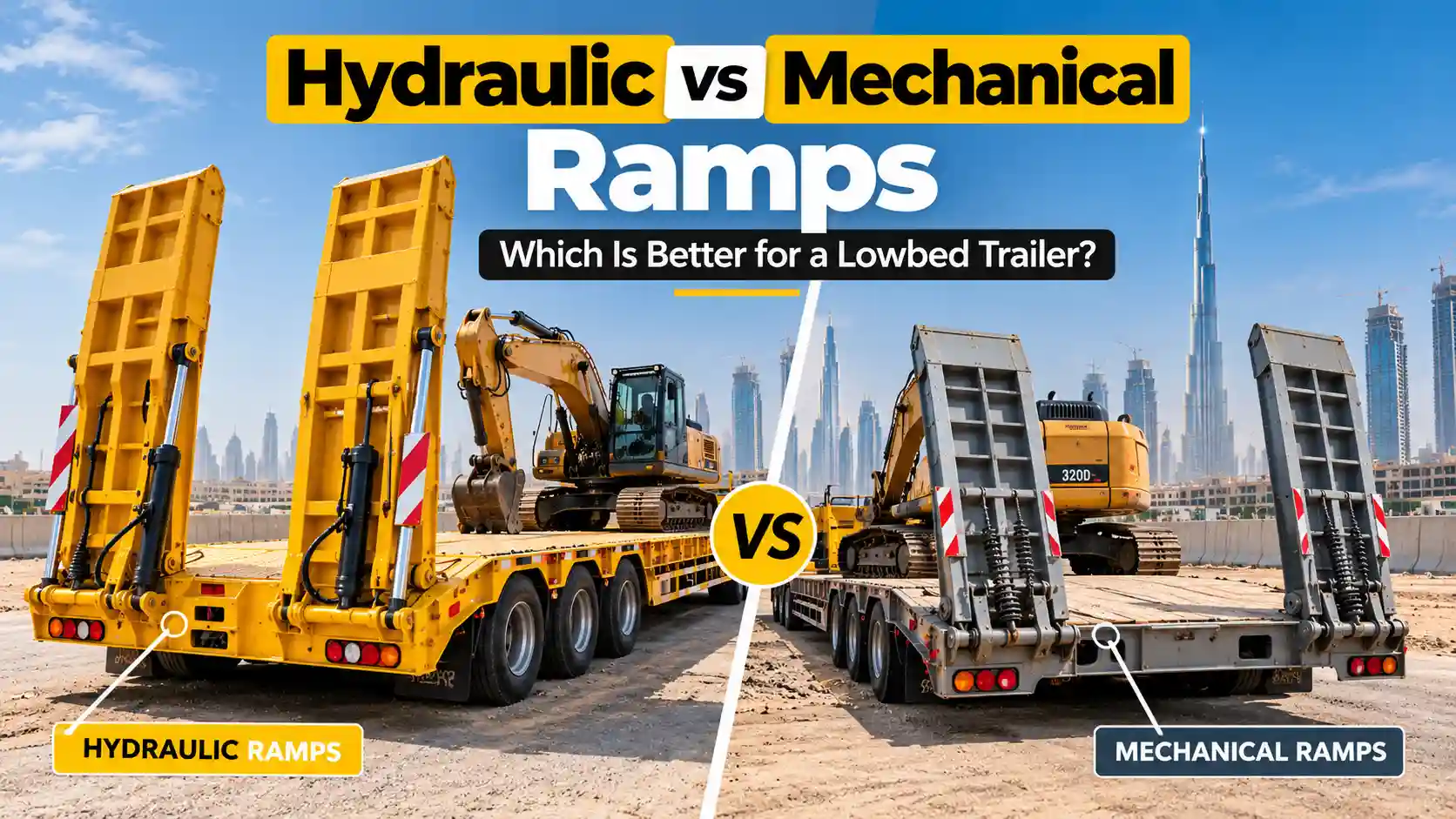
Choosing between hydraulic vs mechanical ramps affects how quickly, safely and practically a lowbed trailer can load heavy equipment. Both systems can work well, but they suit different operating patterns.
Hydraulic ramps use powered cylinders to raise and lower the loading surface. Mechanical ramps rely on a simpler manual or spring-assisted mechanism. The better option depends on the machinery being transported, how often loading takes place, ramp angle, site conditions, maintenance capability and budget.
This guide compares both systems in the context of excavators, loaders, rollers, bulldozers and other machinery carried on lowbed trailers.
Table of Contents
- What lowbed trailer ramps do
- How hydraulic ramps work
- How mechanical ramps work
- Hydraulic vs mechanical ramps comparison
- Ramp angle and machine ground clearance
- Loading frequency and operating effort
- Maintenance and reliability
- Safety and traction
- Which machines suit each ramp type
- When a detachable gooseneck may be better
- How to choose the right ramp
- FAQs
What Do Lowbed Trailer Ramps Do?
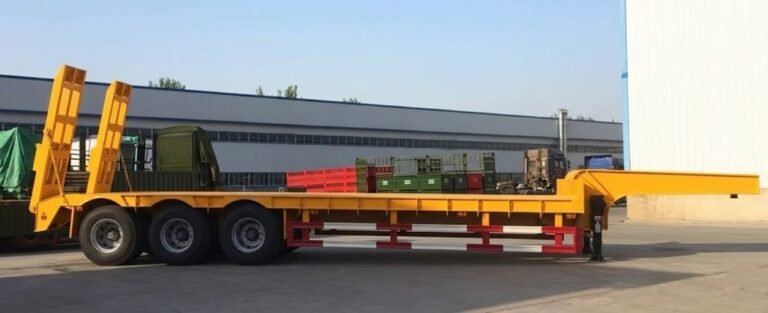
Lowbed trailer ramps create the transition between ground level and the trailer deck so self-propelled equipment can drive on and off without a crane.
Their design affects more than convenience. Ramp length, width, angle, surface traction, hinge strength and load rating influence whether a machine can climb the trailer without bottoming out, slipping or placing excessive stress on the ramp structure.
A longer ramp generally creates a shallower approach angle, while a shorter ramp creates a steeper climb. This matters for machinery with limited ground clearance, long wheelbases, low undercarriages or heavy concentrated axle and track loads. Industry guidance similarly emphasizes ramp geometry, machinery dimensions and traction rather than treating the operating mechanism as the only selection factor.
The ramp should therefore be selected around the actual machinery rather than treated as a minor trailer accessory. Ramp geometry should also be considered alongside the trailer’s overall deck height and dimensions when matching a lowbed to specific machinery.
How Do Hydraulic Lowbed Ramps Work?
Hydraulic trailer ramps use one or more hydraulic cylinders to raise and lower the ramp. A pump supplies pressurized fluid to the cylinders, allowing the operator to control ramp movement with less manual effort.
A typical system can include:
- Hydraulic cylinders
- Hoses and fittings
- Hydraulic fluid reservoir
- Pump or power pack
- Control valves
- Electrical or engine-driven power source
- Hinges and locking points
Hydraulic operation is especially useful where equipment is loaded and unloaded frequently because the operator does not have to manually lift a heavy steel ramp each time.
Current lowbed manufacturers commonly offer hydraulic ramps for frequent machinery loading, particularly where powered deployment and reduced manual effort are priorities.
How Do Mechanical Lowbed Ramps Work?
Mechanical ramps use a simpler physical lifting arrangement. Depending on the trailer, they may be fully manual or use springs to reduce the force needed to raise and lower the ramp.
Their main advantage is simplicity. They do not require hydraulic cylinders, hoses, pumps or hydraulic fluid to operate.
Mechanical ramps normally include:
- Structural ramp sections
- Hinges
- Locking mechanisms
- Springs or counterbalance assistance where fitted
- Ramp supports
Because there are fewer hydraulic components, mechanical ramps can be easier to inspect and repair in locations where specialist hydraulic support is limited.
They can, however, require more operator effort, especially on large heavy-duty ramp assemblies. Spring-assisted designs can reduce that effort without adding a complete hydraulic power system.
Hydraulic vs Mechanical Ramps
| Factor | Hydraulic Ramps | Mechanical Ramps |
|---|---|---|
| Ramp operation | Powered by hydraulic cylinders | Manual or spring-assisted |
| Operator effort | Lower | Usually higher |
| Loading frequency | Well suited to frequent cycles | Practical for occasional loading |
| Initial complexity | Higher | Lower |
| Hydraulic components | Required | Not required |
| Maintenance | Hydraulic and structural inspection | Primarily structural and mechanical inspection |
| Field repair | Can require hydraulic expertise | Often simpler |
| Purchase cost | Usually higher | Usually lower |
| Best fit | Frequent heavy-equipment loading | Simple, lower-maintenance operations |
This comparison does not mean that one system is automatically safer or stronger. Ramp capacity, geometry, construction and correct operation matter more than the operating mechanism alone.
That distinction is important because some competitor content reduces the decision to hydraulic being “better” simply because it is powered. A ramp with poor geometry or inadequate structural capacity is not improved by adding hydraulic cylinders.
Ramp Angle Matters as Much as Ramp Type
When comparing hydraulic vs mechanical ramps, operators often focus too heavily on the lifting mechanism.
A machine must transition from the ground onto the ramp and then from the ramp onto the trailer deck. If either transition is too sharp, parts of the machine can contact the ramp or deck.
Important dimensions include:
- Ramp length
- Deck height
- Breakover angle
- Machine ground clearance
- Wheelbase or track length
- Approach angle
- Departure angle
Tracked excavators may tolerate some ramp conditions differently from wheeled loaders or rollers, but no machine should be assumed to suit a ramp solely because its weight is below the ramp rating.
A longer ramp can reduce the loading angle, which can help low-clearance machines. Foldable or double-fold ramp arrangements can also create more suitable loading geometry in some applications. Lowbed suppliers commonly treat ramp design and approach angle as application-specific specifications.
Loading Frequency Changes the Best Choice
A trailer that loads machinery several times each working day has different requirements from a trailer that loads one machine and then spends most of the day on the road.
For frequent loading, hydraulic ramps can reduce repeated manual handling and make deployment more convenient. This can matter in plant hire, construction logistics and equipment delivery operations where ramps are cycled repeatedly.
Mechanical ramps can make more sense where loading is less frequent and simplicity is a higher priority.
The correct decision is therefore operational, not purely technical. In practice, hydraulic vs mechanical ramps should be compared against the number of loading cycles the trailer actually performs.
Ask:
- How many loading cycles happen per day or week?
- How heavy are the ramp sections?
- Will one operator routinely deploy the ramps?
- Is hydraulic maintenance readily available?
- Does the trailer work far from a workshop?
- Is loading speed commercially important?
Maintenance and Reliability
Both systems require maintenance, but they fail in different ways.
Hydraulic Ramp Maintenance
A hydraulic system should be checked for:
- Hose abrasion
- Fluid leakage
- Damaged fittings
- Cylinder seal leakage
- Bent cylinder rods
- Low fluid level
- Pump or power-pack problems
- Electrical faults
- Damaged controls
- Hinge wear
- Locking mechanism condition
Hydraulic systems add components that mechanical ramps do not have, so there are more potential failure points.
That does not make them inherently unreliable. A correctly designed and maintained hydraulic system can provide dependable service for frequent ramp operation.
Mechanical Ramp Maintenance
Mechanical ramps should be checked for:
- Spring condition
- Hinge wear
- Cracks or deformation
- Locking pins
- Counterbalance components
- Corrosion
- Ramp alignment
- Weld condition
- Anti-slip surface damage
Their simpler design can be advantageous where trailers operate far from specialist hydraulic workshops.
However, simplicity does not remove the need for inspection. A worn spring, hinge or locking mechanism can still make a mechanical ramp difficult or unsafe to operate.
This is why maintenance capability should be considered alongside initial purchase cost when comparing hydraulic vs mechanical ramps.
Loading Safety Depends on More Than Hydraulics
Neither ramp type guarantees safe loading.
Safe loading depends on the entire loading system, including:
- Correct ramp load rating
- Suitable ramp width
- Correct ramp spacing
- Structural condition
- Ground stability
- Ramp traction
- Machine alignment
- Operator competence
- Trailer stability
- Weather and contamination
Mud, sand, hydraulic oil, water and loose material can reduce traction on a ramp surface.
This is particularly relevant for tracked and wheeled construction equipment moving between UAE construction sites, quarries, yards and industrial areas.
The loading area should be firm and as level as practical. The machine should approach the ramps squarely unless the equipment manufacturer or approved loading procedure specifies otherwise.
The ramp’s rated capacity and geometry are therefore more important than simply asking whether it is hydraulic or mechanical.
Hydraulic vs Mechanical Ramps for Excavators
Excavators are among the most common machines carried on lowbed trailers. If excavators are one of the main loads you carry, the wider loading process is covered in our guide on how to transport an excavator on a lowbed trailer.
Their suitability for a ramp depends on:
- Operating weight
- Track width
- Track length
- Ground clearance
- Counterweight position
- Attachment configuration
- Manufacturer loading instructions
Hydraulic ramps can be convenient for fleets that load excavators frequently. Mechanical ramps can still work effectively where the ramp is correctly rated, aligned and designed for the machine.
The decision should not be based on excavator weight alone.
Golden Space’s existing guide on transporting excavators explains the wider loading process, including machine dimensions, trailer selection and load positioning.
What About Wheel Loaders, Rollers and Bulldozers?
Different machines interact with ramps differently.
Wheel Loaders
Wheel loaders can create substantial axle loads on relatively small contact areas. Ramp width, tyre position and structural capacity must be checked.
Road Rollers
Rollers can concentrate considerable weight over a limited contact area. The ramp structure and surface must be designed for that loading pattern.
Bulldozers
Tracked bulldozers need sufficient ramp width, traction and structural capacity. Ground clearance and blade position can also affect the approach.
Pavers and Low-Clearance Machinery
Some paving and specialist machines have limited ground clearance.
A steep rear ramp can create a breakover problem even when ramp capacity is adequate. For such machines, loading geometry can be more important than the distinction between hydraulic vs mechanical ramps.
When Mechanical Ramps Make More Sense
Mechanical ramps are often a strong choice when:
- Loading is occasional rather than continuous
- Lower initial cost is important
- The fleet prioritizes simple field maintenance
- Hydraulic service support is limited
- Operators are familiar with the ramp mechanism
- The ramp assembly is manageable with spring assistance
- The machinery does not require unusually complex loading geometry
A mechanical system can be a practical heavy-duty solution rather than simply a cheaper substitute for hydraulics.
Its value is strongest when simplicity reduces maintenance demands and the loading cycle does not justify additional hydraulic equipment.
Industry comparisons similarly identify lower complexity and easier field maintenance as important reasons operators continue to select mechanical or spring-assisted systems.
When Hydraulic Ramps Make More Sense
Hydraulic ramps are often better suited when:
- Machinery is loaded and unloaded frequently
- Ramp assemblies are too heavy for practical manual handling
- Faster deployment matters operationally
- One operator may need to manage ramp deployment
- The fleet already has hydraulic maintenance capability
- Heavy construction machinery is moved regularly
The main benefit is controlled powered operation.
That makes hydraulic ramps attractive for fleets where repeated ramp deployment forms a significant part of daily work.
Hydraulic ramps should still be locked and used according to the trailer manufacturer’s operating procedure. Hydraulic pressure should not automatically be treated as a replacement for any mechanical locking or support system specified by the manufacturer.
Is a Detachable Gooseneck Better Than Rear Ramps?
Sometimes the right answer to hydraulic vs mechanical ramps is neither.
Very heavy or low-clearance machinery can be difficult to load over a steep rear ramp.
A detachable gooseneck allows equipment to approach the main deck from the front, often reducing the loading angle compared with climbing conventional rear ramps.
This can be useful for:
- Low-clearance machinery
- Very heavy tracked equipment
- Machines with poor breakover angles
- Applications where rear loading geometry is impractical
A detachable gooseneck adds its own complexity, tare weight, purchase cost and maintenance requirements. Current lowboy guidance treats it as a separate loading solution rather than an automatically superior configuration.
It should therefore be evaluated against the machinery and operating pattern in exactly the same way as a ramp system.
How to Choose Between Hydraulic and Mechanical Ramps
When specifying a lowbed trailer, start with the machines rather than the ramp mechanism.
1. Record Machine Weight
Use the actual transport weight, including attachments that remain fitted.
2. Measure Track or Tyre Width
The contact surfaces must fit safely on the ramps.
3. Check Ground Clearance
Low-clearance machinery may require a shallower loading angle.
4. Review Loading Frequency
Frequent daily loading strengthens the case for powered ramp operation.
5. Assess Maintenance Capability
Consider whether hydraulic technicians, hoses, seals and replacement components are readily available where the trailer operates.
6. Check Loading-Site Conditions
Uneven construction sites can affect ramp contact and trailer stability.
7. Confirm Ramp Rating
The rated capacity must match the loads imposed by the machinery during loading, not simply the trailer’s total payload rating.
8. Review Ramp Surface
The surface should provide suitable traction for the tyres or tracks using it.
9. Inspect the Hinge and Rear Structure
Ramp loads transfer into the rear of the trailer. The ramp cannot be evaluated independently from its hinges, mounting structure and supports.
10. Consider Alternative Loading Systems
If ramp angle remains unsuitable, determine whether a detachable gooseneck or another loading method would better suit the machinery.
Golden Space’s lowbed dimensions guide provides additional context on deck height, usable deck length, width and axle configuration when matching machinery to a trailer.
Which Ramp Is Better for UAE Lowbed Operations?
There is no universal winner.
For fleets that regularly load excavators, loaders and similar equipment, hydraulic ramps can reduce manual handling and make repeated loading cycles more convenient.
For operators who prioritize mechanical simplicity, lower system complexity and easier field maintenance, mechanical ramps can be the stronger option.
UAE operating conditions also make practical serviceability important. Construction sites, dust, heat, rough approaches and long operating days increase the value of routine inspection regardless of ramp type.
The correct comparison is therefore not simply hydraulic versus mechanical.
It is:
Which loading system best matches the machinery, loading frequency, ramp geometry, operating environment and maintenance capability?
Frequently Asked Questions
What Is the Main Difference Between Hydraulic and Mechanical Lowbed Ramps?
Hydraulic ramps use powered hydraulic cylinders to raise and lower the loading surface. Mechanical ramps rely on manual movement, springs or another mechanical counterbalance system.
Are Hydraulic Ramps Better for Heavy Equipment?
They can be more convenient for frequent heavy-equipment loading because powered operation reduces the effort required to move large ramp sections.
However, the ramp still needs the correct structural rating, width, length, traction and loading angle.
Are Mechanical Ramps More Reliable?
Mechanical ramps contain fewer hydraulic components, which can simplify maintenance and field repair.
Reliability still depends on design quality, hinge condition, springs, locking systems, welds and routine inspection.
Are Hydraulic Trailer Ramps Safer?
Not automatically.
Powered operation can reduce manual handling, but loading safety still depends on ramp strength, geometry, traction, trailer stability, machine alignment and correct operating procedures.
Can a Hydraulic Ramp Fail?
Yes.
Hoses, fittings, cylinder seals, pumps, electrical components and controls can leak, wear or fail. Routine inspection and maintenance are therefore necessary.
What Is a Spring-Assisted Ramp?
A spring-assisted ramp is a mechanical ramp that uses spring force to reduce the effort required to raise or lower the ramp.
It provides a middle ground between a fully manual ramp and a powered hydraulic system.