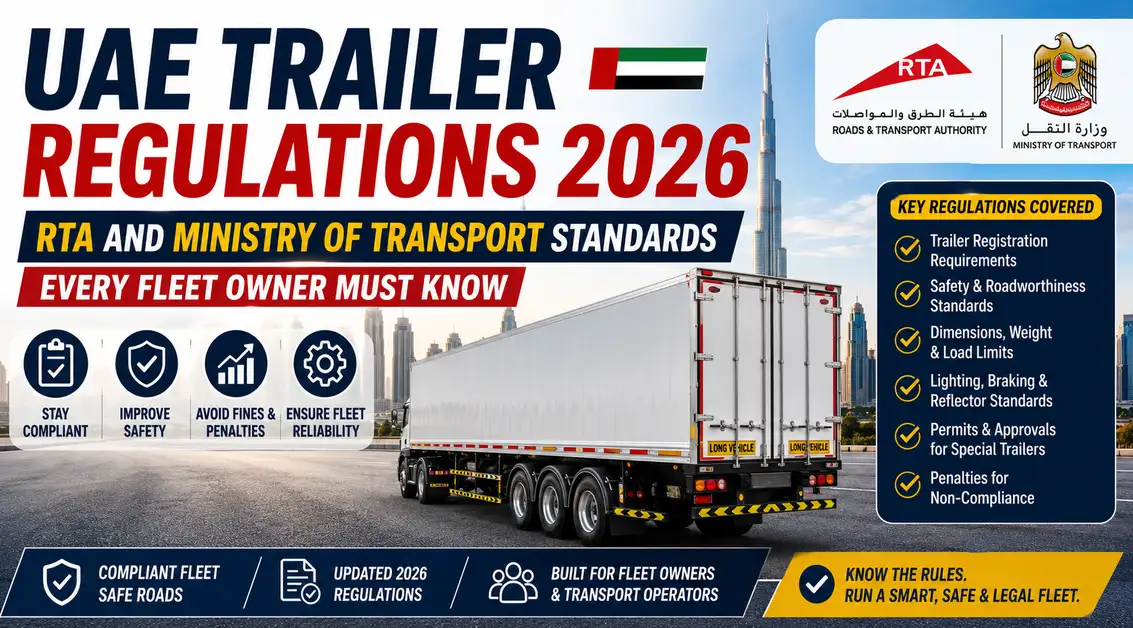
UAE Trailer Regulations 2026 — RTA and Ministry of Transport Standards
In the first quarter of 2026, the RTA ran a major trailer inspection campaign across six strategic locations in Dubai — including Sheikh Mohammed bin Zayed Road and Emirates Road. Out of 177 trailers specifically examined, the campaign uncovered 134 technical faults and issued 88 violations. The most common issues were worn tyres, defective lighting, missing reflective stickers, and unsafe loading practices.
That is a violation rate of nearly 50 percent among trailers pulled for inspection.
If you operate trailers commercially in the UAE and have not reviewed your fleet against current regulations, there is a reasonable chance your vehicles are not fully compliant. That exposes your business to fines of up to AED 15,000 per trip, permit refusals, and the reputational consequences of a failed inspection on a major logistics or construction contract.
This guide covers everything UAE fleet owners and trailer operators need to know in 2026. You will learn the exact weight and dimension limits enforced on federal roads, how the fine structure works, what the permit process looks like for oversized loads, what technical safety standards your trailers must meet, and how to register a trailer correctly through the appropriate authorities.
The Regulatory Framework: Who Governs UAE Trailer Operations
UAE trailer regulation is not managed by a single body. Understanding which authority covers which aspect of compliance prevents the most common administrative errors that fleet managers make.
The Ministry of Energy and Infrastructure (MOEI) issues federal decrees and cabinet resolutions governing maximum weights and dimensions for all heavy vehicles on UAE roads. Cabinet Resolution No. 138 of 2023, which implements Federal Decree No. 12 of 2023, sets the current enforceable weight and dimension limits. These apply across all seven emirates to all heavy vehicles using UAE public roads, including vehicles licensed in other countries and permitted into the UAE.
The Roads and Transport Authority (RTA) in Dubai handles trailer registration, periodic inspection, and licensing for vehicles operating in and around Dubai. The RTA also issues mobility permits for heavy vehicles that require exemptions on restricted routes or time windows.
The Ministry of Interior (MOI) manages the heavy vehicle passing permit system for certain road categories and coordinates traffic enforcement across emirates through police commands. The MOI portal at moi.gov.ae provides the digital service for issuing permits for heavy vehicles to pass on designated roads.
The Integrated Transport Centre (ITC) in Abu Dhabi and equivalent emirate-level transport authorities in Sharjah, Ajman, and the northern emirates handle registration and compliance for vehicles operating primarily in those jurisdictions.
Each emirate retains the right to impose additional restrictions beyond the federal framework. Abu Dhabi applies its own time restrictions and route controls for heavy vehicles. Dubai has specific peak-hour bans on key corridors. Understanding the federal baseline and each emirate’s local additions is the starting point for full compliance.
UAE Weight Limits for Heavy Vehicles and Trailers
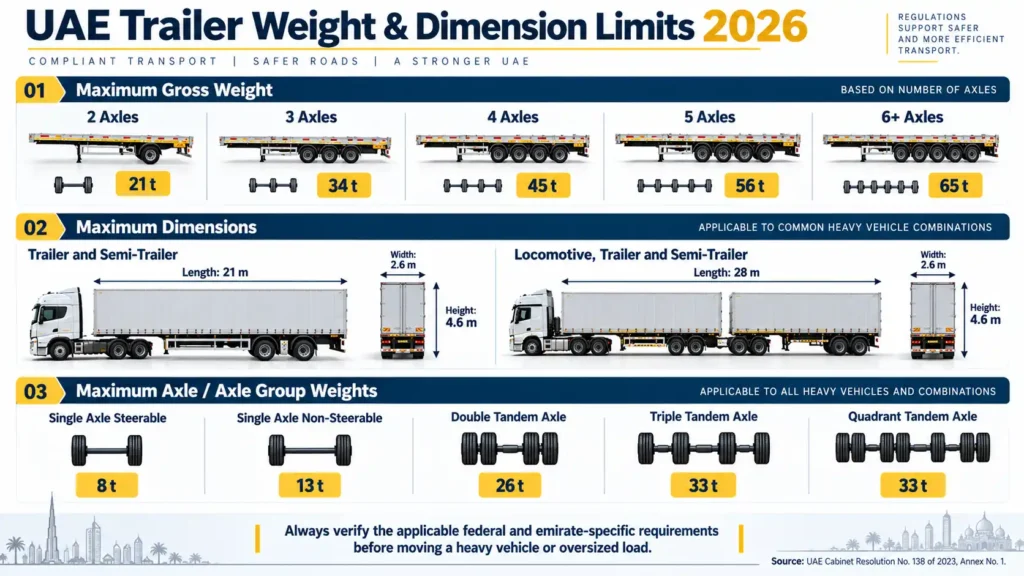
Federal Decree No. 12 of 2023 sets the maximum permissible gross weights for heavy vehicles based on axle configuration. These limits apply per trip and are enforced electronically through smart gate systems installed on national roads.
Gross Vehicle Weight by Axle Count
| Number of Axles | Maximum Gross Weight |
| 2 axles | 21 tonnes |
| 3 axles | 34 tonnes |
| 4 axles | 45 tonnes |
| 5 axles | 56 tonnes |
| 6 axles | 65 tonnes |
The 65-tonne maximum for six-axle combinations represents the absolute ceiling for standard commercial heavy vehicle operations on UAE federal roads. Any load exceeding this requires a special transport permit, route planning approval, and in many cases a police escort.
These limits apply to the gross combination weight — the total of the vehicle, trailer, and cargo together. Fleet managers who calculate against cargo weight alone, without accounting for tare weight of the prime mover and trailer, consistently arrive at incorrect compliance figures.
UAE Dimension Limits for Trailers and Combinations
Alongside weight limits, the federal resolution sets strict dimension limits by vehicle and combination type. Exceeding any dimension limit carries a separate fine regardless of whether the vehicle is within weight limits.
Maximum Permitted Dimensions by Vehicle Type
| Vehicle Configuration | Max Length | Max Width | Max Height |
| Single heavy vehicle | 12.5 m | 2.6 m | 4.6 m |
| Truck head and semi-trailer | 21 m | 2.6 m | 4.6 m |
| Truck head, trailer and semi-trailer | 28 m | 2.6 m | 4.6 m |
| Heavy vehicle carrying small vehicles | 23 m | 2.6 m | 4.75 m |
The 4.6-metre height limit applies universally to standard heavy vehicle combinations. The only category permitted to exceed this is car carrier trailers, which are allowed up to 4.75 metres due to the nature of multi-deck vehicle loading.
Any load that pushes total height, width, or length beyond these limits requires a special transport permit before the vehicle moves on public roads.
The Fine Structure: What Non-Compliance Costs
The UAE fine structure for heavy vehicle violations is graduated based on the severity and category of the breach. All fines apply per trip, meaning a vehicle completing multiple runs in a day can accumulate multiple fine events if it passes a monitoring point each time.
Weight Violation Fines
Exceeding the maximum gross weight by less than 10 percent in a single trip carries a fine of AED 400 per tonne or part thereof.
Exceeding by 10 to 20 percent raises the per-tonne fine to AED 500.
Exceeding by more than 20 percent brings the per-tonne fine to AED 600, capped at a maximum of AED 15,000 per trip.
Axle weight violations carry a flat fine of AED 1,500 per individual axle or tandem axle group found to be over-limit in a single trip.
Dimension and Evasion Fines
Exceeding any specified maximum dimension — height, width, or length — carries a fine of AED 3,000 per trip.
Intentionally evading a weight station or smart gate monitoring site carries a fine of AED 5,000 per trip. UAE smart gates use high-resolution cameras, 3D laser scanners, and electronic sensors with a reported accuracy rate of 98 percent. Evasion is both risky and increasingly difficult to execute without detection.
Non-compliance with permit controls for loads that are not easily divisible — meaning oversized cargo that cannot be broken down into smaller loads — also carries a fine of AED 5,000 per trip.
Violations are recorded electronically and can affect fleet compliance records, permit approval history, and the frequency of future inspections.
Heavy Vehicle Permits: When You Need One and How to Get It
Standard compliant trailers operating within the federal weight and dimension limits do not require special movement permits. The permit requirement applies specifically to loads or vehicle combinations that exceed the standard limits.
When a Permit Is Required
A heavy vehicle movement permit is required when your trailer combination exceeds any of the dimension or weight limits set by Federal Decree No. 12 of 2023, or when you need to operate on roads or during time windows that carry additional restrictions in a specific emirate.
In Dubai, the RTA issues mobility permits for heavy vehicles requiring access during restricted peak hours (06:30 to 08:30, 13:00 to 15:00, and 17:30 to 20:00 on major corridors) or for vehicles that exceed standard dimension limits. In Abu Dhabi, the Integrated Transport Centre issues equivalent permits through the TAMM platform.
For movement on roads under federal jurisdiction, the Ministry of Interior’s heavy vehicle passing permit service is the relevant application channel. This service is accessible through the MOI portal at moi.gov.ae.
The Permit Application Process
Step 1: Confirm your load dimensions and gross combination weight accurately. Do not estimate. Incorrect figures on a permit application can invalidate the permit if the vehicle does not match at inspection.
Step 2: Identify the relevant authority for your route. Dubai routes go through the RTA. Abu Dhabi routes go through ITC via TAMM. Federal road movement permits go through the MOI. Cross-emirate routes may require applications to multiple authorities.
Step 3: Submit your application with required documentation. This typically includes the vehicle registration documents, a cargo photograph, the planned route, and the load specification including dimensions and weight.
Step 4: Allow processing time. Standard permit applications in most emirates are processed within three working days. Applications for exceptional loads — those exceeding 60 tonnes or 4 metres in height — may take longer and attract higher fees.
Step 5: Carry the issued permit in the vehicle throughout the movement. Enforcement checks at smart gates and mobile inspection units verify permit validity against the vehicle’s actual dimensions and load.
For the national transportation vehicle permit covering freight operations, the Ministry of Energy and Infrastructure charges AED 100 plus AED 10 per tonne of total load for goods transport vehicles. Renewals not completed within 30 days of expiry attract a delay fee of AED 50 per month, capped at AED 150.
Technical Safety Requirements: What Your Trailer Must Have
Beyond weight and dimensions, UAE trailer regulations require specific technical safety equipment on all trailers operating on public roads. The RTA’s 2026 trailer inspection campaign identified the most common areas of non-compliance — tyres, lighting, and reflective marking — as the focus areas for ongoing enforcement.
Braking Systems
All trailers in the UAE must be equipped with serviceable braking systems. For multi-axle semi-trailers, Anti-lock Braking Systems (ABS) are required as a minimum. The UAE’s road safety framework references ECER 13 standard, which mandates ABS plus Electronic Stability Control (ESC), or Electronic Braking System (EBS) plus ESC, for vehicles and trailers operating in this category.
ABS prevents wheel lock-up during heavy braking, maintaining steering control. EBS goes further, electronically managing brake force distribution between tractor and trailer based on load and speed data. EBS can reduce stopping distance by up to 20 percent compared to standard air brake systems, and it improves stability significantly for heavy or tall loads.
Lighting and Reflective Equipment
Every trailer must carry fully operational rear lights, brake lights, and turn signals visible to following traffic. Side marker lights are required for trailers above a certain length. Reflective stickers must be present and undamaged on the rear and sides of the trailer.
The RTA’s 2026 campaign found defective rear and side lighting and missing reflective stickers among the most frequent violations. These are cheap fixes that operators neglect — and enforcement teams specifically target them because they create genuine danger for other road users, particularly on night hauls and during Shamal dust events that reduce visibility across UAE highways.
Tyres
Tyre condition is inspected at all major checkpoints. Tyres must meet minimum tread depth requirements and must not show sidewall damage, bulging, or exposed cord. Operating an overloaded trailer on tyres not rated for the actual load creates an accelerated failure risk that goes beyond compliance — it is a breakdown and accident risk on high-speed federal roads.
Underrun Protection
Side and rear underrun protection devices — the bars that prevent smaller vehicles from sliding under the trailer in a collision — are mandatory on UAE-registered trailers. Missing or damaged underrun guards result in violations at inspection.
Trailer Registration in UAE: The Step-by-Step Process
New trailers must be registered before operating on UAE public roads. The registration authority depends on where the business is primarily based and where the trailer will predominantly operate.
Step 1: Obtain your vehicle identification documentation. A new trailer manufactured in the UAE should come with a manufacturer’s certificate of conformity or equivalent documentation confirming it meets UAE technical standards. This is your starting document for registration.
Step 2: Present for technical inspection. The trailer must pass a technical inspection at an approved inspection centre. The inspection verifies dimensions, braking system function, lighting, reflective equipment, and structural integrity. In Dubai, RTA-approved inspection centres handle this.
Step 3: Submit registration application with required documents. These typically include the technical inspection certificate, the manufacturer’s documentation, the business trade licence, and the Emirates ID of the authorised representative.
Step 4: Pay applicable registration fees and receive registration plates and certificate. Maintain copies of all registration documents in the vehicle at all times.
Step 5: Schedule periodic re-inspection. Commercial trailers in the UAE require periodic technical inspection for registration renewal. The frequency varies by emirate and vehicle category. Missing a renewal window creates a compliance gap even if the vehicle itself is in good technical condition.
Businesses looking to ensure new trailers are registered-ready from the point of manufacture should work with UAE-based trailer manufacturers who build to RTA and federal standards. Golden Space Trailer Manufacturer. in Al Sajaa, Sharjah, has been manufacturing UAE-compliant trailers since 2010 and delivers units with the technical documentation required for immediate registration. You can review their full trailer range.
Expert Tips for Staying Compliant in 2026
Run a quarterly compliance audit across your fleet. Regulations are updated, inspection criteria evolve, and trailer condition deteriorates with use. A quarterly internal check against the current federal dimension and weight limits, combined with a physical inspection of tyres, lighting, and reflective equipment, prevents the most common violation categories from appearing at an enforcement checkpoint.
Weigh your loads before departure, not after a weigh station alert. Smart gates operate at 98 percent accuracy. By the time a gate detects an overloaded trailer, the fine is already triggered. Operators who install or use calibrated weighbridge equipment before departure eliminate weight violation risk at the source.
Build permit lead time into your project schedule. Standard permits take three working days. Exceptional load permits take longer. A construction project requiring a 70-tonne crawler crane movement that is planned at the last minute will either be delayed or result in an unpermitted move that attracts significant fines.
Verify emirate-specific restrictions before routing cross-border movements. A combination legally compliant under federal limits may still face additional time or route restrictions when entering Dubai, Abu Dhabi, or Sharjah. Check RTA route bulletins and emirate transport authority updates before dispatching inter-emirate heavy loads.
Specify compliance requirements when ordering new trailers. A trailer manufacturer who understands UAE regulations will build ABS or EBS braking systems, correct lighting configurations, and appropriate underrun protection into the standard specification. Ask for documentation confirming compliance at the point of purchase, not after the trailer arrives at the inspection centre.
For a practical breakdown of which trailer types suit different cargo categories and how to specify them correctly for UAE operations, the guide on types of trailers for UAE logistics and construction covers all major configurations in detail.
For the official federal regulatory framework, the Ministry of Energy and Infrastructure publishes all current resolutions and technical specifications governing heavy vehicle operations on UAE roads. The Ministry of Interior’s heavy vehicle permit service handles permit applications for road movement.
Frequently Asked Questions
What is the maximum weight a trailer can carry on UAE federal roads?
The maximum depends on axle configuration. A six-axle combination — the most common setup for heavy haulage — is permitted up to 65 tonnes gross vehicle weight under Federal Decree No. 12 of 2023. Loads exceeding this limit require a special transport permit from the relevant authority before the vehicle moves on any public road.
What are the fines for an overloaded trailer in UAE?
Fines are graduated by how far over the limit the vehicle is running. Exceeding gross weight by less than 10 percent costs AED 400 per tonne. Between 10 and 20 percent costs AED 500 per tonne. Over 20 percent costs AED 600 per tonne, capped at AED 15,000 per trip. Axle-specific overloading carries an additional AED 1,500 per overloaded axle or axle group. Evading a weigh station adds AED 5,000.
Do I need a permit to move an oversized trailer load in UAE?
Yes, if your load or combination exceeds the standard dimension or weight limits. Standard loads within the legal limits do not require a special movement permit, though registration and periodic inspection are required for all commercial trailers. Oversized or overweight loads require a permit from the RTA (Dubai), ITC via TAMM (Abu Dhabi), or MOI (federal roads), depending on the route. The standard processing time is three working days.
What technical safety equipment is mandatory on UAE trailers?
All commercial trailers must have serviceable braking systems meeting UAE standards, including ABS as a minimum for multi-axle semi-trailers. Full rear and side lighting must be operational, reflective stickers must be present and undamaged, tyres must meet minimum condition standards, and underrun protection devices must be fitted front and rear. The RTA’s 2026 inspection campaign specifically identified lighting, reflective marking, and tyre condition as the most frequently violated requirements.
How do I register a new trailer in UAE?
Registration requires a manufacturer’s certificate of conformity or equivalent documentation, a passed technical inspection at an approved centre, your trade licence, and Emirates ID. Submit these to the RTA (Dubai), ITC (Abu Dhabi), or the equivalent emirate transport authority where your business is registered. Commercial trailers require periodic re-inspection for registration renewal. Working with a UAE-based manufacturer who builds to local regulatory standards ensures the documentation package is correct from the point of handover.
Conclusion
UAE trailer regulation has become more sophisticated and more actively enforced in 2026 and 2026. The combination of 24 smart gate installations across national roads, the RTA’s ongoing inspection campaigns, and a graduated fine structure that reaches AED 15,000 per trip means that non-compliance is no longer a manageable risk — it is an operational and financial liability.
The key facts every fleet owner must hold clearly in mind are these: gross weight limits are set by axle count up to a maximum of 65 tonnes for six-axle combinations. Height, width, and length limits are fixed by vehicle type. Exceeding any limit costs money per trip, per tonne, and per axle. Oversized loads require permits before movement. Technical safety equipment including ABS braking, full lighting, reflective marking, and underrun protection is mandatory and actively inspected.
Staying compliant in this environment requires three things working together: trailers built to UAE regulatory standards from day one, load management practices that verify compliance before departure, and route planning that accounts for emirate-specific restrictions in addition to the federal framework.
Start with the equipment. A UAE-manufactured trailer built to current RTA and federal standards, with correct braking, lighting, and structural specifications, removes the compliance risk at the foundation of your fleet. Everything else builds from there.