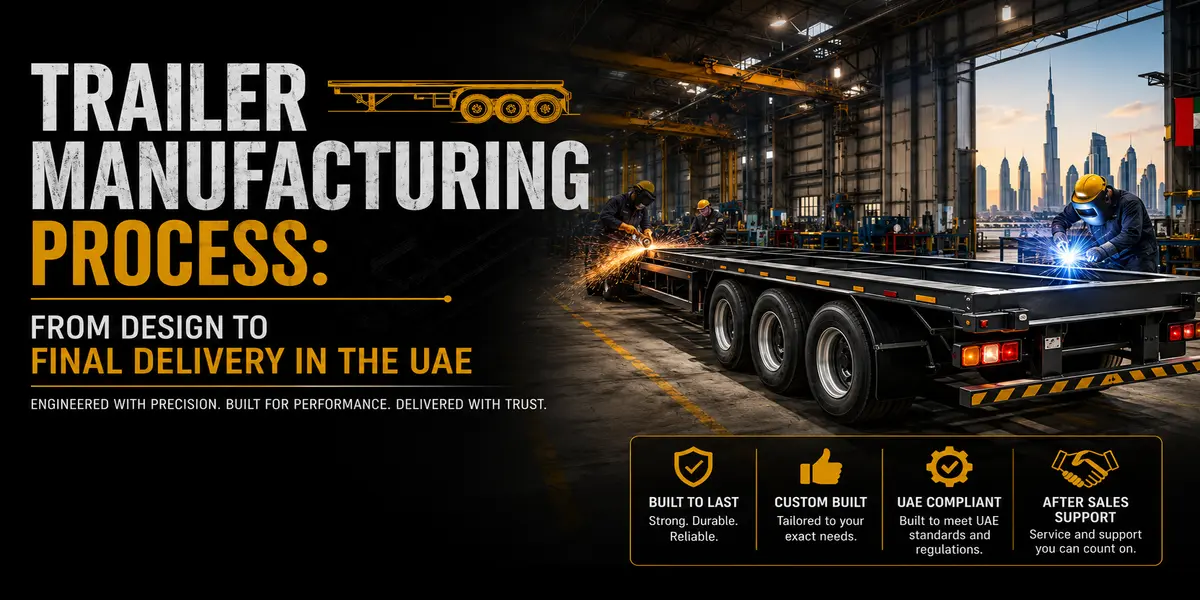
Trailer Manufacturing Process: From Design to Final Delivery in UAE
The trailer manufacturing process starts with a transport requirement and ends with a finished trailer ready for service. Between these points, the manufacturer defines the application, develops the design, prepares materials, fabricates the structure, installs major systems, finishes the trailer, and completes quality checks.
A trailer is not simply a frame with wheels. Its dimensions, load distribution, axle arrangement, suspension, braking system, deck design, and loading method must work together. The right manufacturing process also helps businesses avoid costly changes after production begins.
For UAE companies, the design must suit the cargo and operating environment. Weight, dimensions, axle loading, route requirements, and applicable transport rules should be considered before the build is finalized.
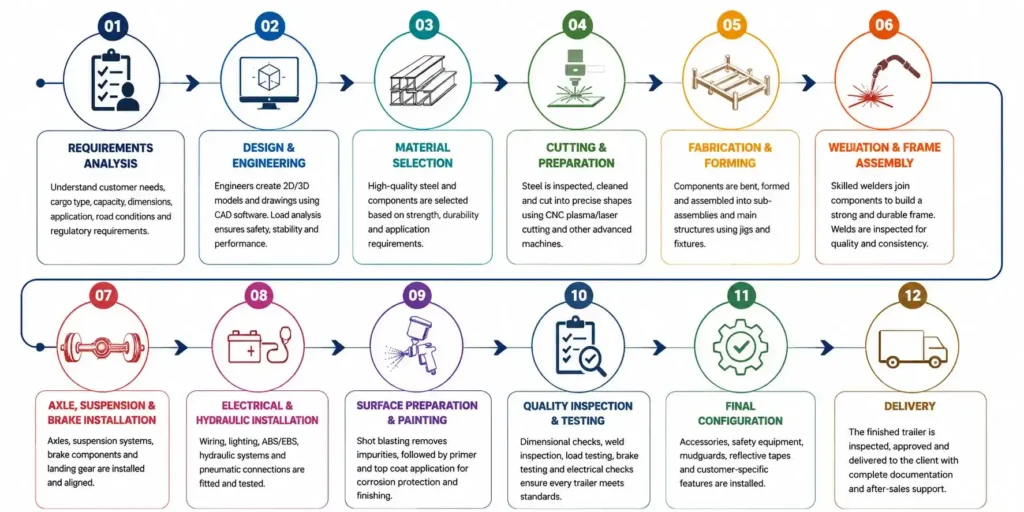
Trailer Manufacturing Process Flow Chart
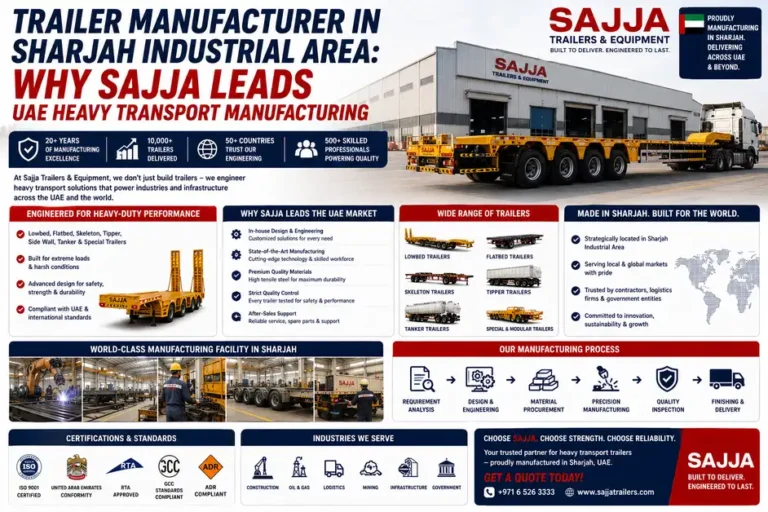
The trailer manufacturing process flow follows a logical sequence from requirements analysis to delivery:
1. Requirements Analysis Comes First
The first step is understanding what the trailer needs to do. The manufacturer needs information about the cargo, operating conditions, towing vehicle, and loading method.
Cargo weight and dimensions are central to this stage. The manufacturer may also need to know whether the cargo will be loaded by crane, forklift, ramp, or another method.
The business should also explain where the trailer will operate. A construction company, logistics fleet, steel supplier, and oil and gas operator can have very different requirements.
This information helps determine whether a standard design is suitable or whether a custom configuration is more practical.
2. Trailer Design and Engineering
Once the requirements are clear, the engineering stage converts them into a trailer design.
Engineers consider overall dimensions, frame arrangement, deck height, axle configuration, suspension, braking, load distribution, tyres, coupling arrangements, and required equipment. CAD drawings can help define dimensions and component positions before fabrication begins.
Load distribution is particularly important. The intended cargo should not be treated separately from the trailer’s axle arrangement and towing combination.
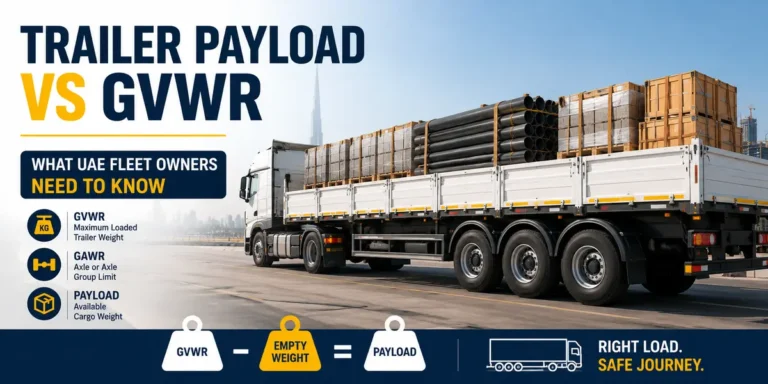
For UAE road operation, the final design must also account for applicable legal limits. UAE regulations address heavy-vehicle weights, axle loads, and vehicle dimensions. Requirements can vary according to the vehicle combination, cargo, route, and approval needed.
Golden Space states that it engineers and manufactures trailers for UAE roads, climate conditions, and regulatory requirements from its Sajja Industrial Area facility in Sharjah.
3. Material Selection
Material selection follows the engineering requirements.
Structural materials and components need to suit the intended trailer application. The manufacturer must consider structural requirements, expected loading, durability, overall trailer weight, and fabrication requirements.
Material selection is not simply about choosing the heaviest or strongest material available. The goal is to create a practical structure that meets the intended duty without introducing unnecessary weight.
The chosen materials then move into the preparation stage, where they are measured, cut, drilled, formed, or otherwise prepared for fabrication.
4. Cutting and Material Preparation
The manufacturing process moves from drawings to physical components during cutting and preparation.
Steel sections, plates, brackets, supports, and other parts are prepared according to the approved design. Depending on the facility and component, manufacturers may use different cutting and machining equipment.
Dimensional accuracy matters at this stage. Components that do not match the design can create alignment issues during frame assembly.
Preparation may also include drilling holes, forming sections, cleaning surfaces, and organizing components for the fabrication sequence.
This controlled approach reduces unnecessary rework later in production.
5. Fabrication and Forming
Fabrication brings individual components together to create structural assemblies.
The manufacturing team positions longitudinal members, cross-members, supports, brackets, and other parts according to the design. Fixtures or jigs may be used where appropriate to help maintain alignment.
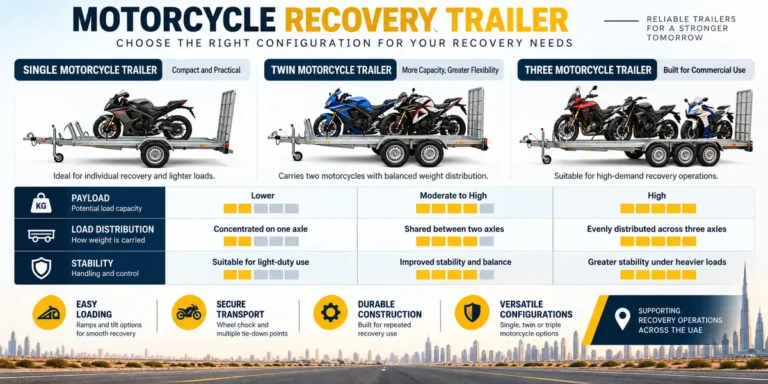
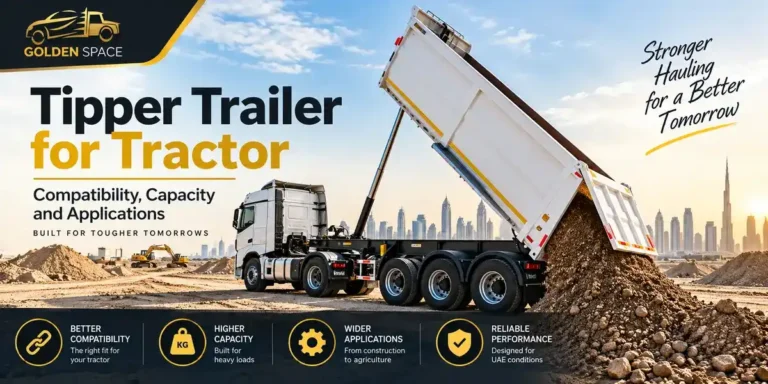
The process differs between trailer types. A flatbed, low-bed, skeleton, tipper, and car carrier each have different structural and operational requirements.
That is why trailer manufacturing is application-led. The same fabrication approach cannot simply be applied to every trailer configuration.
Businesses comparing trailer options can also review Golden Space’s trailer manufacturing range in the UAE to see the different applications supported by its product lineup.
6. Welding and Frame Assembly
Welding joins the fabricated structural components and forms the main trailer frame.
The process can include the chassis members, cross-members, reinforcement areas, brackets, supports, and other structural connections shown in the approved design.
Alignment is important during welding. Distortion or incorrect positioning can create problems when axles, suspension components, deck structures, or other systems are installed later.
Quality checks during fabrication can identify visible defects before the trailer progresses further through production.
Manufacturing resources from established trailer builders also place strong emphasis on controlled fabrication, welding quality, inspection, and process consistency. The principle is simple: structural work should be checked before later stages hide or complicate a problem.
7. Axle, Suspension and Brake Installation
After the primary frame is ready, major running components can be installed.
These may include axles, suspension, wheels, tyres, landing gear, braking components, and other mechanical systems required by the design.
Axle configuration must work with the intended load distribution. Suspension selection also needs to suit the trailer’s application and operating conditions.
Brake installation is another important part of the build. The completed system should be checked as part of the manufacturer’s inspection process before the trailer enters service.
The exact configuration varies between trailer types, so component choices should always follow the approved specification.
8. Electrical and Hydraulic Installation
Some trailers require electrical or hydraulic systems in addition to their basic mechanical components.
Electrical work can include lighting, wiring, connectors, and other circuits required by the design. Hydraulic systems may be used on applications such as tipping, powered ramps, recovery equipment, or other specialized functions.
Not every trailer requires hydraulic equipment. Adding systems without a real operational need can increase complexity and maintenance requirements.
During installation, components should be positioned for reliable operation and practical inspection. Wiring and hydraulic lines also need suitable routing and protection for their operating environment.
9. Surface Preparation and Painting
Once fabrication is complete, the trailer moves through surface preparation and finishing.
Preparation helps create a suitable surface for the selected coating system. The process may involve cleaning, removing contaminants, and preparing exposed surfaces before primer and finishing coats are applied.
A protective finish is especially relevant for trailers working in demanding environments. UAE operations can involve heat, dust, industrial sites, coastal exposure, and long periods on the road.
The exact preparation and coating system should be based on the trailer specification and the manufacturer’s process. Unsupported claims about coating life or corrosion protection should be avoided.
10. Quality Inspection and Testing
Quality inspection takes place before the trailer is handed over.
Checks can cover dimensions, structural workmanship, welding, axle installation, braking components, lighting, electrical connections, hydraulic systems where fitted, and the overall finish.
The purpose is not only to identify visible defects. Inspection also confirms that the finished trailer matches the approved specification.
Testing requirements can vary by trailer type and application. A manufacturer should therefore define the relevant checks based on the final configuration.
Golden Space states that its trailers undergo quality inspection before delivery and that its manufacturing approach includes strict quality control.
11. Final Configuration
The final configuration brings the trailer into its intended working form.
This can include final accessories, mudguards, lighting, safety equipment, identification, and customer-specific features.
Customization should not begin only after manufacturing is complete. It should influence the engineering and fabrication stages from the start.
For example, a company transporting heavy machinery may need a different deck arrangement from a logistics operator moving containers. A trailer designed for repeated steel transport may need different securement features from one used for construction equipment.
This is why custom manufacturing starts with the application, not with the paint or final accessories.
12. Delivery and After-Sales Support
Once the trailer passes its final checks, it can be prepared for delivery and registration-related requirements.
Documentation and final identification should be reviewed before handover. The customer should also understand relevant maintenance requirements and operating procedures.
After-sales support matters because trailers remain working assets after they leave the factory. Spare parts, repairs, technical guidance, and future modifications may become necessary as operating conditions change.
Golden Space says it provides after-sales support, spare parts, and technical guidance as part of its long-term customer relationship.
Semi Trailer Manufacturing Process vs. Standard Trailer Builds
The semi trailer manufacturing process follows the same broad sequence of design, material preparation, fabrication, welding, assembly, finishing, and inspection.
The major difference is the relationship between the semi-trailer and its tractor unit. The coupling arrangement, kingpin area, axle position, braking system, suspension, and overall load distribution must suit the complete combination.
The same applies to the tractor trailer manufacturing process. Engineers should consider how the trailer will operate with its intended towing vehicle rather than designing the trailer in isolation.
For heavy commercial use, this relationship becomes particularly important when cargo weight, dimensions, and axle distribution are significant.
What Are the Main Trailer Manufacturing Requirements?
The exact trailer manufacturing requirements depend on the trailer type and application.
Before manufacturing begins, businesses should normally define:
- Cargo type and dimensions
- Expected load weight
- Loading and unloading method
- Operating routes
- Towing vehicle
- Required axle configuration
- Deck arrangement
- Securement requirements
- Electrical or hydraulic equipment
- Applicable road and registration requirements
UAE regulations also establish requirements for vehicle dimensions, weights, and axle loads. The specification should therefore be reviewed before production is finalized.
Golden Space’s manufacturing operation is based in Al Sajaa Industrial Area, Sharjah, and its current site states that the company manufactures standard and custom trailers for UAE industries.
How to Choose Trailer Manufacturing Companies in the UAE
Businesses comparing trailer manufacturing companies should look beyond the initial quotation.
A manufacturer should understand the cargo and explain why a particular design is suitable. Engineering capability is important because the trailer should be developed around the intended application.
Manufacturing control also matters. Ask where the trailer is fabricated, how quality is checked, what can be customized, and how support is handled after delivery.
A factory visit can also provide useful information. It allows fleet managers to see the fabrication environment and discuss requirements directly.
Golden Space’s trailer manufacturing facility in Sharjah is based in Al Sajaa Industrial Area. Its current manufacturing information describes in-house production, custom builds, and quality inspection before handover.
For a closer look at completed projects, the trailer manufacturing work gallery shows trailers designed, fabricated, and inspected at the Sharjah facility.
How to Become a Trailer Manufacturer
People searching how to become a trailer manufacturer often focus on fabrication equipment first. Manufacturing, however, requires much more than welding capability.
A serious operation needs engineering knowledge, production space, skilled fabricators, material suppliers, quality procedures, inspection processes, safety controls, and an understanding of applicable vehicle requirements.
Starting a trailer manufacturing business also requires a clear market strategy. Construction, logistics, oil and gas, industrial transport, container handling, and machinery transport can all demand different trailer configurations.
The process therefore combines engineering, fabrication, procurement, production management, quality control, and customer support.
Why the Manufacturing Process Matters to UAE Businesses
The manufacturing process directly influences how well a trailer fits its intended job.
A trailer designed without accurate cargo information can create loading problems. Poor structural planning can complicate component installation. Incorrect axle positioning can affect load distribution. Weak process control can create quality problems that are expensive to correct later.
A properly planned manufacturing process keeps these decisions connected.
Golden Space has operated in the UAE since 2010 and states that its Sajja, Sharjah facility manufactures trailers for construction, logistics, oil and gas, automotive, and industrial sectors.
From Customer Requirement to Finished Trailer
A strong trailer begins with the right specification. The manufacturer first understands the cargo and operating conditions, then converts those requirements into an engineered design.
From there, materials are prepared, the structure is fabricated and welded, mechanical and electrical systems are installed, and the trailer receives its final finish.
Inspection then confirms that the completed unit matches its intended configuration before delivery.
For UAE businesses, the most useful approach is to choose a manufacturer that understands both trailer engineering and local operating requirements. Golden Space manufactures standard and custom trailers from its Sharjah facility and serves businesses across the UAE.
Frequently Asked Questions
What is the trailer manufacturing process?
The trailer manufacturing process normally includes requirements analysis, engineering, material selection, cutting, fabrication, welding, mechanical assembly, system installation, finishing, inspection, final configuration, and delivery.
What is included in a trailer manufacturing process flow chart?
A trailer manufacturing process flow chart shows the main production stages in order. It usually starts with customer requirements and design, then moves through fabrication, assembly, finishing, inspection, and delivery.
What is the difference between semi trailer manufacturing and other trailer manufacturing?
The core manufacturing stages are similar. Semi-trailers require additional attention to the tractor connection, kingpin area, axle arrangement, suspension, braking, and load distribution within the complete vehicle combination.
What information is needed before manufacturing a custom trailer?
The manufacturer needs details about cargo type, dimensions, weight, loading method, towing vehicle, intended routes, and required equipment. These details help engineers develop a suitable configuration before fabrication begins.
Can Golden Space manufacture custom trailers in the UAE?
Yes. Golden Space states that it manufactures standard and custom trailers at its Al Sajaa Industrial Area facility in Sharjah. Its current range covers multiple trailer types for UAE transport and industrial applications.