Flatbed Trailer Accessories: Safe and Efficient Loading
Flatbed trailers are used for cargo that cannot easily fit inside an enclosed trailer. Their open deck supports loading from the rear, sides, or above. This makes them useful for steel, machinery, construction materials, fabricated structures, and other industrial cargo.
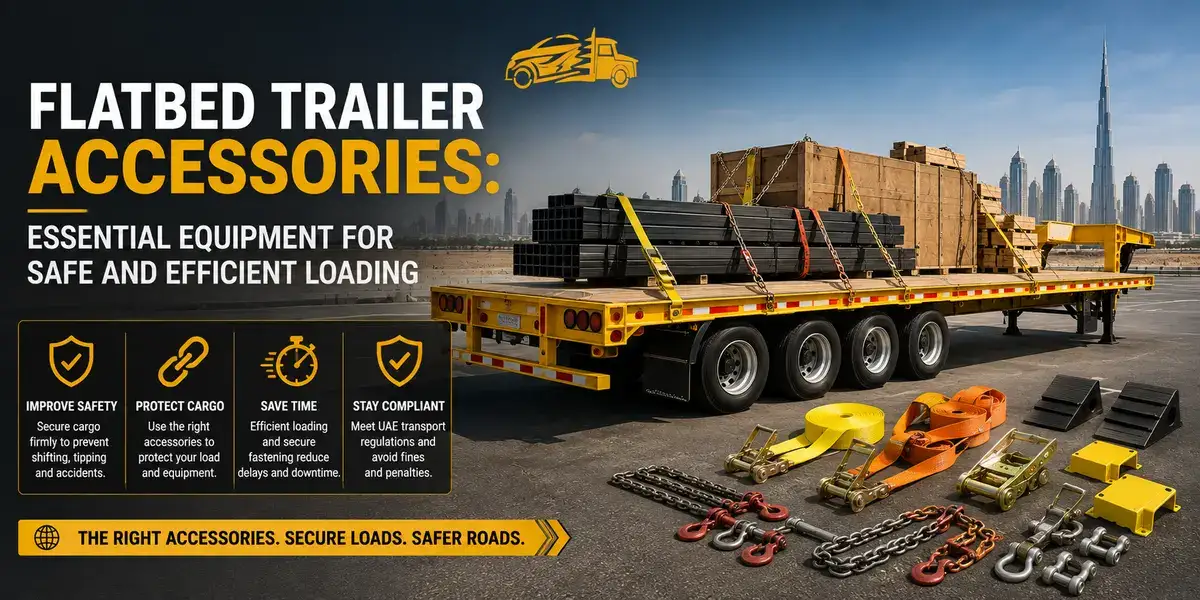
The right flatbed trailer accessories help secure cargo, protect surfaces, and make loading more organized. Common equipment includes winches, straps, chains, binders, anchor points, edge protectors, tarps, ramps, and safety equipment.
However, there is no single accessory setup for every load. Cargo weight, size, shape, loading method, and trailer configuration all affect the equipment required. UAE operators must also consider applicable rules for load distribution, vehicle weight, axle loads, and dimensions.
What Are Flatbed Trailer Accessories?
Flatbed trailer accessories are equipment and components used to load, secure, protect, and manage cargo on an open trailer.
Some accessories directly restrain the cargo. Others protect the cargo or make loading easier. For example, straps and chains secure loads, while edge protectors help shield straps from sharp surfaces.
A practical flatbed equipment list should therefore be based on the cargo being transported. A company moving steel may need a different setup from a contractor transporting construction machinery.
Golden Space manufactures flatbed trailers in the UAE for construction, logistics, industrial, and heavy transport applications. Its open-deck design allows flexible loading methods for different cargo types.
Essential Flatbed Straps and Accessories
Winches and Winch Straps
Winches are used with winch straps to apply tension across cargo. They can be useful for operators who repeatedly secure similar loads.
The strap should match the intended cargo and attachment points. Its working load limit also needs to suit the securement requirement.
Winches can improve loading efficiency because the equipment remains ready for repeated use. This can be useful for fleets handling regular cargo movements.
Ratchet Tie-Down Straps
Ratchet straps use a mechanical tensioning mechanism to secure cargo. They are commonly used for suitable general freight and packaged materials.
The strap is only one part of the complete securement system. Operators should also consider the fittings, anchor points, strap angle, contact surfaces, and condition of the webbing.
Straps with cuts, heavy abrasion, damaged fittings, or other serious defects should be removed from service according to the applicable inspection procedure.
Chains and Load Binders
Chains can be suitable for heavy industrial cargo when the chain and securement arrangement are rated for the application.
Load binders are used to tension chains. Common designs include ratchet and lever binders, with different operating characteristics.
The chain grade alone does not determine whether a securement system is suitable. The working load limit, anchor strength, cargo weight, and securement arrangement must also be considered.
D-Rings and Tie-Down Points
Tie-down points provide attachment locations for straps and chains. Their position can affect how easily cargo can be secured.
Poorly positioned anchors may force awkward strap angles or make access difficult. This can complicate the loading process.
For a new trailer, tie-down requirements should be considered alongside the type of cargo and normal loading method.
Corner and Edge Protectors
Sharp cargo edges can damage webbing during transport. Corner protectors place a protective layer between the load and the strap.
They can also distribute pressure across a wider area. This makes them useful when securing steel sections, fabricated components, timber, and similar materials.
The protector should suit the cargo and securement equipment being used.
Which Accessories Suit Different Cargo?
Different cargo types create different loading and securement challenges.
| Cargo Type | Useful Accessories | Main Consideration |
| Steel sections | Chains, binders, edge protectors | Weight and sharp edges |
| Construction machinery | Chains, binders, ramps | Weight and movement |
| Pipes | Suitable straps or chains | Rolling and shifting |
| Palletized materials | Ratchet straps, anchors | Stability |
| Fabricated structures | Straps or chains, edge protection | Shape and contact points |
| Weather-sensitive cargo | Suitable straps and tarps | Environmental exposure |
This is a general guide, not a universal securement procedure. The final equipment choice should be based on the actual load and the ratings of the equipment.
Tarps for Flatbed Cargo Protection
A flatbed trailer leaves cargo exposed to the surrounding environment. Tarps can provide protection from rain, dust, sunlight, and road debris where suitable.
Different cargo types may require different tarp designs. Machinery, steel, timber, and other materials can have different coverage requirements.
A tarp should not replace cargo securement. Its primary purpose is protecting the load from environmental exposure.
This can be particularly useful for UAE transport where cargo may travel through dusty industrial areas, highways, and exposed project sites.
Loading Ramps for Machinery
Some machinery can be driven onto a flatbed instead of being lifted into position. Loading ramps can provide a controlled path for compatible equipment.
Ramp selection should consider equipment weight, dimensions, wheel or track arrangement, ramp length, and trailer design.
The connection between the ramp and trailer must also be secure. The loading surface should provide suitable traction for the equipment being moved.
For businesses transporting machinery regularly, ramp requirements should be considered when selecting or specifying the trailer.
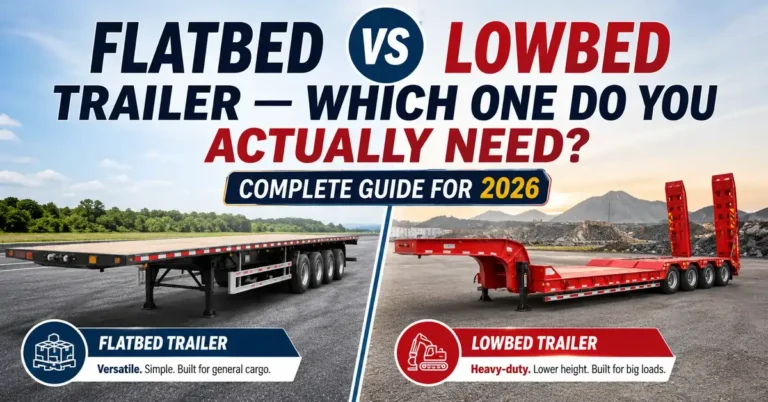
Businesses that regularly move excavators, generators, or other heavy machinery may also need to compare a flatbed with a low-bed trailer in the UAE. A lower deck can be more suitable when overall transport height is a major concern.
Safety Equipment for Flatbed Loading
Safety equipment supports controlled loading and road visibility.
Wheel chocks can help prevent unwanted vehicle movement during loading. Flags, reflective markings, and other visibility equipment may be required when cargo extends beyond normal dimensions.
UAE requirements also address heavy-vehicle load distribution, load fixation, weight, axle loads, and vehicle dimensions. Operators should check the current requirements that apply to their vehicle, cargo, route, and any required permits.
Accessory selection should therefore support both the physical characteristics of the cargo and the applicable transport requirements.
How to Choose the Right Flatbed Trailer Accessories
Start with the cargo rather than the accessory.
Identify the load’s weight, dimensions, shape, surface, and approximate center of gravity. Then determine how the cargo will be loaded and restrained.
Next, examine the trailer configuration. Check the deck, tie-down points, winch locations, ramps, and other relevant components.
The working load limit of the securement equipment must also be suitable for the application. Straps, chains, binders, and anchor points should work together as one system.
Storage is another practical consideration. Frequently used equipment should be easy to access and inspect before loading.
Flatbed Trailer Requirements for UAE Businesses
A trailer should reflect the work it will perform.
A steel distributor may prioritize suitable tie-down points, chains, binders, and edge protection. A construction company may need ramps and securement equipment for machinery. A logistics company carrying different cargo types may need a more flexible arrangement.
Golden Space states that its flatbed trailers are available in standard and custom configurations. Check options include 12-metre, 15-metre, and custom lengths, with different axle configurations.
This makes accessory requirements worth discussing during trailer specification rather than treating them as an afterthought.
For businesses operating around Dubai, Abu Dhabi, and other UAE industrial areas, the trailer should suit the normal cargo, loading equipment, routes, and operating conditions.
How Accessories Improve Loading Efficiency
The right equipment can make repeated loading tasks more consistent.
Imagine a fleet that transports similar steel products every day. Suitable anchor points, prepared straps or chains, and accessible edge protectors can reduce unnecessary handling.
The same principle applies to machinery. A suitable ramp and securement arrangement can simplify the process of getting equipment onto the deck and securing it for transport.
Equipment organization also matters. Straps, binders, chains, and protective equipment should be stored where operators can inspect and access them easily.
A simple pre-loading inspection can confirm that the required equipment is available and in usable condition.
Used Flatbed Trailer Accessories: What to Check
Businesses considering used flatbed trailer accessories should inspect them carefully before use.
Check webbing for cuts, severe abrasion, or other damage. Inspect hooks, fittings, chains, binders, and mechanical parts for visible defects or signs of excessive wear.
Compatibility also matters. An accessory may be in good physical condition but still be unsuitable for a particular trailer or cargo.
Cost should not be the only deciding factor. Securement equipment must remain appropriate for the load and its intended use.
When Custom Flatbed Accessories Make Sense
Standard accessories can work well for common cargo. Custom requirements become more relevant when a company repeatedly handles unusual loads or specialized equipment.
A custom trailer can be designed around the cargo and loading process. This may include the arrangement of tie-down points, deck dimensions, loading access, or other trailer features.
Golden Space manufactures trailers in its Sajja Industrial Area facility in Sharjah and provides standard and custom trailer solutions for UAE businesses.
The goal should be a practical setup that supports the company’s normal work without adding equipment that has little use.
Choosing a Flatbed Trailer Around Your Cargo
The best accessory package is the one that fits the cargo and trailer together.
Start by identifying the loads your business carries most often. Then determine how those loads are loaded, protected, restrained, and transported.
From there, select suitable straps, chains, binders, anchor points, edge protectors, tarps, ramps, and safety equipment.
For businesses ordering a new trailer, these requirements should be discussed before the final configuration is chosen. Golden Space can help businesses evaluate trailer requirements through its trailer manufacturing in Sharjah and provide a configuration suited to the intended application.
Businesses that are ready to discuss a specific cargo or trailer requirement can also request a trailer quote.
Frequently Asked Questions
What are the most important flatbed trailer accessories?
Common accessories include winches, straps, chains, binders, tie-down points, edge protectors, tarps, ramps, and safety equipment. The right combination depends on the cargo and trailer configuration.
What should be included in a flatbed equipment list?
A practical equipment list should cover cargo securement, load protection, loading equipment, visibility equipment, and inspection needs. The list should reflect the type of cargo handled by the fleet.
Are flatbed straps suitable for heavy cargo?
Straps can be suitable for many loads when their ratings and securement arrangement match the application. Heavy industrial cargo may require chains or another suitable securement method.
How can flatbed trailer accessories improve loading efficiency?
Suitable accessories can make repeated loading tasks more consistent. Accessible anchor points, prepared securement equipment, ramps, and organized storage can reduce unnecessary handling.
Can Golden Space customize a flatbed trailer for specific cargo?
Yes. Golden Space use standard and custom flatbed configurations. Businesses can discuss cargo type, dimensions, loading method, and operating requirements when specifying a trailer.