Trailer Axle Capacity : How Axle Count Affects Payload and Stability
Trailer axle capacity plays a major role in how much weight a trailer can support and how it behaves on the road. Axle ratings affect load support, while axle count influences weight distribution and stability. The correct configuration also supports predictable braking and handling under load.
Fleet managers should look beyond axle numbers when selecting commercial equipment. Frame strength, suspension, tyres, brakes, and gross vehicle rating also affect usable capacity. Tractor compatibility and local road requirements can further influence the practical load.
These factors help operators choose equipment based on actual working conditions. They also prevent confusion between axle capacity, payload, and the trailer’s overall weight rating.
What Is Trailer Axle Capacity?
Trailer axle capacity describes the amount of weight an axle or axle group is designed to support. It is not automatically the same as the trailer’s payload. Payload depends on the complete trailer rating, empty weight, axle limits, and operating conditions.
An axle rating comes from the manufacturer’s design and component specifications. The rating should be considered with tyres, wheels, suspension, brakes, and structural components. The lowest applicable limit can restrict the usable load.
For commercial fleets, axle capacity is one part of a wider weight assessment. This approach provides a clearer picture than using axle count alone.
What Determines a Trailer Axle Rating?
Axle Construction and Rating
Axle design affects how much weight the assembly can support. The beam, spindle, hubs, bearings, and related components all contribute to the final rating. Manufacturer information provides the most reliable reference.
Suspension, Tyres and Brakes
Suspension transfers forces between the axle and trailer frame. Tyres and wheels also have their own load limits. Braking components must suit the loaded vehicle combination.
A higher-rated axle does not automatically increase the trailer’s overall capacity. Every connected system must remain suitable for the intended operating load.
Trailer Frame and Running Gear
The chassis transfers loads between the body and running gear. Cross-members, mounting points, and structural members therefore affect overall capability. A frame can limit the practical use of higher-rated axles.
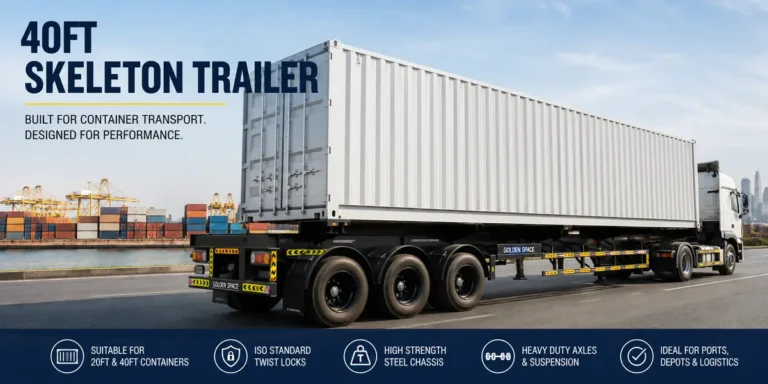
Businesses evaluating a commercial Skeleton Trailer should compare the complete running-gear specification. Axle count alone does not show the full operating capacity.
How to Identify Trailer Axle Capacity
Identifying an axle should begin with manufacturer information. An axle plate, stamped rating, serial number, or technical document can provide useful evidence. These details are more reliable than visual estimates.
Physical measurements can help when information is missing. Tube diameter, hub dimensions, bearing information, and bolt patterns can narrow down possible ratings. However, these clues should never be treated as final proof.
Check the Axle Rating Plate and Markings
Look for labels or stamped information on the axle assembly. Record the rating, identification number, and model details. These records can then be compared with manufacturer documentation.
Measure the Axle and Tube
Tube diameter can provide an identification clue. Measure carefully and compare the result with known manufacturer specifications. Similar tube sizes can still represent different axle ratings.
Check Lug, Hub and Bearing Information
Five-lug, six-lug, and eight-lug patterns can help identify axle components. Lug count alone does not establish capacity. Bearing numbers and hub dimensions can provide additional identification details.
How Axle Count Affects Payload
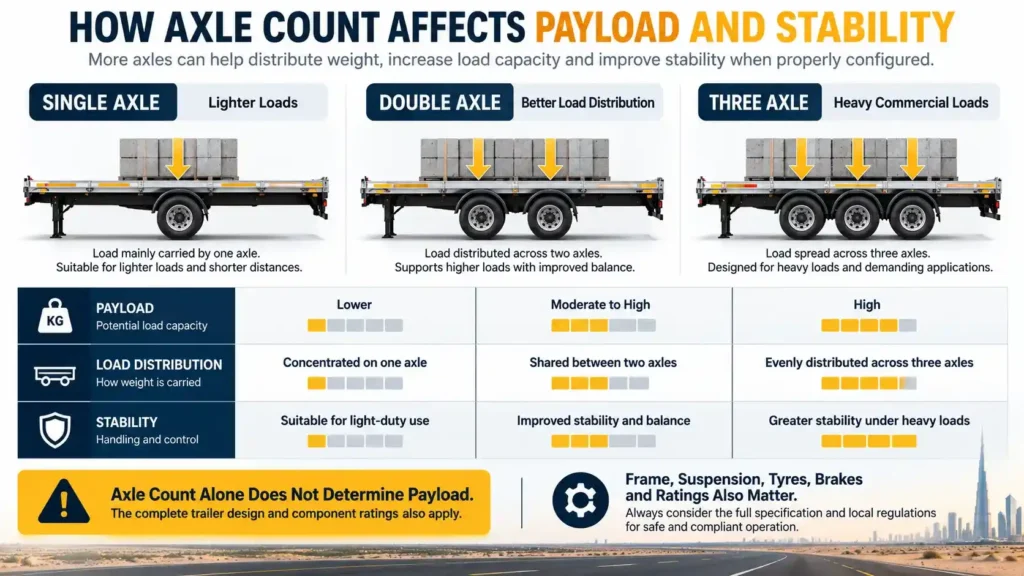
Adding axles creates more load-bearing positions under a trailer. This can spread weight more effectively when the chassis and running gear are designed for it. However, axle count does not automatically increase payload by the same proportion.
Single-axle configurations can suit lighter applications. Tandem and multi-axle layouts can distribute larger loads across additional positions. The final rating still depends on the complete trailer design.
Single-Axle Trailers
A single axle carries load through one axle position. This can support simpler trailer designs and easier manoeuvrability. Such configurations are commonly suited to lighter applications.
Double-Axle Trailers
A double axle distributes load across two axle positions. This can improve stability and support heavier loads than many single-axle layouts. Actual capacity depends on axle ratings and the rest of the trailer.
Three-Axle and Multi-Axle Trailers
Three or more axles spread loads across additional positions. This arrangement is common in heavy commercial equipment. Additional running gear also creates more components requiring inspection and maintenance.
Double Axle Trailer Weight Capacity
Double axle trailer weight capacity depends on much more than axle count. Each axle’s rating, suspension, tyres, brakes, frame, and GVWR influence the final capacity. Applicable road limits can impose another restriction.
Two double-axle trailers can therefore have different capabilities. Their chassis construction and component specifications may not match. Fleet managers should compare the complete technical specification before selecting one.
This same principle applies to tandem configurations. Additional axles can improve load distribution without creating unlimited payload.
Semi-Trailer Axle Capacity
Semi trailer axle capacity requires attention to the complete tractor and trailer combination. Axle groups need to support the intended cargo while working within the trailer’s approved rating. The tractor can also impose separate limitations.
Commercial semi-trailers commonly use multi-axle arrangements for heavier applications. Their axle position can influence weight distribution across the chassis. This makes cargo placement an important part of the loading plan.
How Axle Count Affects Stability
Axle count can influence how a trailer responds to its load. Additional axles can distribute weight across more positions and reduce concentration around one axle. Stability also depends on suspension, wheelbase, cargo position, and centre of gravity.
Load Distribution
A balanced load helps prevent unnecessary concentration on one axle group. Heavy cargo should be positioned according to the trailer’s approved loading arrangement. Poor distribution can create excessive axle loading.
Centre of Gravity
A high centre of gravity can affect how a loaded trailer responds during turns. Cargo height and position therefore matter when evaluating stability. Trailer design should match the type of cargo being transported.
Braking and Cornering
Axles work with the suspension and brake system during braking and turning. A suitable configuration can provide more predictable behaviour under load. Operators must still stay within the approved operating limits.
Trailer Axle Weight and Legal Loading
Trailer axle weight is the actual weight carried through a particular axle or axle group. Moving cargo can change axle weight without changing total cargo weight. This makes axle loading an important consideration during heavy transport.
UAE regulations establish separate requirements for total vehicle weight and axle groups. Operators should confirm current rules for the exact vehicle and route before heavy-load operations.
Trailer Axle Capacity Chart
A simple trailer axle capacity chart can illustrate how axle count and individual ratings relate to combined axle capacity.
| Configuration | Example Axle Rating | Example Combined Rating |
| Single axle | 5,000 kg | 5,000 kg |
| Tandem axle | 5,000 kg each | 10,000 kg |
| Triple axle | 7,000 kg each | 21,000 kg |
These are illustrative figures only. They are not Golden Space specifications or legal loading limits. Actual capacity depends on the complete trailer design and applicable ratings.
Trailer Axle Capacity Calculator
A basic trailer axle capacity calculator can begin by adding the ratings of the axle group. Two identical 5,000 kg axles give a combined rated figure of 10,000 kg. That figure does not automatically become the trailer’s payload.
The next step is comparing axle capacity with GVWR and structural ratings. Suspension, tyres, brakes, tractor capability, and legal limits can reduce the usable amount. The lowest applicable restriction should guide the loading decision.
Utility, Dump and Enclosed Trailer Axle Capacity
Axle requirements vary across trailer types. A utility trailer may use lighter running gear, while a dump trailer can require stronger components for heavier materials. An enclosed trailer also carries its body weight before cargo is added.
Capacity information should therefore remain model-specific. A rating from one trailer type should never be transferred to another without verification.
Trailer Axle Capacity by Wheel and Lug Configuration
Wheel-lug patterns can help identify certain axle assemblies. However, they should be treated as identification clues rather than direct capacity ratings.
5-Lug Axle Identification
Five-lug patterns appear on various smaller trailer applications. Their presence does not establish a specific axle capacity. Additional manufacturer or component information is needed for confirmation.
6-Lug Axle Identification
Six-lug patterns can also occur across different axle configurations. Hub size, bearing information, and axle markings should be checked alongside lug count. This produces a more reliable identification.
8-Lug Axle Identification
Eight-lug arrangements are often associated with larger wheel and axle assemblies. They still do not provide a guaranteed capacity rating by themselves. Manufacturer data should remain the final reference.
Choosing the Right Axle Configuration
Start with the expected cargo weight and operating conditions. Consider how the load will be distributed and how frequently the trailer will operate near its upper range. Then assess the trailer’s complete running gear.
Review axle rating, suspension, tyres, brakes, frame construction, and GVWR together. Confirm manufacturer specifications before ordering or loading. This provides a more reliable basis for equipment selection.
Businesses comparing trailer options can also review Trailer configurations based on their intended duty. The chosen axle arrangement should match the application rather than simply maximize the number of axles.
Trailer Axle Capacity for UAE Commercial Fleets
UAE commercial fleets can operate in construction, logistics, industrial transport, and heavy equipment sectors. These applications can involve high loads and demanding routes. Axle configuration should reflect the actual duty cycle.
Businesses should also consider local road restrictions and the complete tractor-trailer combination. Dense or concentrated cargo requires particular attention to axle distribution. The selected configuration should support the intended workload without exceeding approved limits.
For companies reviewing local manufacturing options, UAE Trailers provides access to different trailer configurations and applications.
Common Axle Capacity Mistakes
A common mistake is assuming more axles automatically mean proportionally more payload. Another is using lug count or tube size as the final capacity rating. These features can assist identification but should not replace manufacturer information.
Another mistake is checking only the axle rating. The frame, suspension, tyres, brakes, and GVWR also affect the usable load. Ignoring one component can create an inaccurate loading plan.
Fleet operators should also avoid using specifications from another trailer. Similar designs can have different ratings and component configurations. The exact technical documentation should always guide the decision.
Frequently Asked Questions
Can axle lubrication affect operating performance?
Correct lubrication helps moving axle and hub components operate as intended. Poor lubrication can increase friction, heat, and wear. Maintenance should follow the component manufacturer’s recommendations.
What signs can indicate an axle problem?
Uneven tyre wear, unusual vibration, abnormal noise, visible bending, or excessive hub heat can indicate a possible problem. These signs should be investigated before continued heavy operation. A qualified technician should assess suspected damage.
Can an axle rating be changed after installation?
Changing a rating is not simply an administrative adjustment. The axle, suspension, tyres, brakes, and frame may require technical assessment. Any approved change should be supported by the manufacturer or relevant authority.
Does axle age affect its original rating?
Age alone does not automatically change the original rating. However, corrosion, damage, wear, and previous modifications can affect the axle’s condition. Regular inspection remains important for older equipment.
Should replacement axles match the original dimensions?
Replacement axles should match the required rating and physical configuration. Hub spacing, spring position, brake equipment, and mounting dimensions can all matter. Matching only one measurement may still create an unsuitable replacement.