Oversized Load Permits in UAE: How to Get a Special Transport Permit
Most heavy haul delays in the UAE are not caused by road conditions, traffic, or equipment failure. They are caused by permit problems that were entirely avoidable with the right preparation.
A construction company booked a lowbed to move a 75-tonne crawler crane from Sharjah to a project site in Abu Dhabi. The move is planned for 7 a.m. on a weekday. Nobody checked that Dubai’s peak-hour ban kicks in at 6:30 a.m. or that the load exceeds the 65-tonne standard limit and requires a special transport permit with a three-working-day processing window. The crane sits in a yard for four days. The contractor pays delay charges. The project falls behind schedule.
This happens regularly across the UAE’s construction, oil and gas, and infrastructure sectors. The permit system is clear and workable but only for operators who understand how it functions before they need it urgently.
This guide explains exactly what triggers an oversized load permit in the UAE, which authority issues it depending on your emirate and route, what documents you need, how the fee structure works, what conditions the permit imposes on your movement, and what the most experienced heavy haul operators do to keep things running on time.
What Is an Oversized Load Permit in UAE and When Do You Need One
An oversized load permit also called a special transport permit or abnormal load transport permit is a formal authorization that allows a vehicle to operate on UAE public roads while exceeding one or more of the standard legal limits for weight, height, width, or length.
Standard legal limits under Federal Decree No. 12 of 2023 set the baseline. The maximum permitted height for most heavy vehicle combinations is 4.6 metres. The maximum width is 2.6 metres. The maximum length for a truck head and semi-trailer combination is 21 metres. The maximum gross vehicle weight for a six-axle combination is 65 tonnes.
Any cargo or vehicle combination that exceeds these parameters on a UAE public road without a valid special transport permit is in violation. Fines reach AED 3,000 per trip for dimension violations and AED 5,000 per trip for evading a monitoring point.
Cargo commonly requiring oversized load permits in the UAE includes excavators and crawler cranes on lowbed trailers, industrial transformers and generators, large prefabricated structural elements, oil and gas processing modules, bridge girders, and wind turbine components. Any load that pushes the total combination above the federal limits needs a permit before the vehicle moves.
Why Oversized Load Permits Matter More Than Ever in 2026
The UAE’s enforcement infrastructure has expanded significantly since the federal weight and dimension law came into full effect in 2024. Twenty-four smart gate installations now operate on national roads, equipped with high-resolution cameras, 3D laser scanners, and electronic sensors running at a reported accuracy rate of 98 percent.
These gates do not require human intervention to detect a violation. They scan every vehicle that passes through. If your load or combination exceeds the permitted limits without a valid special permit on file, the violation is recorded electronically. It affects your fleet’s compliance record, your access to future permits, and the frequency of physical inspections your vehicles will face on subsequent movements.
The practical consequence is clear. Operators who managed oversized loads without permits in previous years relying on the lower detection probability of manual inspection systems now face near-certain detection on any route that passes through a smart gate. The permit is not optional in 2026. It is the only way to move an oversized load legally and avoid accumulating violations that compound across your fleet’s operational history.
Which Authority Issues Your Permit: A UAE-Specific Guide
This is where most operators make their first error. The UAE does not have a single permit-issuing body for oversized loads. The correct authority depends on your route and the emirate where your movement takes place.
Roads and Transport Authority (RTA) Dubai
The RTA handles special transport permits for all heavy vehicle movements within Dubai and on routes that pass through the emirate. Applications are submitted through the RTA’s electronic portal. The RTA defines the approved route, time windows, and any control points your convoy must pass through. Deviating from the approved route after permit issuance is a violation that can result in fines or temporary suspension of your transport operations.
The RTA also issues mobility permits for heavy vehicles that need to operate during Dubai’s restricted peak hours 06:30 to 08:30, 13:00 to 15:00, and 17:30 to 20:00 on major corridors. These are separate from the oversized load permit but are often required alongside it for daytime movements through Dubai’s major arterial roads.
Integrated Transport Centre (ITC) via Asateel and TAMM Abu Dhabi
Freight transport operators in Abu Dhabi must be registered on the Asateel platform managed by the ITC, which operates under Abu Dhabi’s Department of Municipalities and Transport. The Asateel system handles freight vehicle permits, driver professional licences, and electronic tracking requirements for all vehicles operating in the emirate.
For oversized and special loads moving within Abu Dhabi or through the emirate, the permit application is processed through the ITC’s services, accessible via the TAMM platform at tamm.abudhabi. All freight vehicles operating in Abu Dhabi must have an electronic tracking device installed and linked to the Asateel platform as a prerequisite for permit issuance.
Ministry of Interior (MOI) Federal Roads
For movements on roads under federal jurisdiction that cross emirate boundaries, the MOI issues heavy vehicle passing permits through its e-services portal at moi.gov.ae. This covers inter-emirate transport on federal highways where no single emirate transport authority has sole jurisdiction.
Sharjah Roads and Transport Authority Sharjah
For movements originating in or passing through Sharjah’s road network, including routes through Sajaa Industrial Area and the broader Sharjah industrial corridor, permit applications are handled through the Sharjah Roads and Transport Authority. For queries specific to road access and load movement, Sharjah Municipality coordinates with the transport authority on route approvals for abnormal loads.
For cross-emirate movements for example, a lowbed moving a tower crane from Al Sajaa, Sharjah to a construction site in Abu Dhabi you may need permits from multiple authorities. This is standard practice for long-distance heavy haul in the UAE and experienced operators plan for it.
The Fee Structure for Special Transport Permits in UAE
Permit fees in the UAE are set by load category. The structure is straightforward and does not change frequently, but always verify current fees directly with the issuing authority before filing your application.
| Load Category | Permit Fee per Vehicle |
| Large-sized loads (exceeding standard limits) | AED 20 |
| Special loads (over 60 tonnes and over 4 metres in height) | AED 200 |
| Knowledge and Innovation fee (additional charge) | AED 20 |
For most genuinely oversized loads the kind involving heavy construction plant on multi-axle lowbeds the applicable category is the special load fee of AED 200 plus the AED 20 knowledge and innovation surcharge, bringing the total to AED 220 per vehicle per permit.
These fees are intentionally accessible. The financial barrier to compliance is low. The more significant cost of getting a permit wrong is the time cost the three-working-day processing window that can delay an urgent movement if applications are not submitted in advance.
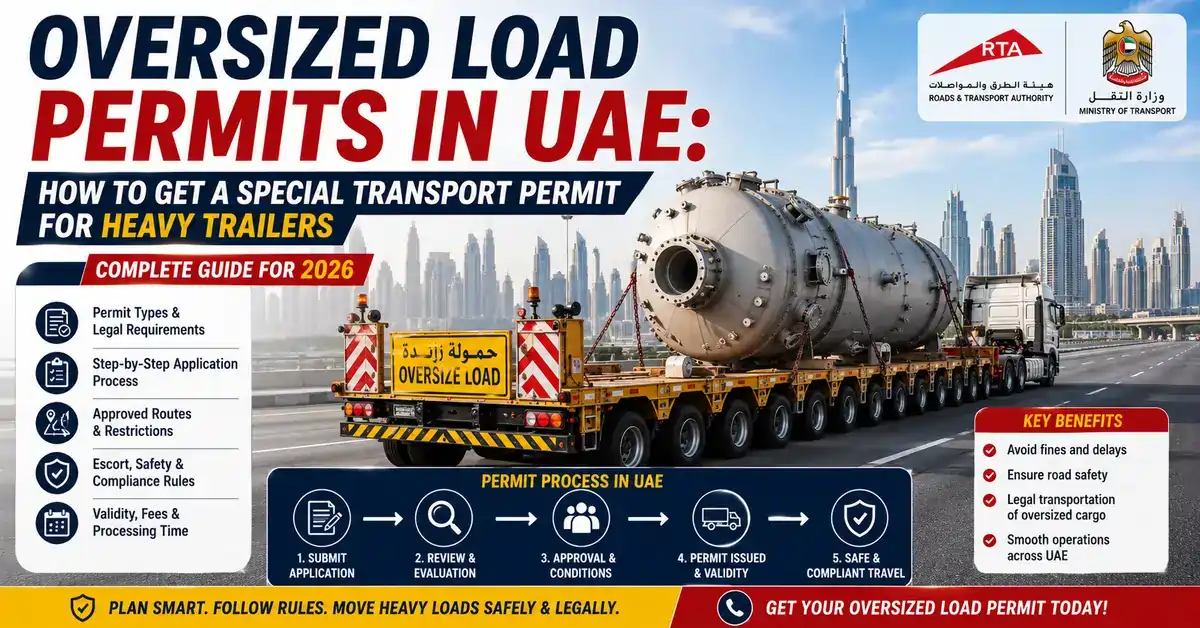
Step-by-Step: How to Apply for an Oversized Load Permit in UAE
Follow this sequence for every special transport movement to avoid delays, rejections, and violations.
Step 1: Measure and document your load accurately.
Before doing anything else, get the exact dimensions and gross combination weight of your loaded trailer. Measure height, width, and total length with the prime mover attached. Weigh the combination at a calibrated weighbridge. Inaccurate figures on a permit application can invalidate the permit if your vehicle does not match at a monitoring point.
Step 2: Identify which authority covers your route.
Map your complete planned route from origin to destination. If it stays within Dubai, go to the RTA. If it stays within Abu Dhabi, use the ITC via Asateel and TAMM. If it crosses emirate boundaries on federal roads, apply to the MOI. If the route crosses Sharjah, apply to the Sharjah Roads and Transport Authority. Multi-emirate routes often need parallel applications.
Step 3: Prepare your application documents.
Standard document requirements across UAE permit authorities include a photograph of the cargo and the loaded trailer combination, the vehicle registration documents for the prime mover and trailer, the cargo specification sheet showing dimensions and gross weight, a description of the planned route, and your trade licence or company registration.
For Abu Dhabi movements, the Asateel platform registration and the vehicle’s electronic tracking device installation must be confirmed as prerequisites.
Step 4: Submit your application through the relevant electronic portal.
All UAE permit authorities now operate digital submission systems. The RTA uses its own portal. Abu Dhabi uses TAMM. The MOI uses its e-services platform. Paper submissions are no longer standard practice for most permit types. Submit early the standard processing time is three working days, and this cannot be compressed for routine applications.
Step 5: Review your permit conditions carefully before moving.
When the permit is issued, read every condition it contains. It will specify the approved route, permitted time windows, any checkpoints your convoy must pass through, escort requirements if applicable, and the validity period. Operating outside any of these conditions while on the road is treated as a violation even if you hold a valid permit.
Step 6: Carry the permit and cargo documentation in the vehicle throughout the movement.
Enforcement teams at smart gates and mobile inspection units can verify permit validity electronically, but the physical or digital permit document should be available in the cab at all times. The driver should also carry the cargo’s weight and dimension documentation.
Escort Vehicle and Police Requirements for Abnormal Loads
Not every oversized load permit in the UAE triggers an escort requirement. The need for escort vehicles depends on the scale of the load.
Standard oversized loads that exceed federal dimension limits but remain within manageable parameters typically move without an escort vehicle if the permit conditions do not specify one. The permit defines this for your specific movement.
For super loads exceeding 100 tonnes, police escort coordination is required. Traffic police escorts are arranged through the relevant emirate’s police command in coordination with the permit authority. For major movements in Dubai, this is coordinated through Dubai Police. In Abu Dhabi, coordination goes through Abu Dhabi Police and the ITC.
Pilot vehicles vehicles that travel ahead or behind the heavy load combination to alert other traffic are commonly required for very wide or very long loads even when the weight does not reach the super load threshold. The permit documentation will state whether a pilot vehicle is required and in what configuration.
For movements on Sheikh Zayed Road and other high-traffic arterials in Dubai, heavy convoys are generally restricted to off-peak and night-time windows. Operations during restricted peak hours require the RTA mobility permit in addition to the standard special transport permit.
Common Mistakes to Avoid
Applying too late. Three working days is not three calendar days. Apply at least five calendar days before your planned movement to account for the processing window and any queries the authority may raise about your application.
Using the wrong authority for your route. A permit issued by the RTA for a Dubai route does not cover movement through Abu Dhabi or on federal inter-emirate roads. Operators who apply to only one authority for a multi-emirate route create compliance gaps that smart gates will detect.
Inaccurate cargo measurements. If your loaded trailer is measured at 4.8 metres in height but your permit application stated 4.5 metres, the permit does not cover the actual vehicle configuration. This is treated as an unpermitted movement. Always measure with the cargo secured in its transport position, not estimated from catalogue dimensions.
Ignoring permit conditions. A permit defines an approved route, not just an approved vehicle. Deviating from the permitted route even for a seemingly minor detour around a traffic incident invalidates the permit’s coverage for that deviation. If a route change is necessary, contact the issuing authority before deviating.
Not confirming Abu Dhabi’s Asateel registration is current. All freight vehicles operating in Abu Dhabi require current Asateel registration with an active tracking device link. An expired or incomplete Asateel registration prevents permit issuance regardless of how complete the rest of your application is.
Expert Tips for Heavy Haul Operators in UAE
Build your permit timeline into the project schedule from day one. If your project involves moving heavy plant equipment, the permit lead time should appear as a task on your project timeline alongside procurement, fabrication, and mobilization. Late permit applications are one of the most common causes of preventable project delays in UAE construction and infrastructure.
Commission a route survey before applying. A physical or GPS-assisted route survey identifies low-clearance structures, sharp turns with inadequate swept path, weight-restricted bridges, and road sections with constraints your permit application must address. Doing this before submitting saves rejection delays and ensures your approved route is actually passable.
Use the night-time window strategically. Dubai’s infrastructure strongly favours E11 (Sheikh Zayed Road) and E311 (Sheikh Mohammed bin Zayed Road) for heavy haul movements. Night operations between 20:00 and 06:30 avoid peak-hour restrictions, reduce police escort requirements on some route types, and lower overall transport cost. Plan night movements for major inter-emirate hauls wherever the site conditions allow.
Ensure your trailer is built and registered for the load. A permit does not override a trailer’s rated capacity. If you are moving a 70-tonne load on a lowbed with a 50-tonne rating, the trailer is structurally non-compliant regardless of what the permit says. Work with a UAE-based trailer manufacturer to ensure your lowbed configuration is correctly rated for the loads your operation requires. Golden Space Trailer Manufacturer., based in Al Sajaa, Sharjah, manufactures custom lowbed and flatbed trailers rated for UAE’s heaviest haul applications.
Maintain a permit application record for your fleet. Each permit application creates a compliance record. Consistent, on-time permit applications and clean movement histories support faster approvals on future applications. Repeated violations or rejected applications flag your fleet for increased inspection frequency.
For a broader overview of UAE trailer weight, dimension, and technical safety regulations, the complete guide on UAE trailer regulations for fleet owners covers the full federal and emirate-level framework in detail.
Frequently Asked Questions
Q: How long does it take to get an oversized load permit in UAE?
A: Standard permit applications are processed within three working days by the RTA, ITC, and MOI. This is a fixed processing window, not a maximum that can be shortened for urgent requests under normal circumstances. For movements requiring police escort coordination or non-standard route approvals, additional time may be needed. Always apply at least five calendar days before the planned movement to account for the processing window and any clarification requests.
Q: How much does a special transport permit cost in UAE?
Permit fees are structured by load category. Large loads that exceed standard dimension limits but fall below the special load threshold are charged AED 20 per vehicle. Special loads defined as exceeding 60 tonnes with a height over 4 metres are charged AED 200 per vehicle, plus an additional AED 20 knowledge and innovation fee. These fees apply per vehicle per permit and are among the most accessible permit fees in the GCC region.
Q: Do I need separate permits for each emirate my oversized load passes through?
In most cases, yes. Each emirate’s transport authority governs movements within its road network. A route passing through Sharjah, Dubai, and Abu Dhabi may require permit applications to the Sharjah Roads and Transport Authority, the RTA, and the ITC via Asateel and TAMM respectively, in addition to an MOI permit for federal road segments. Experienced heavy haul operators manage these parallel applications simultaneously to avoid cumulative delays.
Q: Is a police escort required for all oversized loads in UAE?
Not for all loads. Police escort requirements are triggered by the scale of the movement, most commonly for super loads exceeding 100 tonnes or for movements on high-traffic arterials like Sheikh Zayed Road that require active traffic management. For standard oversized loads that exceed federal dimension limits but remain below the super load threshold, the permit conditions will state whether an escort vehicle or pilot car is required. Always read your permit conditions before moving.
Q: What happens if I move an oversized load without a permit in UAE?
Operating an oversized load without a valid special transport permit is a serious violation under UAE federal regulations. Dimension violations carry a fine of AED 3,000 per trip. Evading a weight station or smart gate carries a fine of AED 5,000 per trip. Non-compliance with permit conditions for indivisible loads adds AED 5,000 per trip. Smart gate systems operating at 98 percent accuracy make detection highly probable on any route that passes a monitoring point. Violations are recorded electronically and affect your fleet’s compliance history and future permit approvals.
Conclusion
Getting an oversized load permit in the UAE is a straightforward process when you understand the system before you need it urgently. Three working days, the right authority for your route, accurate cargo measurements, and a clear document package that is the formula that works every time.
What creates delay and cost is applying to the wrong authority, submitting inaccurate measurements, missing the processing window because the application was left too late, or not accounting for the Asateel registration requirement in Abu Dhabi before the application is submitted.
The enforcement infrastructure in 2026 24 smart gates, electronic record keeping, and graduated fines means that moving without the correct permit is increasingly a question of when detection occurs, not whether it will. The permit system is designed to be workable. The fees are reasonable. The processing time is predictable. Use it correctly and your heavy haul operations run without interruption.
Start every oversized load movement by measuring accurately, identifying the right authority, and submitting your application with enough lead time to receive the permit before your planned departure. Everything else follows from those three steps.