Trailer Types: Complete Guide for UAE Companies
Did you know that using the wrong trailer type does not just delay your delivery it can invalidate your RTA compliance, damage your cargo, and expose your business to liability on the road?
This happens more often than fleet managers admit. A construction company books a flatbed for a load that needs a Lowbed. A logistics firm tries to run container freight on a trailer without twist-lock fittings. A quarry operator runs overloaded tippers because nobody checked the rated payload before purchase.
The UAE’s transport and infrastructure sectors are among the most active in the world right now. Sharjah’s Sajaa Industrial Area, Dubai’s logistics corridors, and Abu Dhabi’s mega project supply chains all run on trailers moving cargo around the clock. Every one of those operations depends on one decision made early: which trailer type is right for this job?
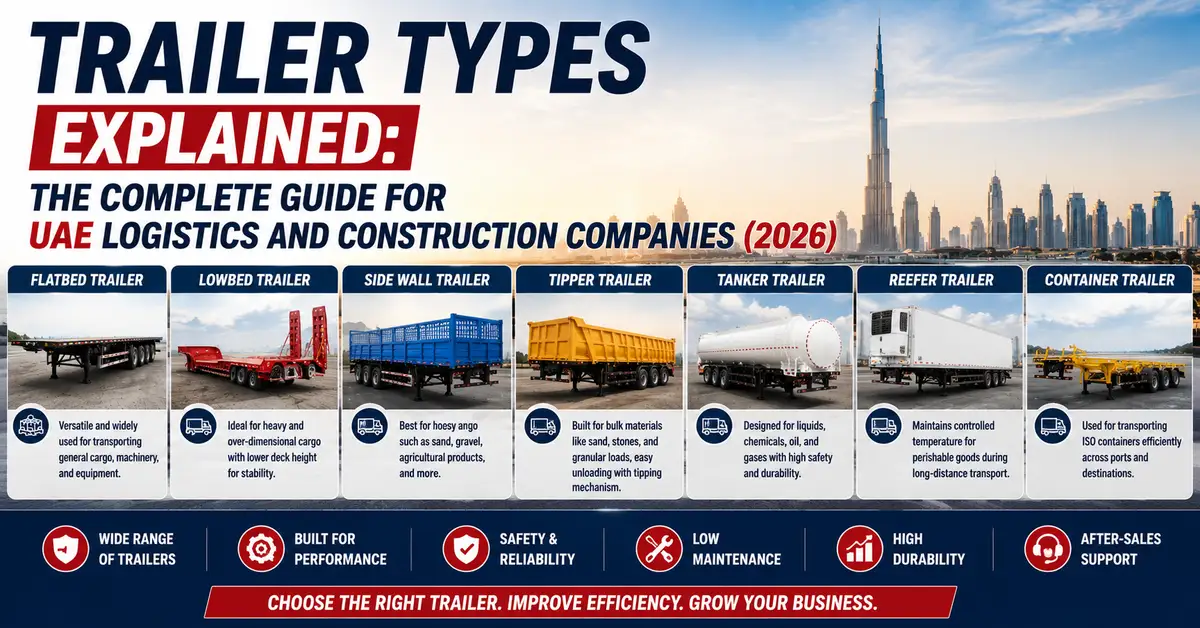
This guide covers every major trailer type used in UAE logistics and construction today. You will learn what each one does, how it works, which industries rely on it, and the key specifications to know before ordering.
Why Understanding Trailer Types Matters in the UAE
The UAE is not a single-terrain, single-industry market. Your trailer operates across desert highways, urban industrial zones, port access roads, and mountain quarry routes in Fujairah — sometimes all in the same week.
Each environment places different demands on your equipment. Each cargo type requires a specific trailer structure to transport it safely and legally. The Roads and Transport Authority (RTA) and the Emirates Authority for Standardization and Meteorology (ESMA) both set clear compliance requirements around load dimensions, axle ratings, and safety equipment for trailers operating on public roads.
Getting the trailer type right from the start protects your cargo, your driver, your compliance record, and your operational budget.
The 9 Main Types of Trailers Used in UAE Logistics and Construction
1. Flatbed Trailer
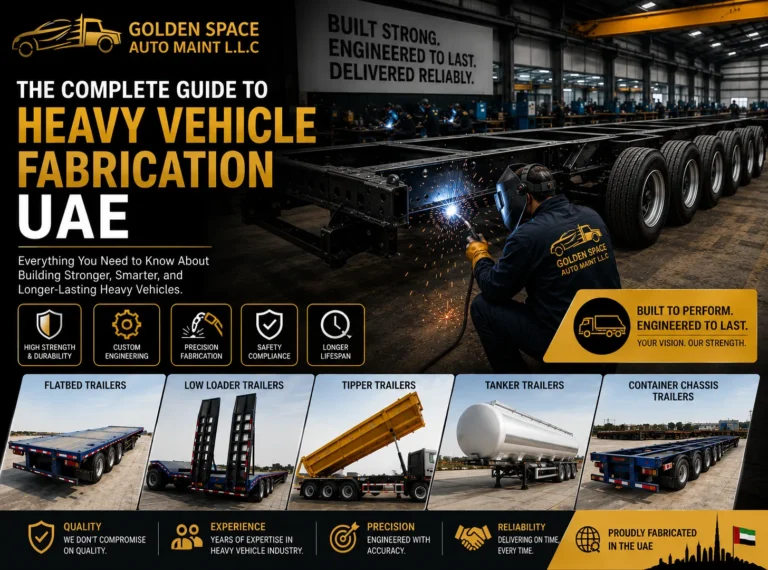
The flatbed trailer is the most widely used trailer type in UAE logistics. It features an open, flat platform with no sides or roof, which allows loading from any direction using a crane, forklift, or side loader.
Flatbeds in the UAE are available in lengths from 12 to 26 meters and carry payloads between 20 and 70 tonnes depending on axle configuration. The open deck makes them ideal for oversized cargo that does not need weather protection.
Best for: Steel products, precast concrete panels, structural beams, construction materials, machinery within standard road height limits, and standard shipping containers.
Key advantage: Fast loading and unloading from any angle with no structural barriers to work around.
Businesses running container freight between Jebel Ali Port and warehouses across Sharjah and Dubai depend on flatbeds for their core daily operations.
2. Lowbed Trailer
A Lowbed trailer, also called a low loader or lowboy, sits much closer to the ground than a standard flatbed. The deck drops significantly between the axle sets, creating a lowered cargo platform that keeps tall loads within the UAE’s 5-metre road height limit.
Lowbed trailers are built for heavy, oversized cargo that would push a standard flatbed above legal height clearance limits. Multi-axle configurations allow them to distribute extreme weights across more road contact points, protecting both the trailer structure and the road surface.
Best for: Excavators, crawler cranes, bulldozers, industrial modules, large transformers, bridge components, and any tall machinery requiring clearance under bridges or power lines.
Key advantage: Moves ultra-heavy cargo legally and safely without needing special height permits in most standard hauls.
Standard UAE payload range: 40 to 150-plus tonnes depending on axle count and configuration.
3. Tipper Trailer
A tipper trailer also known as a dump trailer or bulk tipper is a semi-trailer fitted with a hydraulic lifting system. The system raises the front of the trailer bed, tipping the cargo out through a rear gate by gravity. The entire unloading process takes under two minutes at a working site.
In the UAE construction sector, tipper trailers move sand, gravel, aggregate, fill material, and construction debris constantly across project sites. Quarrying operations in Fujairah’s Hajar Mountain region depend on heavy-duty tippers to move stone from extraction points to crushing stations and onward to road and building projects.
Payload options commonly available in UAE: 35 tonnes, 50 tonnes, and 80 tonnes.
Body specification: Thick-gauge structural steel with reinforced side walls resistant to the abrasive wear of rock, gravel, and compacted aggregate over thousands of loading cycles.
Best for: Sand and gravel haulage, aggregate transport, construction waste removal, quarry operations, and bulk earth moving projects.
Key advantage: Eliminates manual unloading. A single driver completes delivery without ground crew or equipment at the destination.
4. Skeleton Trailer
A skeleton trailer, also called a skeletal trailer, is a lightweight open-frame trailer specifically designed for transporting shipping containers. Unlike flatbeds, skeleton trailers carry no deck flooring. The frame is reduced to the minimum steel structure needed to support containers and the twist-lock fittings at each corner.
Because skeleton trailers use minimal steel compared to flatbed designs, they reduce tare weight and fuel consumption significantly. Twist-lock systems allow containers to be loaded and secured in minutes, making skeleton trailers the fastest container-handling option in high-throughput port logistics.
Best for: 20-foot and 40-foot standard shipping containers, cross-GCC container logistics, port-to-warehouse freight, and import-export cargo movements from Khalifa Port, Jebel Ali, and Port of Fujairah.
Key advantage: Lightweight design maximizes payload within UAE gross vehicle weight limits and reduces fuel costs per kilometer on long-haul routes.
UAE applications: Freight forwarders, shipping lines, container haulage operators, and retail distribution companies running containers between ports and free zones.
5. A-Frame Trailer
An A-frame trailer, also known as a glass transport trailer, is built specifically for carrying fragile flat materials in a vertical or near-vertical position. The name comes from the distinctive A-shaped angled frame running along the trailer bed. Glass panels, stone slabs, curtain wall panels, and aluminum profile bundles are loaded against this frame and secured with padded support arms.
Transporting glass flat on a standard flatbed creates significant breakage risk from road vibration and flex. The vertical positioning on an A-frame eliminates this risk by allowing the glass to flex slightly along its natural axis rather than against it.
Best for: Large-format glass panels for commercial construction, stone slabs for interior fit-outs, aluminum curtain wall systems, and architectural panels destined for high-rise buildings across Dubai and Abu Dhabi.
Key advantage: The only viable road transport solution for full-size architectural glass panels on UAE construction projects.
6. Car Carrier Trailer
A car carrier trailer is a multi-deck open-frame trailer fitted with integrated loading ramps and hydraulic or mechanical deck-height adjustment. It is designed to transport multiple passenger and commercial vehicles simultaneously from manufacturer to dealer, or between locations during fleet relocation and auction logistics.
In the UAE, car carrier trailers serve the automotive distribution industry — moving vehicles from import processing facilities to dealership networks across all seven emirates. They are also used for used vehicle auction logistics, fleet transfers for rental companies, and specialist vehicle delivery for manufacturers.
Typical UAE configuration: 20m, 20.5m, and 21m deck lengths carrying between 6 and 10 vehicles depending on vehicle size.
Best for: New vehicle distribution, automotive fleet relocation, vehicle auction transport, and dealer-to-dealer transfers.
Key advantage: Maximizes vehicles transported per trip and per driver, reducing per-unit delivery cost across large distribution networks.
7. Recovery Trailer
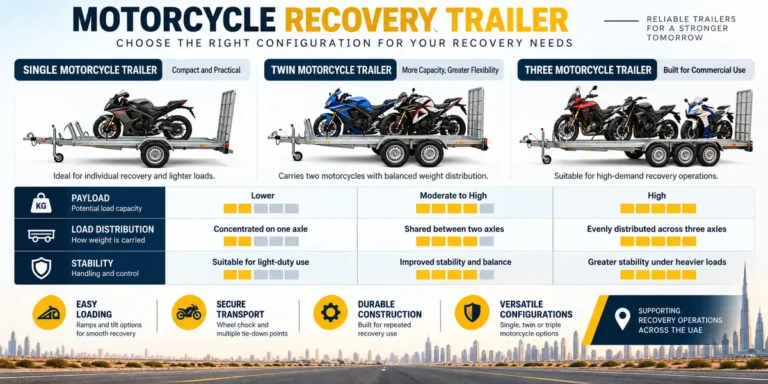
A recovery trailer is a heavy-duty towing trailer fitted with a winch system and loading ramps. It is used to retrieve and transport disabled, damaged, or broken-down vehicles from roadsides to workshops or yards.
In the UAE, roadside breakdowns on federal highways and urban arterial roads require rapid recovery to minimize traffic disruption and safety risk. Recovery trailers carry the winch capacity and structural strength needed to pull and load vehicles that cannot move under their own power.
Available UAE configurations: 16-foot and 18-foot platform lengths with 3-tonne and 10-tonne winch capacity options.
Best for: Roadside vehicle recovery, accident scene clearance, towing of damaged commercial trucks, and transport of seized or impounded vehicles.
Key advantage: The winch and ramp combination allows loading of completely immobile vehicles with no road-side lifting equipment required.
8. Buggy/Dolly Trailer
A buggy/dolly trailer, also called a coupling dolly or converter dolly, is a compact heavy-duty axle assembly that connects multiple semi-trailers into a single road train combination. It is positioned between the prime mover and a trailing semi-trailer to create B-train or multi-trailer setups for high-volume freight movement.
For operations with appropriate UAE road permit approval for extended combinations, dolly trailers reduce per-tonne transport cost significantly by allowing a single prime mover and driver to move the load of two separate trailer units in one trip.
Best for: Long-haul bulk freight on inter-emirate routes, GCC cross-border logistics, high-volume aggregate and construction materials transport, and port operations requiring extended combination vehicles.
Key advantage: Doubles cargo volume per trip and per driver on approved routes, cutting operating cost for high-frequency bulk haulage operations.
Axle specification: BP 16-tonne rated axle in single or double tyre configurations for different coupling load requirements.
9. Container Box Trailer
A container box trailer, also called an enclosed box trailer or van trailer, features a fully enclosed rigid structure with a solid roof, walls, and rear doors. Unlike flatbeds, the box body provides complete cargo protection from weather, dust, and theft during transport.
In the UAE climate, where summer temperatures exceed 45 degrees Celsius and Shamal winds carry significant dust loads, enclosed box trailers protect sensitive cargo that flatbeds cannot. Retail goods, packaged consumer products, electronics, and temperature-sensitive materials all require this protection on road transport.
Best for: Retail distribution, packaged consumer goods, sensitive industrial components, documentation and archival transport, and any cargo requiring dust or weather protection.
Key advantage: Full environmental protection and cargo security on UAE roads without requiring refrigeration or specialized temperature control.
Quick Reference: Trailer Type Selector
| Cargo Type | Recommended Trailer | Key Reason |
| Steel beams, precast concrete | Flatbed | Open deck, easy crane loading |
| Excavators, cranes, heavy plant | Lowbed | Low deck clears height limits |
| Sand, gravel, aggregate | Tipper | Hydraulic self-unloading |
| 20ft and 40ft containers | Skeleton | Twist-lock fittings, lightweight |
| Glass panels, stone slabs | A-Frame | Vertical position prevents breakage |
| Passenger and commercial vehicles | Car Carrier | Multi-deck maximises per-trip volume |
| Broken-down or damaged vehicles | Recovery | Winch and ramp enable immobile loading |
| Multi-trailer bulk freight | Buggy and Dolly | Doubles capacity per prime mover |
| Retail goods, packaged cargo | Container Box | Full enclosure, weather protection |
Common Mistakes UAE Businesses Make When Selecting a Trailer Type
Running tall cargo on a flatbed. An excavator or large piece of plant equipment on a standard flatbed can exceed the UAE’s 5-metre height limit by a significant margin. This creates an RTA compliance failure and a genuine safety risk under road bridges and power lines.
Using a skeleton trailer without checking container twist-lock compatibility. Not all skeleton trailers accommodate both 20-foot and 40-foot containers. Confirm the fitting positions match your container sizes before the trailer enters your logistics rotation.
Underspecifying tipper payload. Running 50 tonnes of aggregate in a 35-tonne tipper repeatedly causes body fatigue, hydraulic system stress, and axle overloading — problems that compound quickly in the abrasive UAE bulk haulage environment.
Choosing a box trailer when the cargo is not weather-sensitive. A box trailer costs more to operate than a flatbed for cargo that does not need enclosure. Matching the trailer type to the actual cargo protection requirement saves real operating cost.
Assuming all trailer types are interchangeable with RTA registration. Each trailer type has specific registration and inspection requirements in the UAE. A car carrier trailer registered and certified for automotive transport cannot legally be converted to run aggregate hauls without re-inspection and reclassification.
Expert Tips for UAE Fleet Managers and Construction Procurement Teams
Match trailer specification to your dominant routes, not your occasional loads. If your most frequent haul is aggregate between a quarry and a road project, specify your tipper payload for that job. Do not undersize because an oversized load occasionally requires a lighter trailer.
Factor in UAE summer conditions when evaluating hydraulic systems. Tipper and recovery trailer hydraulic systems work harder in ambient temperatures above 40 degrees. Ask your manufacturer specifically what hydraulic fluid specification and cooling provisions are built into the system for UAE summer operation.
Prioritise locally manufactured trailers for faster after-sales support. A trailer manufactured in Sharjah’s Sajaa Industrial Area is typically within two to four hours of any breakdown location across the UAE. Parts availability and workshop access are meaningfully faster than for imported units relying on overseas supply chains.
Audit your fleet by trailer type annually. Business requirements shift. A fleet configured for construction logistics two years ago may need different trailer types to match a new project mix today. An annual review prevents the wrong equipment silently reducing operational efficiency.
For further guidance on selecting between your two most common heavy transport options, read the detailed comparison of flatbed vs lowbed trailers.
For the full international framework on heavy road transport safety standards, the International Road Transport Union provides authoritative guidance that UAE-compliant manufacturers reference in their engineering and design processes.
Frequently Asked Questions
What is the most commonly used trailer type in the UAE construction industry?
The tipper trailer handles the highest volume of construction-related freight in the UAE due to the constant demand for sand, gravel, aggregate, and fill material on infrastructure and building projects. Flatbed trailers and lowbed trailers follow closely, covering structural material deliveries and heavy plant transport respectively.
Can the same trailer be used for both container transport and general cargo?
A flatbed trailer can carry containers if it has twist-lock fittings installed at the correct positions for 20-foot and 40-foot containers. However, skeleton trailers are dedicated container-only platforms with no solid deck, so they cannot carry general flat cargo. Always confirm the specific configuration before booking a trailer for container work.
How do I know if my cargo requires a special RTA permit in the UAE?
Any load exceeding 2.6 metres in width, 5 metres in total height, or the weight limits set for the road class you are using will require a special movement permit from the RTA or the relevant emirate transport authority. Your trailer manufacturer or a specialist logistics company can confirm permit requirements based on your specific cargo dimensions and planned route.
What is the difference between a skeleton trailer and a flatbed trailer for container transport?
A skeleton trailer is designed exclusively for shipping containers and offers a lighter tare weight, which means more legal payload capacity within UAE gross vehicle weight limits. A flatbed with twist-locks carries containers adequately but adds more tare weight due to the solid deck structure. For dedicated, high-frequency container haulage, the skeleton trailer is the more fuel-efficient choice.
Are there UAE manufactured trailers available across all nine types?
Yes. Manufacturers based in industrial zones like Sajaa in Sharjah produce all major trailer types locally to UAE road and transport standards. Golden Space Trailer Manufacturer., for example, manufactures all nine trailer types covered in this guide from their Sharjah facility and delivers across all seven emirates and GCC countries.
Conclusion
Choosing the right trailer type is not a back-office administrative decision. It directly shapes how safely and efficiently your business moves cargo across the UAE every single day.
Each of the nine trailer types covered in this guide solves a specific transport problem. Flatbeds handle versatile open-deck freight. Lowbed move oversized and over-height heavy plants. Tippers self-unload bulk construction materials in minutes. Skeleton trailers keep container logistics fast and fuel-efficient. A-frames protect fragile architectural glass. Car carriers maximize automotive distribution volume. Recovery trailers handle breakdown and accident clearance. Buggy and dolly units extend per-trip capacity on approved bulk freight routes. Container box trailers protect sensitive cargo from the UAE’s harsh climate.
Match your trailer type to your cargo, your route, and your UAE regulatory requirements and your operations will run more safely, more cost-effectively, and with fewer compliance interruptions.