How to Choose the Best Trailer Manufacturer in UAE: Complete Guide
Here is a question most fleet managers and logistics directors ask too late: Is my trailer manufacturer actually a long-term business partner, or just a fabrication shop that disappears after delivery?
In the UAE, the trailer market is genuinely large and growing. Mega construction projects, port expansions, and logistics corridor development across all seven emirates have created strong, consistent demand for heavy-duty transport equipment. That demand has also attracted a wide spectrum of manufacturers some outstanding, some far less so.
The problem is that trailers all look similar when they are new. The difference between a well-built unit and a poorly-engineered one only shows up six months in, when welds crack under load, axles fail ahead of schedule, or a trailer fails an RTA inspection on a critical delivery day.
This guide gives you a structured, expert-informed process for evaluating and selecting the best trailer manufacturer in UAE. You will learn exactly what to check, what questions to ask, which red flags to watch for, and how to protect your investment from day one.
Why Choosing the Right Trailer Manufacturer in the UAE Matters in 2026
The UAE is not a standard logistics market. Summer temperatures regularly exceed 45 degrees Celsius on road surfaces. Desert dust, salt air from coastal routes, and high UV radiation all accelerate material degradation on trailers that are not built for these specific conditions.
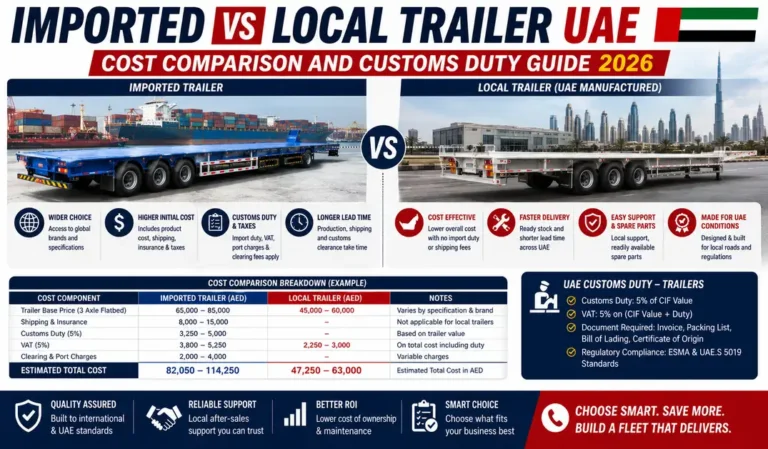
Imported trailers often struggle with the specific environmental challenges of the Middle East, such as high salinity and intense UV radiation, which can accelerate corrosion and metal fatigue. Local fabricators understand these conditions intimately and design chassis and bodies that resist these harsh elements.
Beyond the environmental argument, there is a compliance argument. All trailers must pass RTA checks before they can operate on public roads in Dubai. The Emirates Authority for Standardization and Metrology sets national quality benchmarks for industrial products, including trailers. A trailer that was not built to UAE and GCC standards can be pulled off the road at any inspection point, costing you revenue and forcing expensive retrofitting work.
ISO 9001 is a mandatory RTA supplier qualification requirement for construction and engineering suppliers. When your trailer manufacturer holds this certification, it signals that their production processes meet a verified international standard, not just a claimed one.
A wrong choice at the selection stage creates a chain reaction: higher maintenance costs, compliance failures, unexpected downtime, and ultimately a shorter asset life than your business case assumed.
Key Factors to Evaluate When Choosing a Trailer Manufacturer
1. Manufacturing Experience and Industry Track Record
Experience in the UAE market is not just a marketing phrase. It represents genuine institutional knowledge about what works on local roads, which steel grades perform in desert heat, and how RTA and transport authority inspections are conducted in practice.
When evaluating potential partners, look for expertise, experience, authoritativeness, and trustworthiness. Ask for client testimonials and case studies. Visit their facility to inspect their welding quality and production processes.
A manufacturer with five or more years of continuous operation in the UAE has already absorbed the lessons that newer entrants are still learning. Ask how many units they have produced and delivered, and ask for references you can actually contact.
2. Materials and Build Quality
Steel grade is the single most important technical variable in trailer construction. Leading fabricators in the Emirates utilize high-tensile steel to ensure the structural integrity of the chassis while keeping the tare weight optimized for better fuel efficiency. You should look for manufacturers who implement rigorous testing protocols, including load testing, weld inspections, and brake system verification.
Top manufacturers use high-grade steel, anti-corrosion coatings, and advanced welding techniques. Ask about their production standards and whether they meet UAE regulations and international certifications like ISO.
When you visit a production facility, look at the welds directly. Consistent, clean weld beads indicate proper technique and equipment. Uneven or porous welds are a warning sign regardless of what the manufacturer’s brochure claims.
3. Customization Capability
No two businesses transport identical cargo under identical conditions. A logistics company running containers between Jebel Ali Port and a Sharjah warehouse needs a completely different trailer configuration than a construction contractor moving crawler cranes from Al Sajaa to a Dubai infrastructure site.
No two businesses are the same. A logistics company transporting boxes has different needs than a construction contractor moving excavators. The best trailer company in the UAE offers custom fabrication, allowing you to choose dimensions, axle configurations, and specialized fittings. Custom-built trailers ensure maximum productivity and long-term value.
Sourcing from local providers offers significant advantages in terms of customization and lead times. Instead of waiting months for international shipments, businesses can collaborate directly with engineers to design prototypes that fit their exact specifications. This agility allows logistics companies to adapt quickly to new contracts or project requirements without significant downtime.
When evaluating a custom trailer builder in UAE, ask specifically whether their engineers will review your cargo dimensions and route conditions before beginning the design process. The best manufacturers treat this consultative step as standard practice, not an optional extra.
4. Compliance with UAE and GCC Regulations
Reputable semi-trailer manufacturers in the UAE are well-versed in legal requirements. They ensure that braking systems, often ABS or EBS, meet current safety standards. Lighting and signalling must be compliant with GCC regulations to ensure visibility during night hauls or sandstorms. Proper rear and side underrun protection devices are also mandatory. Always ask for certification and compliance documentation before making a purchase.
At minimum, request documentation that covers:
Certificate of Conformity confirming the trailer meets UAE technical regulations before RTA registration.
Axle load and weight certificates verified against UAE gross vehicle weight limits for public roads.
Braking system certification showing ABS or EBS compliance as required for heavy-duty semi-trailers.
Welding inspection records from the production process, not just a generic quality statement.
You can cross-reference regulatory requirements directly on the RTA official portal before signing any manufacturing agreement.
5. After-Sales Support and Spare Parts Availability
Trailers endure massive stress, and components like suspension leaflets, axles, and brake linings will eventually need replacement. The best manufacturers do not just sell you a unit and disappear. They offer robust after-sales support. Look for companies that maintain a substantial inventory of spare parts locally. Waiting weeks for a replacement axle to ship from overseas can cost you thousands in lost revenue.
A rock-bottom price can hide higher lifecycle costs. Ask about coating systems, brake and tyre wear assumptions, spare parts availability, warranty response times, and expected resale value. Request an itemised quote including chassis, axles, coating, electrics, and accessories so comparisons are accurate.
A good test is to ask the manufacturer directly: if my axle fails on a Friday afternoon in Sharjah, how quickly can your team respond and what parts do you carry in stock? The answer tells you more than any brochure.
Step-by-Step Process: How to Choose the Best Trailer Manufacturer in UAE
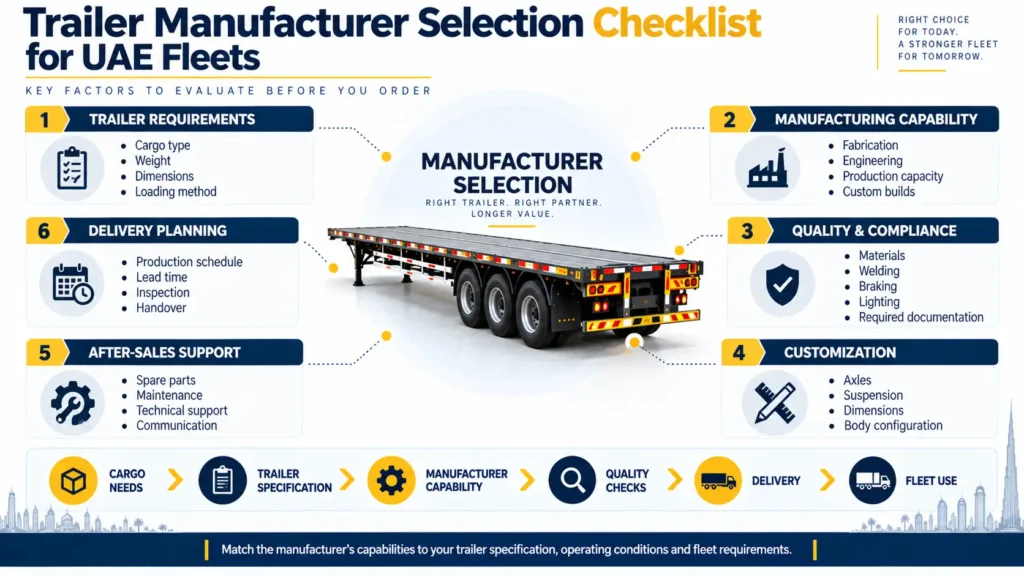
Follow this evaluation sequence before committing to any manufacturer.
Step 1: Define your cargo requirements in writing. Document the types of cargo you transport, their maximum dimensions and weights, the frequency of hauls, and your typical routes. This specification document becomes the basis for every conversation with a manufacturer.
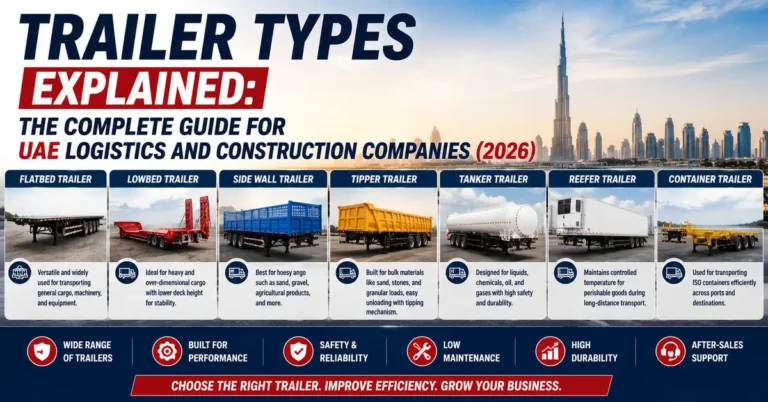
Step 2: Shortlist manufacturers with UAE-specific experience. It is essential to look beyond just the price tag. You need a partner who understands the intricacies of payload capacity, axle configurations, and local road regulations. The market offers everything from flatbed and lowbed trailers to sophisticated tanker and tipper trailers designed for specialized industries.
Step 3: Visit the production facility in person. Seeing the production line gives you a clear sense of the company’s capabilities and quality control measures. Speak to their existing clients to gauge their satisfaction levels regarding product durability and service support.
Step 4: Ask for a detailed technical proposal. Request an itemised quotation that separates chassis cost, axle specification, suspension type, coating system, braking specification, and accessories. This allows genuine comparison between manufacturers rather than comparing headline prices on different builds.
Step 5: Verify certifications independently. Do not accept verbal assurances. Request copies of ISO certifications, RTA type approvals, and any GCC conformity documentation. Check that these are current and have not lapsed.
Step 6: Test the after-sales commitment before purchase. Call their service line or workshop with a technical question. The speed and quality of that response tells you exactly what your post-purchase experience will look like.
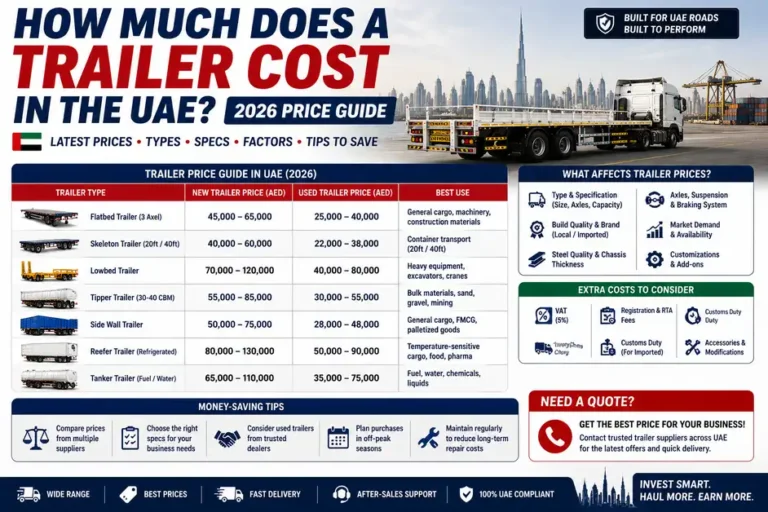
Step 7: Compare total cost of ownership, not just purchase price. A trailer priced AED 20,000 lower that requires two axle replacements in year one is not a saving. Factor in expected maintenance intervals, spare parts costs, and the manufacturer’s warranty terms.
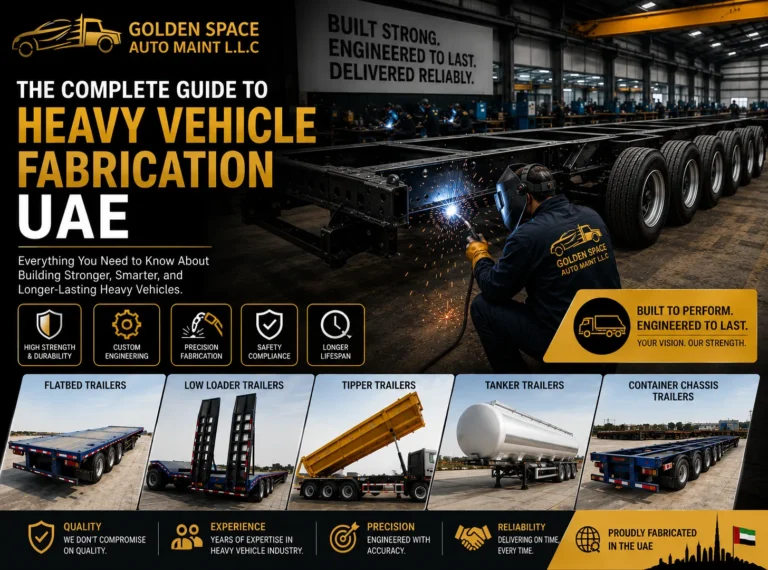
If you are building or expanding a trailer fleet in the Sharjah and Dubai corridor, Golden Space Trailer Manufacturer. in Al Sajaa manufactures a full range of UAE-compliant trailers for commercial and industrial buyers. You can review our complete trailers and explore specific options including lowbed trailers built for heavy equipment transport.
Common Mistakes to Avoid When Selecting a Heavy-Duty Trailer Supplier
Choosing on price alone. Cheapest is not always the best look for durability. Reliable manufacturers deliver trailers quickly without compromising quality. The trailer purchase price represents a fraction of its total cost over five to ten years of operation.
Not verifying certifications. A manufacturer can claim ISO certification and RTA compliance without holding current documentation. Always request the actual certificates, not just a logo on a website.
Skipping the facility visit. Production quality is visible at the factory floor level. Rust on raw materials, poor lighting in the welding area, or an absent quality control station are all signs that you will see again in the finished product.
Ignoring lead times. Custom trailer builders in the UAE vary widely in production capacity. Ask for a confirmed delivery date in writing before signing. A manufacturer who cannot commit to a timeline is one who cannot commit to your project schedule.
Overlooking the spare parts ecosystem. A reputable manufacturer will offer robust after-sales support, including spare parts availability and maintenance services. If the manufacturer you are considering sources components from abroad exclusively, your downtime risk is significantly higher.
Failing to specify the operating environment. A manufacturer who does not ask about your specific routes, load types, and site conditions cannot design the right trailer for your operation. Treat this lack of curiosity as a warning signal.
Expert Tips for Evaluating a Custom Trailer Builder in UAE
Match the manufacturer to your dominant trailer type. Some manufacturers excel at flatbeds and container trailers. Others specialize in lowbeds and heavy haulage configurations. A manufacturer whose production line is dominated by the type you need will produce a better result than one treating your order as a deviation from their standard range.
Ask about steel sourcing. The best UAE manufacturers specify their steel by grade and often source from established mills with verifiable quality documentation. If a manufacturer cannot tell you where their steel comes from, that is a gap worth investigating.
Understand the coating and surface treatment process. Trailers are painted with high-quality coatings that resist UV rays, preventing fading, cracking, or peeling. The chassis undergoes advanced welding to ensure maximum strength and load stability. Sand blasting before primer application, followed by two-coat epoxy painting, is the industry standard for UAE conditions. Anything less will show corrosion within two to three years on coastal routes.
Check the braking system specification carefully. For heavy-duty trailer suppliers operating in UAE, Electronic Braking Systems (EBS) are now the preferred standard on multi-axle configurations. ABS at minimum is required for compliance. Any manufacturer suggesting drum brakes without ABS on a heavy-duty unit is working to an outdated standard.
Request a production schedule in writing. A confirmed production timeline with milestones raw material procurement, chassis fabrication, axle installation, final paint, and quality inspection tells you that the manufacturer operates a real production management process rather than an informal workshop arrangement.
Tools and Resources You Need During Your Selection Process
Before you finalise any manufacturer, use these resources as part of your due diligence.
The RTA official portal publishes current vehicle and trailer registration requirements, inspection criteria, and permit frameworks for heavy vehicles operating in Dubai and across the UAE.
The International Road Transport Union (IRU) provides internationally recognized standards and guidelines for heavy transport safety and compliance that many UAE-market manufacturers reference in their design processes.
Your own GPS and fleet management data, if you operate existing trailers, provides real-world maintenance cost benchmarks. Compare your current cost per kilometre against what a prospective new manufacturer projects. Any significant discrepancy deserves a direct question.
Frequently Asked Questions
What is the most important factor when choosing a trailer manufacturer in the UAE?
A: Build quality and UAE-specific compliance top the list. A trailer that fails an RTA inspection or breaks down under load costs far more than any price premium paid for a quality manufacturer. Look for verified certifications, documented steel grades, and written warranty terms before price becomes a deciding factor.
Q: Can UAE manufacturers build custom trailers for specific cargo needs?
Yes. One of the main benefits of working with local manufacturers is the ability to customise axle configurations, dimensions, chassis strength, and add-ons like specific loading ramps or storage solutions. Local engineers can modify designs to meet exact operational requirements. The best manufacturers will not begin fabrication until their engineers have reviewed your cargo and route specifications in detail.
Are trailers made by UAE manufacturers compliant with GCC regulations?
Yes. Reputable local manufacturers design their trailers to strictly adhere to GCC and local RTA regulations regarding dimensions, weight limits, and safety features. However, compliance varies between manufacturers. Always request the actual certificate documentation rather than accepting verbal confirmation of compliance.
How do I evaluate after-sales support before purchasing a trailer?
Ask for specifics: spare parts stock levels, average response time for breakdown callouts, workshop location relative to your operational area, and the warranty terms in writing. Look for right running gear axles and suspension sized to your true payloads and terrain, with parts readily available locally. A manufacturer confident in their after-sales will answer these questions without hesitation.
Is a locally manufactured trailer better than an imported one for UAE conditions?
For most operational scenarios in the UAE, yes. Local fabricators understand the specific environmental challenges of the Middle East intimately and design chassis and bodies that resist these harsh elements. Businesses can collaborate directly with engineers to design products that fit their exact specifications, with faster lead times than international shipments. Imported units can perform well but often require adaptation to meet UAE road authority requirements.
Conclusion
Choosing the best trailer manufacturer in UAE is a decision that shapes your fleet’s performance, compliance record, and operational costs for years. The market has genuine quality at the top end manufacturers who understand UAE road conditions, hold verifiable certifications, offer real engineering customization, and back their products with serious after-sales infrastructure.
The key takeaways from this guide are straightforward. Define your cargo requirements before approaching any manufacturer. Visit production facilities in person. Verify certifications independently. Evaluate total cost of ownership rather than purchase price alone. Test after-sales responsiveness before you sign.
A manufacturer who can answer every question in this guide clearly and in writing is one worth serious consideration. One who deflects or generalises is telling you something important about what happens after the sale.
If you are operating in the Sharjah, Dubai, or broader UAE market and need trailers built to local road authority standards, explore the full range of locally manufactured trailers options. For a deeper understanding of which trailer type suits your specific cargo, read our guide on flatbed vs lowbed trailers to make your next specification decision with confidence.