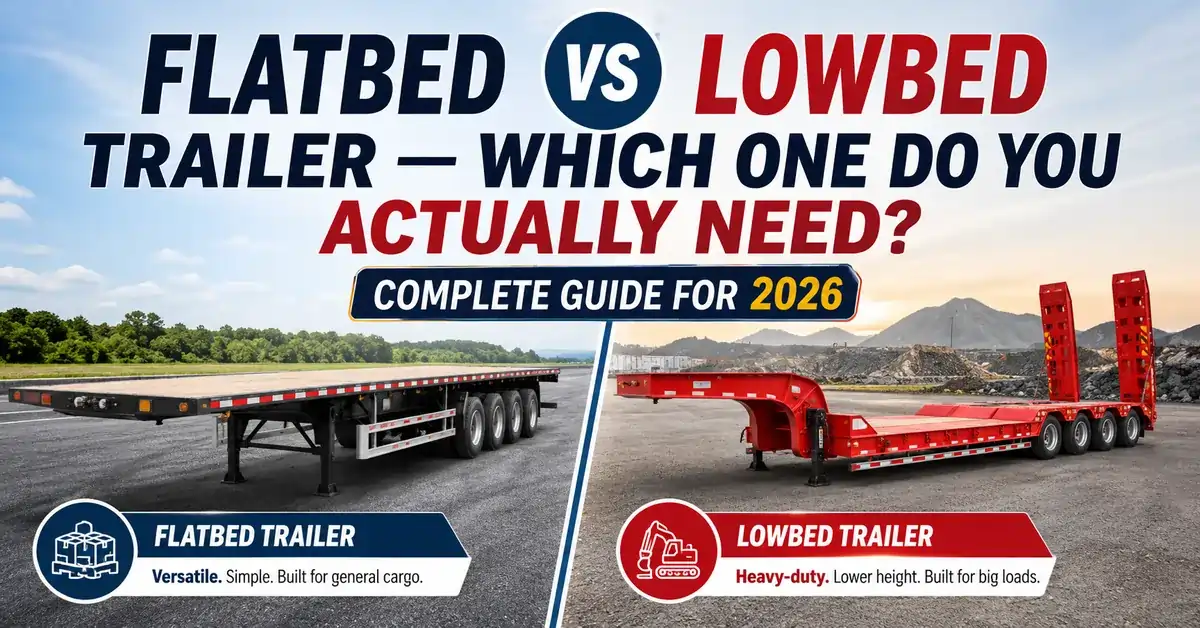
Flatbed vs Lowbed Trailer Which One Do You Actually Need?
Your team has just won a contract to move a 35-tonne excavator from a construction depot in Sajaa Industrial Area, Sharjah, to a project site in Dubai. You call a transport company, and the first question they ask is simple but critical “Do you need a flatbed or a lowbed?”
Most people pause here. Both trailers haul heavy cargo. Both are common on UAE roads. But picking the wrong one does not just slow down your project. It can cost you in RTA permit violations, cargo damage, and unnecessary downtime.
This guide answers the question in plain language. You will learn exactly how each trailer works, which cargo belongs on which platform, how UAE regulations shape your choice, and what real-world scenarios look like in the field. By the end, you will know how to make this decision confidently every single time.
What Is a Flatbed Trailer and How Does It Work?
A flatbed trailer is a versatile open-deck trailer designed for everyday cargo. It features a flat, elevated platform that is easy to load and unload from any angle front, side, or rear.
The deck sits roughly 1.3 to 1.5 metres off the ground. A standard flatbed semi-trailer measures approximately 14.6 to 16.2 metres in length and 2.59 metres in width, with a practical freight capacity of around 20,000 to 22,000 kilograms depending on axle configuration. In the UAE market, 12 to 16-metre flatbed trailers carry between 20 and 55 tonnes, making them ideal for general freight like construction materials, steel pipes, timber, and standard containers.
Because the deck is open and accessible from all sides, flatbeds load and unload quickly. There are no walls or roofs to work around. A forklift, crane, or side loader can place cargo on the deck in minutes. This speed makes flatbeds the preferred choice for logistics operations handling high freight volumes on tight schedules.
You can use a flatbed trailer to ship anything that does not exceed 8.5 feet (roughly 2.6 metres) in height and width, regardless of shape. It is preferable to use flatbeds for freight that can withstand different weather conditions.
What Cargo Works Best on a Flatbed?
Flatbeds handle a wide range of cargo types in the UAE market. Common loads include:
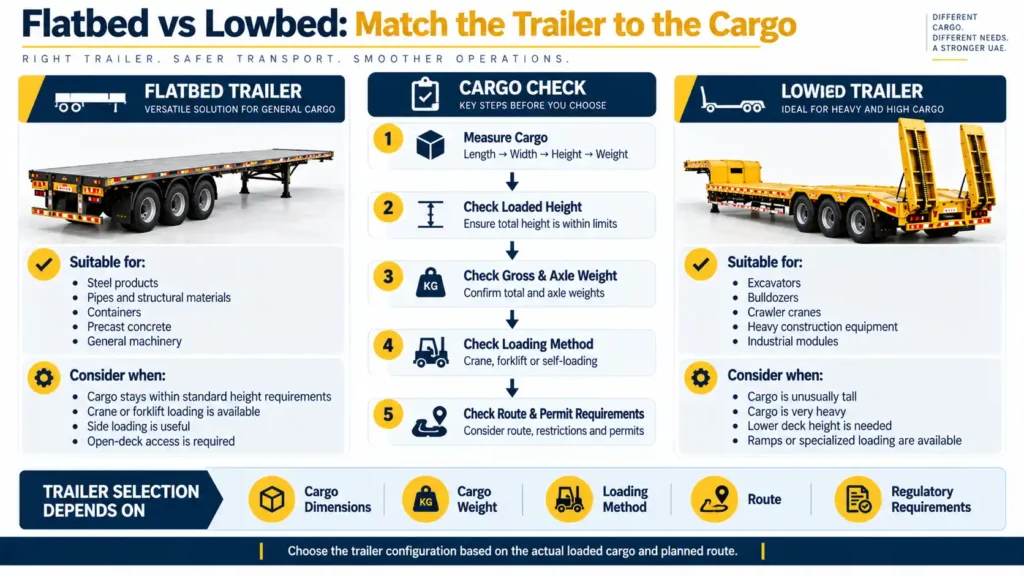
Steel products rebar bundles, I-beams, structural steel sections, and pipes are all natural fits. They load flat, distribute weight evenly, and do not need a lowered deck.
Precast concrete elements panels, wall sections, and floor slabs that are heavy but not exceptionally tall.
Industrial machinery generators, compressors, HVAC units, and manufacturing equipment that sits within standard height limits.
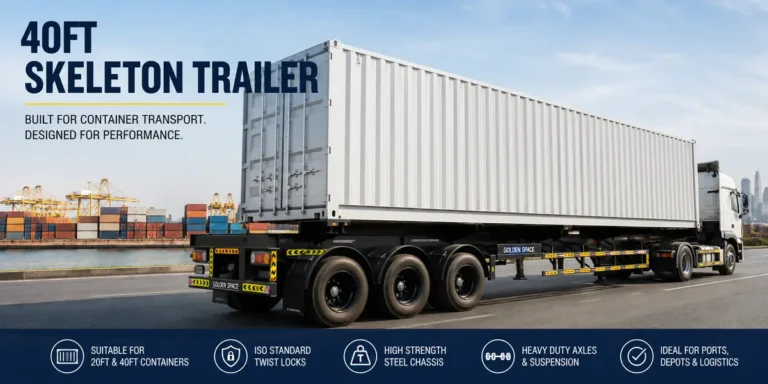
Containers both 20-foot and 40-foot standard shipping containers fit securely on flatbed platforms with twist-lock fittings.
Construction supplies timber, block pallets, and bagged materials moving between ports, warehouses, and project sites across the seven emirates.
What Is a Lowbed Trailer and How Does It Work?
A lowbed trailer, sometimes called a lowboy or low loader, is a type of semi-trailer with a lower deck height than standard trailers. This makes it perfect for transporting tall or heavy cargo without exceeding road height restrictions.
The design is immediately recognizable. The deck drops significantly lower between the two axle sets, creating a well in the middle that keeps tall cargo close to the road surface. Unlike flatbed or box trailers, lowbeds are built closer to the ground. This lower deck height allows them to carry oversized and heavy loads that would be too tall for other trailers.
Lowbed trailers are specially designed for the transport of ultra-high and ultra-heavy objects and are known for their high-strength construction, capable of carrying hundreds of tonnes of heavy loads, which makes them ideal for large equipment as well as building structures.
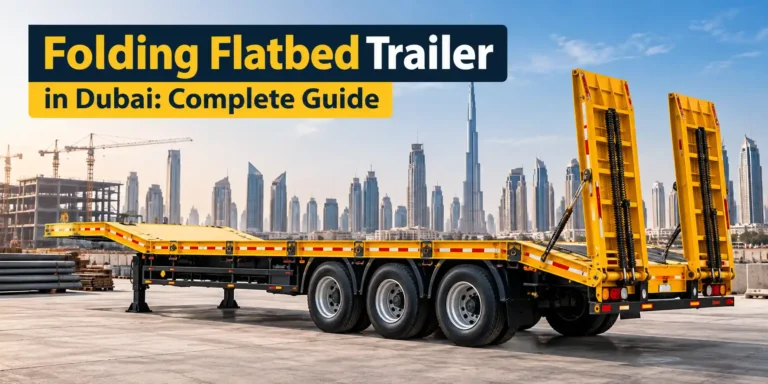
Loading a lowbed requires more planning than loading a flatbed. Lowboys often need ramps, or the front neck part detaches (known as a Removable Gooseneck or RGN) to allow equipment to drive directly onto the deck. This is why you will sometimes see a lowbed trailer with its front end completely removed so that a tracked excavator can roll straight onto the platform
What Cargo Belongs on a Lowbed?
Oversized construction equipment such as excavators and bulldozers are common lowbed loads. These types of equipment are huge in size and weight, which puts high demands on carrying capacity and transportation stability.
Typical lowbed cargo in the UAE context includes:
Heavy construction plant excavators, bulldozers, crawler cranes, and motor graders with high silhouettes.
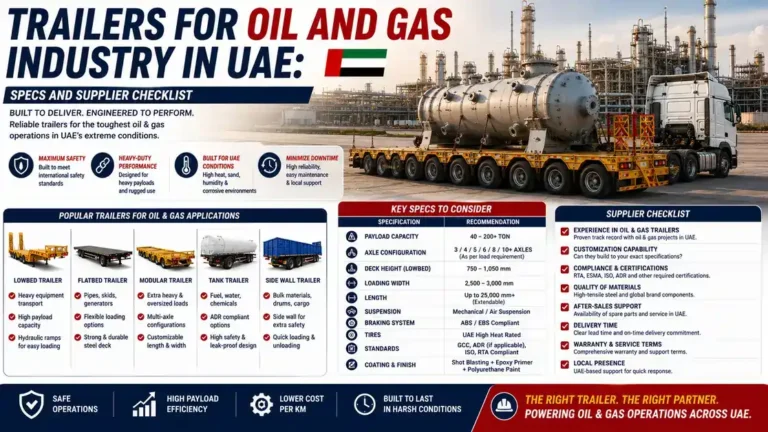
Industrial modules large oil and gas processing units, turbine assemblies, and transformer equipment.
Bridge and infrastructure components steel girders, large-diameter pipes, and tunnel boring sections.
Military and specialist vehicles tracked or wheeled vehicles with unusual proportions that flatbeds cannot safely accommodate.
Flatbed vs Lowbed Trailer: The Key Differences at a Glance
Understanding the contrast between the two becomes clearest in a side-by-side comparison.
| Feature | Flatbed Trailer | Lowbed Trailer |
| Deck height | 1.3 – 1.5 m from ground | 0.5 – 0.8 m from ground |
| Typical payload | 20 – 55 tonnes | 40 – 150+ tonnes |
| Max cargo height | Up to approx. 2.6 m | 3.5 m+ (stays within UAE 5 m limit) |
| Loading method | Crane, forklift, side loader | Ramps, RGN, crane |
| Common uses | Steel, containers, machinery, materials | Excavators, cranes, heavy plant, modules |
| Permit requirement | Usually not required | Often required for oversized/overweight loads |
| Operating cost | Lower | Higher |
| Loading speed | Fast | Slower more rigging needed |
Choosing between a lowbed trailer and a flatbed trailer is not about which one is “better,” but which one is right for your actual transport needs. A wrong choice can lead to higher costs, compliance issues, and reduced operating efficiency.
Why This Decision Matters in the UAE in 2026
The UAE is not a generic transport market. Rapid infrastructure expansion across all seven emirates means heavy equipment transport demand has never been higher. Mega projects in Dubai, industrial growth in Sharjah’s Sajaa Industrial Area, and port expansions in Abu Dhabi all require constant movement of oversized cargo.
That is precisely why getting this decision right carries real financial and legal consequences here.
UAE Road Regulations and the RTA Factor
The standard maximum width for road transport in the UAE is 2.6 metres, with a height limit of 5 metres. Cargo exceeding these dimensions requires prior approval from the Roads and Transport Authority (RTA) or local entities in other emirates.
This is where the lowbed trailer earns its place. The RTA has strict rules about load height, width, and weight. Using a lowbed trailer makes it easier to comply with these regulations since the deck is low enough to carry tall machines without breaking road clearance laws.
When you transport an excavator on a flatbed, the machine’s cab and boom structure can push the total height well past the 5-metre ceiling. The same machine on a lowbed sits low enough to move without a special permit in most cases. Permit fees in the UAE vary by load size: AED 20 per vehicle for large loads and AED 200 for special loads exceeding 60 tonnes or 4 metres in height, with an approval process that typically takes 3 working days.
For a fleet operator running multiple heavy hauls per week in and out of Sharjah or Dubai, those permit delays and fees accumulate quickly. Choosing the right trailer from the start eliminates unnecessary friction.
For most heavy vehicles on federal roads in the UAE, the maximum permitted height envelope is 4.6 metres, with length configurations ranging from 12.5 to 28 metres depending on trailer setup. Route planning, including avoiding peak traffic windows and residential corridors with stricter controls, matters just as much as the trailer choice itself.
You can always check the latest regulations directly on the RTA official website before any heavy transport movement.
Step-by-Step: How to Choose the Right Trailer for Your Load
Follow this decision process before booking any trailer in the UAE.
Step 1: Measure your cargo accurately.
Get exact dimensions height, width, length, and weight. Do not estimate. A few centimetres in height can be the difference between a standard move and a permit job.
Step 2: Check the height threshold.
If the cargo exceeds 8.5 feet (approximately 2.6 metres) in height, a lowbed should be considered. Route and regulations also matter over-height cargo requires special permits, and using a lowbed can keep your cargo within legal limits.
Step 3: Check the weight threshold.
If you need to move extremely heavy cargo, a lowbed trailer is the right choice, as configurations such as the 3-axle lowbed provide better weight distribution. For loads under 25 to 30 tonnes that sit within standard height limits, a flatbed handles the job more economically.
Step 4: Consider loading conditions on site.
Flatbeds accept crane, forklift, and side-loader operation with no special rigging. Lowbeds need ramps or RGN detachment to load tracked vehicles. If your site lacks the right equipment, factor that into your planning.
Step 5: Factor in route and timing.
In the UAE, certain roads restrict heavy vehicle movement during peak hours. Times to avoid heavy transport include 06:30 to 08:30, 13:00 to 15:00, and 17:30 to 20:00 on major corridors. Some urban routes also impose height restrictions at specific bridges and underpasses.
Step 6: Contact your trailer manufacturer or supplier early.
If you are operating from Sajaa Industrial Area or anywhere in the greater Sharjah zone, speak with your trailer supplier about configuration options. Companies likeGolden Space Trailer Manufacturer manufacture both flatbed and lowbed trailers locally, which means faster turnaround, UAE-compliant specs, and after-sales support without import lead times. You can explore our flatbed trailer range.
Common Mistakes to Avoid
Even experienced logistics managers make avoidable errors when choosing between these two trailer types.
Underestimating cargo height. The most common mistake. A machine measured on the ground may add significant height when secured on a flatbed with timber blocking underneath. Always measure the loaded configuration, not just the machine itself.
Ignoring axle count and weight distribution. More axles spread the load across a greater road surface area. Adding axles to a lowboy trailer can boost weight capacity from 40,000 pounds to 80,000 pounds. Always confirm that the trailer’s axle setup matches your load’s gross weight requirements under UAE regulations
Assuming one trailer type fits all cargo. Although both models are incredibly versatile, they have certain limitations, so it is essential to be aware before purchasing or booking. A flatbed is not a fallback option for oversized loads just because it is cheaper to hire.
Neglecting the permit timeline. If your load requires an RTA special permit, apply at least 3 working days in advance. Last-minute permit applications create project delays that no amount of trailer availability can fix.
Overlooking loading infrastructure at destination. A lowbed needs adequate ground clearance and space to deploy ramps or detach its gooseneck. If the destination site is tight or uneven, that creates real problems on arrival.
Expert Tips for Heavy Equipment Transport in the UAE
People who move heavy cargo across the UAE every day share a consistent body of knowledge. Here is what matters in practice.
Know your corridor. The E311 (Sheikh Mohammed Bin Zayed Road) and E611 (Emirates Road) are the main arteries for heavy freight between Sharjah, Dubai, and Abu Dhabi. These roads handle wide loads more easily than older urban routes.
Build relationships with your trailer supplier. A locally manufactured trailer, built to UAE road standards and supported by a Sharjah-based workshop, saves you time and money compared to imported units with long parts lead times.
Plan for frequency. Renting a lowbed might be more cost-effective than owning one if you only need to transport heavy loads occasionally. Check regulations to be aware of height and weight limits in your area to avoid fines.
Secure your load properly. Flatbed loads require chains, straps, and edge protectors. Lowbed loads particularly tracked machines require wheel chocks, chain binders, and sometimes welded stops for long-distance hauls. The RTA’s enforcement teams check load security at fixed weighbridge points and on mobile inspection units.
Work with a trailer manufacturer who understands local regulations. UAE-specific factors like Salik toll gates, bridge height restrictions in older parts of Sharjah, and summer-season road surface heat all affect trailer selection and maintenance. A local manufacturer understands these variables by default.
Frequently Asked Questions
What is the main difference between a flatbed and a lowbed trailer?
The deck height is the core difference. A flatbed sits 1.3 to 1.5 metres off the ground and handles general cargo up to standard road height limits. A lowbed sits much closer to the ground often 0.5 to 0.8 metres and is designed specifically for tall, heavy, or oversized loads that would exceed height limits on a flatbed. The choice depends entirely on the dimensions and weight of what you are moving.
Do I need an RTA permit to use a lowbed trailer in the UAE?
It depends on the load. Loads exceeding 2.6 metres in width or 5 metres in height require prior approval from the RTA or local transport authorities in the relevant emirate. Fees vary by load: AED 20 per vehicle for large loads and AED 200 for special loads exceeding 60 tonnes or 4 metres in height. Standard loads within these limits do not need a special permit regardless of whether a flatbed or lowbed is used.
Can a flatbed trailer carry an excavator?
In some cases, yes for smaller compact excavators with a low profile. But most full-size excavators are too tall for a flatbed when the combined deck height and machine height are added together. If your cargo might exceed legal height limits, a lowboy trailer becomes the better choice. Always measure the total loaded height before choosing your trailer type.
Which trailer is more cost-effective for regular construction logistics in Sharjah and Dubai?
If you mainly handle general cargo, containers, steel products, or palletised goods, a flatbed trailer offers greater flexibility, faster loading, and lower operating costs. For most standard logistics operations, a flatbed trailer delivers the best balance of performance and economy. Reserve the lowbed for loads that genuinely require its lower deck height and higher capacity.
Is a lowbed trailer always safer than a flatbed for heavy loads?
For tall and very heavy cargo, yes. Lowbed trailers offer increased safety for heavy and tall cargo due to their low deck height, reducing the chance of tipping. Flatbed trailers are easy to load, but they require more attention when securing loads to prevent cargo from shifting. Safety comes from matching the right trailer to the right cargo, not from always defaulting to one type.
Conclusion
The flatbed versus lowbed question is not complicated once you understand what each trailer is actually built to do.
Flatbeds are fast, flexible, and cost-effective. They move steel, containers, building materials, and standard machinery across the UAE efficiently every day. If your cargo stays within the UAE’s standard road height limits and does not exceed typical weight thresholds, a flatbed is your most practical choice.
Lowbeds are precision tools for specific jobs. They solve the height and weight problems that flatbeds cannot. Excavators, crawler cranes, large industrial modules, and any cargo that would push past the 5-metre ceiling on a standard platform belong on a lowbed.
The bottom line is this: measure your cargo first, check the UAE height and weight regulations, factor in your loading site conditions, and then make your call. When you choose correctly from the start, you avoid permit delays, reduce safety risk, and keep your project moving on schedule.
If you need a UAE-manufactured trailer built to local road standards and backed by local service Golden Space Trailer Manufacturer in Al Sajaa, Sharjah, builds both flatbed and lowbed trailers for commercial buyers across all seven emirates.