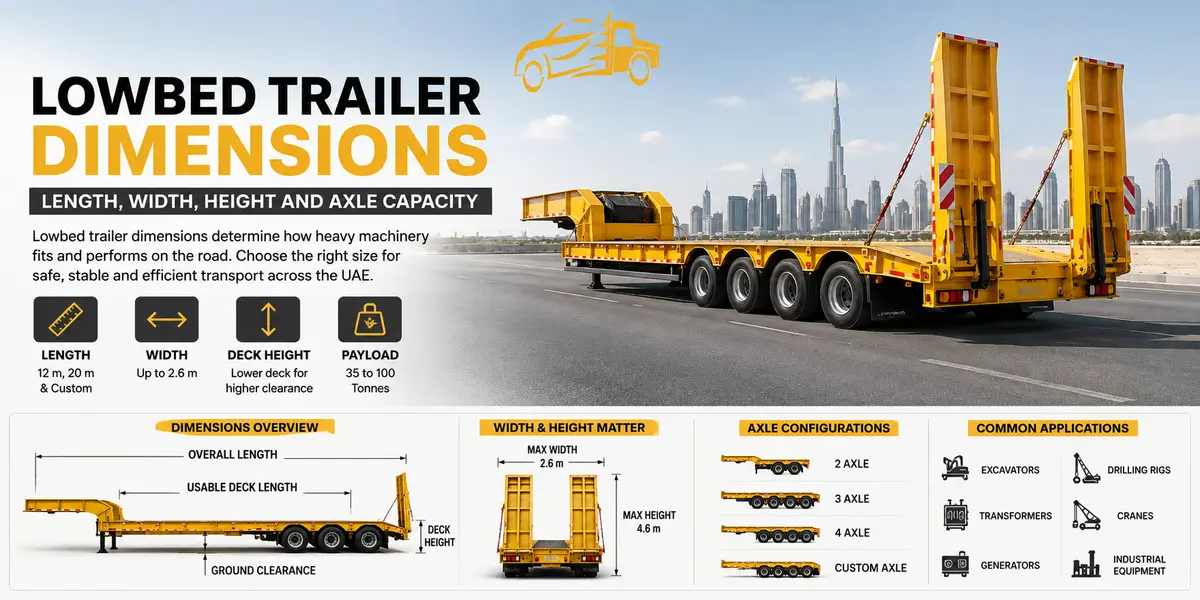
Lowbed Trailer Dimensions: Length, Width, Height and Axle Capacity
A lowbed trailer carries heavy machinery closer to the road than a standard flatbed. Its lower platform provides extra overhead clearance for excavators, cranes, transformers and other tall equipment. Lowbed trailer dimensions determine how much space the cargo needs and how the loaded vehicle performs during transport.
The right dimensions depend on cargo length, width, height and weight. They also depend on deck design, axle configuration and the intended route. Businesses that need different trailer types can compare options from a trailer manufacturer.
What Are Lowbed Trailer Dimensions?
Lowbed trailer dimensions describe the measurements that determine how equipment fits on the trailer. The main measurements are overall length, usable deck length, deck width and deck height.
Payload capacity is also important. It shows how much cargo the trailer is designed to carry. Axle configuration affects weight distribution and must match the complete vehicle requirements.
A longer trailer is not always the better choice. The usable loading space must match the actual dimensions of the equipment.
Overall Length
Overall length refers to the physical length of the trailer. The complete truck combination will be longer because it includes the tractor.
Usable deck length is more important when checking cargo fit. Gooseneck design, axle placement and rear structure can affect the available loading space.
Deck Width
Deck width determines how much space the equipment has across the platform. The cargo should fit securely without creating an excessive overall vehicle width.
The complete loaded width matters for road compliance. Therefore, the equipment should be measured at its widest point before selecting a trailer.
Deck Height
Deck height measures the distance from the road to the loading platform. A lower deck reduces the height added underneath the cargo.
This makes lowbed trailers useful for tall construction machinery and heavy industrial equipment. The low profile can also improve clearance when travelling beneath bridges and other structures.
Standard Lowbed Trailer Dimensions
There is no single size suitable for every heavy machine. Current specifications list 12 metre, 20 metre and custom lengths. Payload capability extends from 35 to 100 tonnes, with 2-axle, 3-axle, 4-axle and custom configurations available.
| Specification | Available Options |
| Standard length | 12 m and 20 m |
| Custom length | Available |
| Payload | 35 to 100 tonnes |
| Axle configuration | 2, 3, 4 or custom |
| Deck design | Low-profile |
| Frame material | High-strength structural steel |
These specifications provide a starting point for selecting a trailer. The final choice should be based on the actual cargo measurements and transport requirements.
How to Measure Cargo for a Lowbed Trailer
Measure the equipment in its transport position rather than its normal working position. Components such as booms, arms and buckets can change the final dimensions.
For an excavator, check its overall length, track width, transport height and actual weight. Include the boom, arm, bucket and counterweight when they remain attached.
Transformers, generators and industrial equipment also require accurate measurements. Include every component that will travel on the trailer.
These measurements help determine the required deck length, width, height and payload. They also help engineers select a suitable axle configuration.
Lowbed Trailer Length and Deck Space
Trailer length should match the cargo footprint. A 12 metre configuration can suit many construction machines, while a 20 metre trailer provides more loading space for larger equipment. Custom lengths can be used when standard dimensions do not suit the cargo.
Overall length should not be confused with usable deck length. The gooseneck and axle arrangement can reduce the space available for the machine.
This is especially important for long machinery and industrial equipment. Always confirm the usable deck dimensions before ordering.
Lowbed Trailer Deck Height and Transport Height
Deck height is critical when transporting tall machinery. A lower platform reduces the height added beneath the cargo.
The basic calculation is:
Total transport height = cargo height + deck height
For example, a 3.5 metre machine on a 0.8 metre deck creates an approximate transport height of 4.3 metres.
This calculation helps when comparing trailer specifications. However, it does not automatically confirm legal approval for a specific route.
The complete vehicle, cargo position, route and applicable requirements must be checked before transport.
Low Bed Trailer Width and UAE Road Limits
The cargo must fit securely across the deck. The complete loaded vehicle must also meet the applicable UAE road requirements.
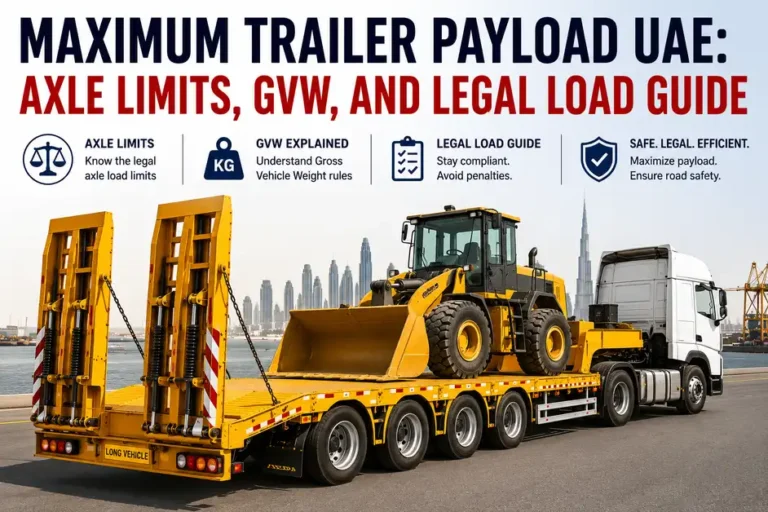
UAE Cabinet Decree No. 138 of 2023 specifies a maximum overall width of 2.6 metres for a truck head and semi-trailer combination. It also specifies a maximum overall height of 4.6 metres and maximum overall length of 21 metres.
These figures apply to the complete vehicle combination. They should not be treated as measurements for the trailer deck alone.
Oversized or overweight movements can require additional approval. Dubai RTA provides mobility permits for over-weight and over-dimension vehicles.
Always confirm the requirements for the actual route before moving oversized equipment.
Lowbed Trailer Dimensions by Axle Configuration
Axle configuration affects weight distribution and trailer capacity. It should be selected according to the complete transport requirement.
2-Axle Lowbed Trailer
A 2-axle configuration can suit lighter heavy-haul applications. The trailer rating must support the planned cargo and complete vehicle weight.
3-Axle Lowbed Trailer
A 3-axle configuration provides additional load distribution. It can suit heavier machinery when the trailer is designed for the required payload.
4-Axle Lowbed Trailer
A 4-axle configuration distributes weight across additional axle positions. It can support heavier transport requirements when correctly specified.
Custom Axle Configuration
Some machinery requires a custom axle arrangement. The final design can depend on cargo weight, dimensions and transport requirements.
There is no universal axle rule for every machine. The complete vehicle specification should always be considered.
Lowbed Trailer Payload Capacity
Payload and gross vehicle weight are different measurements. Payload refers to the cargo, while gross vehicle weight includes the tractor, trailer and cargo.
A trailer rated for 60 tonnes does not automatically mean the vehicle can legally carry 60 tonnes of cargo. The weight of the tractor and trailer must also be included.
Current lowbed specifications provide payload capability from 35 to 100 tonnes. Custom payload requirements are also available.
UAE regulations also establish gross-weight limits according to axle configuration. Payload should therefore be checked against the complete vehicle specification.
40 Ft Low Bed Trailer Dimensions
The term 40 ft low bed trailer dimensions usually refers to a trailer around 12.2 metres long. However, 40 feet does not define every trailer measurement.
Deck height, usable deck length, width, payload and axle configuration can vary between manufacturers. Two trailers with similar overall lengths can therefore have different capabilities.
If your equipment needs approximately 40 feet of loading space, provide its exact dimensions and weight. The manufacturer can then determine the appropriate deck and axle configuration.
Lowbed Trailer Dimensions for Excavators
Excavators are common loads for lowbed trailers because their height can create clearance problems on conventional trailers. The lower deck helps keep the machine closer to the road.
Before transport, measure the excavator in its prepared position. Check the tracks, overall width, machine length, cab height, boom position and transport weight.
The bucket and arm position can also change the final dimensions. Include them when they remain installed during transport.
Golden Space specifically lists excavators among the equipment transported by its lowbed trailers, alongside transformers, generators, drilling rigs and oil and gas equipment.
Lowbed Trailer vs Flatbed Trailer
Lowbed and flatbed trailers serve different cargo requirements. A flatbed has a higher loading platform and works well for machinery, steel and construction materials.
A lowbed places the cargo closer to the road. This makes it more suitable when equipment height is a major transport concern.
Golden Space manufactures both lowbed and flatbed trailers for different applications. Its current flatbed specifications include 12 metre, 15 metre and custom lengths.
If the cargo can be transported on either design, comparing the lowbed and flatbed trailer specifications can help determine the better option.
Choosing the Right Lowbed Trailer Dimensions
Start with the cargo measurements before choosing the trailer. Measure its length, width, height and actual transport weight.
Next, determine the required deck length and deck height. Then select the payload and axle configuration based on the complete vehicle requirements.
Finally, check the overall vehicle dimensions and applicable UAE road requirements. This process helps prevent loading problems and unnecessary transport delays.
For companies operating close to the Al Sajaa industrial area, the trailer manufacturer in Sharjah page provides information about the local manufacturing facility. The factory is based in Al Sajaa Industrial Area, Sharjah.
Conclusion
The right lowbed trailer dimensions depend on the equipment being transported. Start by measuring the cargo in its actual transport position.
Then select the required deck length, width, height, payload and axle configuration. Finally, check the complete vehicle against applicable UAE requirements.
A properly specified lowbed trailer provides the space, payload and clearance needed for heavy equipment transport. It also reduces the risk of selecting a trailer that does not match the cargo or planned route.
Frequently Asked Questions
What are the standard lowbed trailer dimensions in the UAE?
Current specifications include 12 metre and 20 metre lengths, plus custom lengths. Payload capability runs from 35 to 100 tonnes, with 2-, 3-, 4-axle and custom configurations.
What is the deck height of a lowbed trailer?
Deck height varies according to trailer design and cargo requirements. A lower deck provides more overhead clearance for tall machinery.
How do I calculate low bed trailer dimensions for an excavator?
Measure the excavator in its transport position. Check its length, width, height and weight. Then match those measurements to the required deck and payload specifications.
Are 40 ft low bed trailer dimensions the same for every manufacturer?
No. A 40 ft description does not define deck height, usable deck length, payload or axle configuration. Specifications vary by trailer design.
What is the maximum height for a truck and semi-trailer in the UAE?
The UAE federal table specifies a maximum overall height of 4.6 metres for a truck head and semi-trailer combination. Route and permit requirements should also be confirmed.