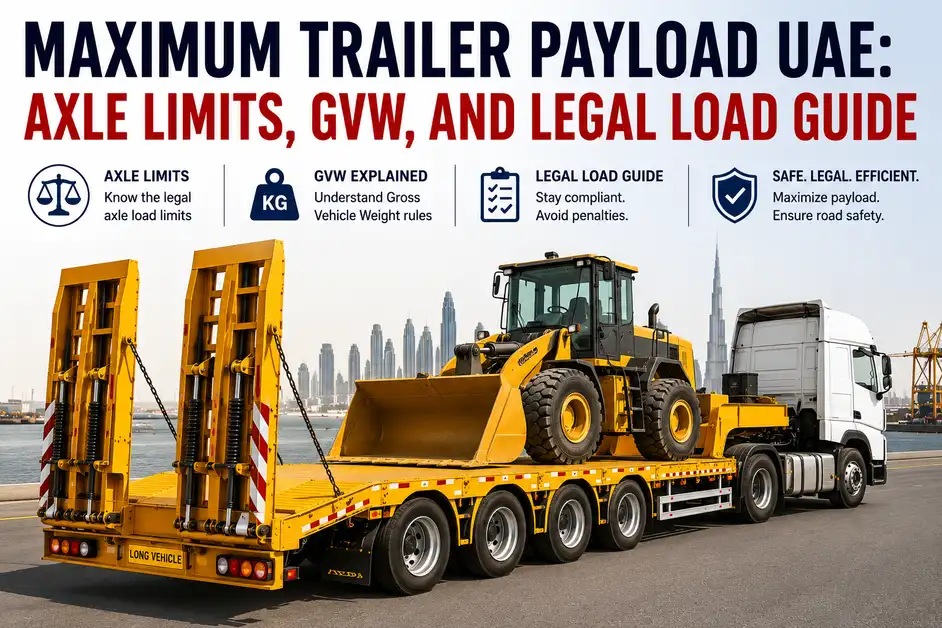
Maximum Trailer Payload UAE: Load Guide
Overloading a trailer by even a small margin can result in fines, vehicle impoundment, or worse, an accident caused by poor weight distribution.
Many fleet operators in the UAE underestimate how axle weight limits and gross vehicle weight rules apply to their specific trailer setup. This guide explains maximum trailer payload UAE concepts, how axle limits work, and how to stay compliant while maximizing your cargo capacity.
What Maximum Trailer Payload Means and How It Works
Maximum trailer payload refers to the total weight of cargo a trailer can legally and safely carry. This figure depends on several factors working together rather than a single fixed number.
Gross vehicle weight limit, often shortened to GVW, represents the total weight of the trailer plus its cargo, plus the weight of the prime mover in some calculations. This combined figure must stay within limits set by UAE transport authorities.
Axle weight limit UAE regulations specify how much weight each axle can bear. A trailer with more axles can often carry higher total weight because the load distributes across more points of contact with the road.
Axle spacing also matters. Wider spacing between axles allows for better weight distribution, which can affect how much weight each axle legally bears under the same total load.
Why Payload Limits Matter in 2026
The UAE enforces vehicle weight regulations to protect road infrastructure and ensure safety. According to the Roads and Transport Authority, vehicles exceeding weight limits face penalties and may be required to offload excess cargo before continuing.
Road damage from overloaded vehicles creates long term infrastructure costs. Heavier than permitted loads accelerate wear on road surfaces, particularly on highways connecting industrial areas to ports and construction sites.
Safety implications are significant. Overloaded trailers experience longer stopping distances and reduced stability, increasing accident risks especially during braking or cornering.
A trailer overload fine can also disrupt operations beyond the immediate penalty. Vehicles found overloaded may face delays while authorities arrange for excess cargo removal, affecting delivery schedules and project timelines.
Key Factors Affecting Payload Limits
Number of Axles
More axles generally allow for higher total payload because weight distributes across additional contact points. A trailer with two axles has different limits compared to one with three or four axles.
Axle Spacing
Greater axle spacing can affect how weight distributes along the trailer length. This spacing factors into calculations for both individual axle limits and overall gross vehicle weight limit compliance.
Trailer Type and Design
Different trailer types have different baseline capacities. A skeleton trailer designed for containers has different weight distribution characteristics compared to a tipper trailer carrying loose materials.
Load Distribution
How cargo sits on the trailer affects axle weight distribution even within the same total payload. Uneven loading can cause individual axles to exceed limits even if total weight stays within overall limits.
Trailer Type and General Capacity Considerations Table
| Trailer Type | Typical Axle Configuration | General Load Distribution Notes |
| Flatbed Trailer | Standard multi axle | Even distribution along deck length important |
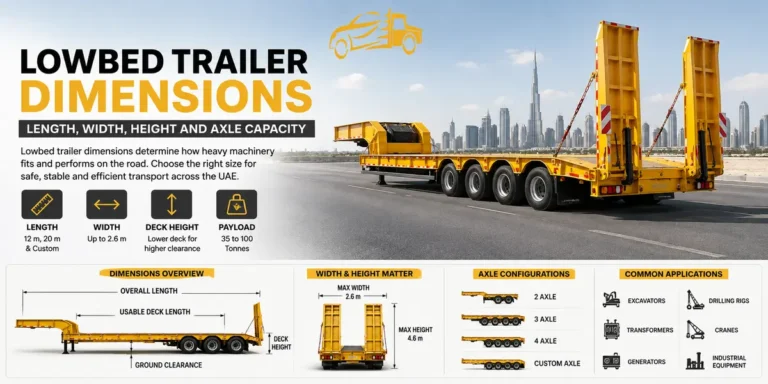
| Low-Bed Trailer | Multi axle, sometimes with buggy extension | Heavy machinery placement affects axle loading |
| Skeleton Trailer | Standard BP16T configuration | Container weight concentrated at twist lock points |
| Tipper Trailer | Multi axle depending on capacity | Load shifts during tipping affect distribution |
Always confirm exact axle weight limit UAE figures and gross vehicle weight limit values for your specific trailer configuration with relevant authorities, since these figures can vary and are subject to regulatory updates.
Step by Step Guide to Ensuring Legal Load Compliance
- Confirm your trailer’s specifications including axle count, axle spacing, and manufacturer rated capacity.
- Check current axle weight limit UAE regulations through official RTA or Federal Traffic Council UAE resources.
- Calculate your planned cargo weight and consider how it will distribute across the trailer deck.
- Use a weighbridge check before departure for loads close to maximum capacity limits.
- Adjust load positioning if weighbridge results show uneven axle weight distribution.
- Document weight checks for loads that operate near legal limits regularly.
- Train drivers and loading staff on proper load distribution practices for your trailer types.
Real World Scenario: Weighbridge Check Reveals Distribution Issue
A construction company transported precast concrete panels using a flatbed trailer rated for a specific total payload. The total cargo weight fell within the gross vehicle weight limit, but a weighbridge check revealed one axle exceeded its individual limit.
The issue stemmed from how the panels were positioned, concentrating weight toward the rear of the trailer. Repositioning the load redistributed weight more evenly across all axles, bringing each axle within its legal limit while keeping total weight unchanged.
This example shows why checking individual axle weights matters separately from total payload calculations. Staying within overall gross vehicle weight limit does not guarantee each axle meets its individual limit.
Common Mistakes to Avoid
Many operators focus only on total cargo weight without considering how that weight distributes across axles. A load within the overall gross vehicle weight limit can still result in individual axle violations.
Another mistake involves not accounting for the prime mover weight when calculating combined gross vehicle weight limit figures. Some calculations require including the towing vehicle weight alongside trailer and cargo weight.
Skipping weighbridge checks for loads close to maximum capacity is risky. Visual estimates of cargo weight are often inaccurate, especially for irregular shaped items like construction materials or machinery.
Some operators also assume all trailers of the same type have identical limits. Custom builds or modified trailers may have different rated capacities than standard models, even within the same trailer category.
Expert Tips and Best Practices
Always verify your specific trailer’s rated capacity documentation rather than relying on general assumptions about trailer types. Manufacturer specifications provide the most accurate baseline for your equipment.
Use weighbridge facilities for loads approaching maximum capacity, particularly for irregular cargo like machinery or construction materials where weight distribution is harder to estimate visually.
Train loading teams on how axle spacing affects weight distribution. Proper positioning of heavy items relative to axle locations helps maintain compliance even with challenging cargo shapes.
Keep documentation of weight checks for high value or frequently near limit loads. This record helps demonstrate compliance efforts if questions arise during inspections.
For trailers needing higher capacity for heavy machinery transport, our guide on low-bed trailer specifications covers axle configurations designed for heavier loads within legal limits.
Frequently Asked Questions
Q: What is the difference between payload and gross vehicle weight limit?
Payload refers to the cargo weight a trailer carries, while gross vehicle weight limit includes the trailer itself, cargo, and sometimes the prime mover combined. Both figures matter for compliance.
Q: How does axle weight limit UAE regulation affect how I load my trailer?
Axle weight limits specify maximum weight each axle can bear, separate from total cargo weight. Cargo positioning affects how weight distributes across axles, which can cause violations even within overall weight limits.
Q: What happens if my trailer exceeds the legal load limit UAE allows?
Overloaded trailers can face fines, and authorities may require offloading excess cargo before the vehicle continues. This creates both financial penalties and operational delays.
Q: How can I check if my trailer load meets axle weight requirements?
A weighbridge check measures actual weight distribution across each axle. This is the most reliable way to confirm compliance, especially for loads close to maximum capacity.
Q: Does axle spacing affect how much weight my trailer can carry?
Yes, axle spacing influences how weight distributes along the trailer. Different spacing configurations can affect individual axle weight limits even for trailers with the same total capacity rating.
Conclusion
Understanding maximum trailer payload UAE rules involves more than knowing a single weight figure. Axle weight limit UAE regulations, gross vehicle weight limit calculations, and load distribution all play roles in legal compliance.
Avoiding common mistakes like ignoring axle distribution or skipping weighbridge checks helps prevent trailer overload fine penalties and operational delays. Always verify current regulations through official sources and confirm your specific trailer’s rated capacity before planning heavy loads.
For trailers built with capacity and axle configurations suited to your cargo needs, explore our complete trailer range to find specifications matching your operational requirements.
For current and accurate weight limit regulations, consult the Roads and Transport Authority Dubai and the Federal Traffic Council UAE for official guidance on axle limits and legal load requirements.