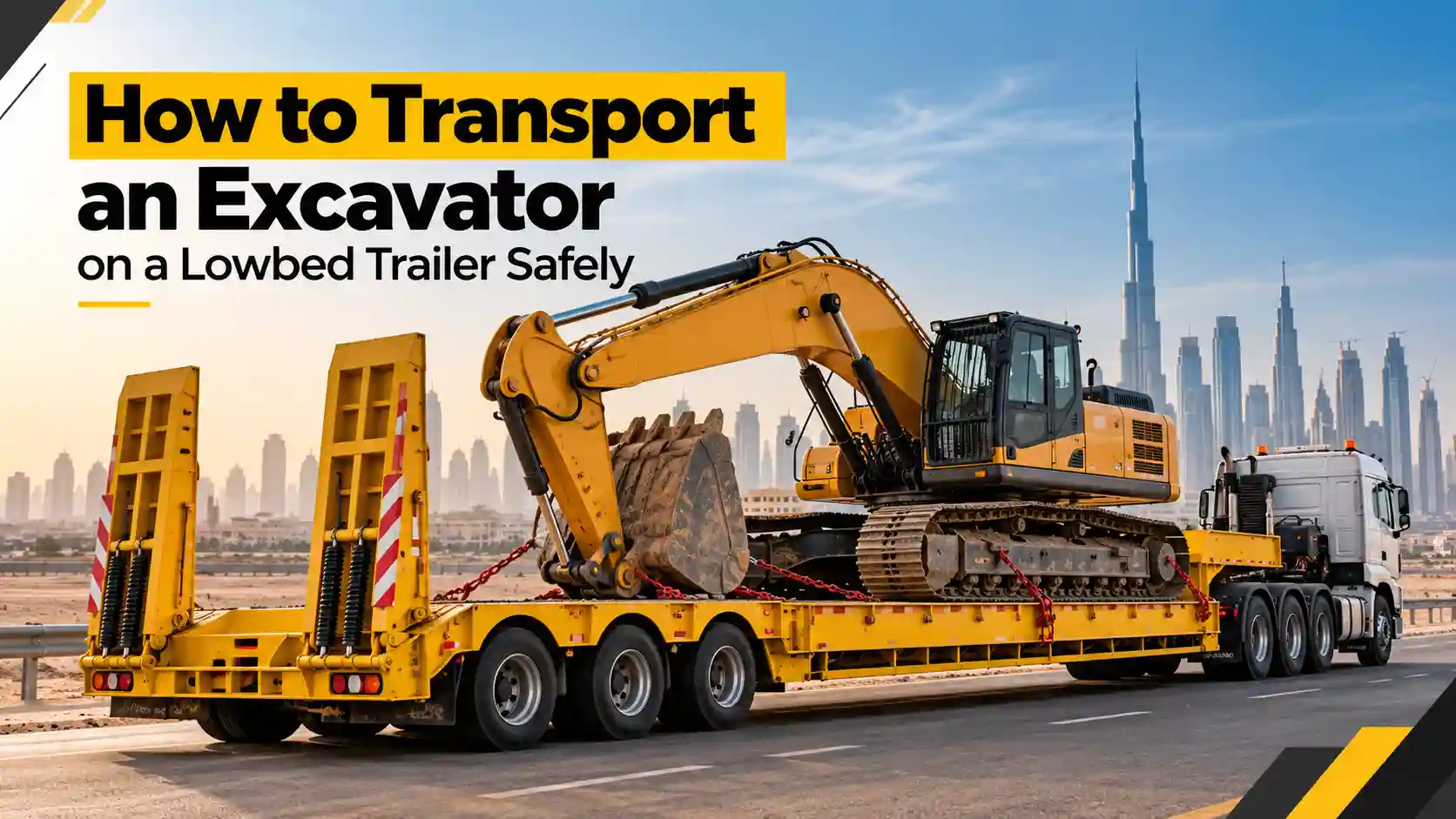
How to Transport an Excavator on a Lowbed Trailer Safely
Knowing how to transport an excavator safely is not simply a matter of finding a trailer with enough stated payload capacity. The excavator’s operating weight, dimensions, attachments, centre of gravity, trailer axle configuration, ramp geometry, route restrictions and load securement all affect whether the move can be completed safely and legally.
For construction companies, plant hire businesses and heavy transport operators in the UAE, a lowbed trailer is often the preferred solution because its lower deck helps reduce total transport height while providing a stable platform for tracked machinery.
This guide explains how to transport an excavator on a lowbed trailer from pre-loading checks to unloading, with particular attention to UAE operating conditions and heavy vehicle requirements.
Table of Contents
- Why lowbed trailers are used for excavator transport
- Check the excavator before selecting the trailer
- Match the lowbed trailer to the machine
- Plan the route and check UAE requirements
- Prepare the loading area
- Load the excavator safely
- Position and secure the excavator
- Complete a pre-trip inspection
- Drive and monitor the load
- Unload safely
- Common excavator transport mistakes
- Choosing a lowbed trailer for repeated excavator transport
Why Lowbed Trailers Are Used for Excavator Transport
Excavators combine high weight with significant height, concentrated mass and an uneven weight distribution caused by components such as the boom, bucket and counterweight. That makes trailer selection more complicated than matching the machine weight to a payload figure.
A lowbed trailer places the main deck lower than a conventional flatbed. The reduced deck height can lower the overall loaded height, which is important when planning routes around bridges, overhead structures and legal dimension limits. The low platform also helps keep the combined centre of gravity lower during excavator transport.
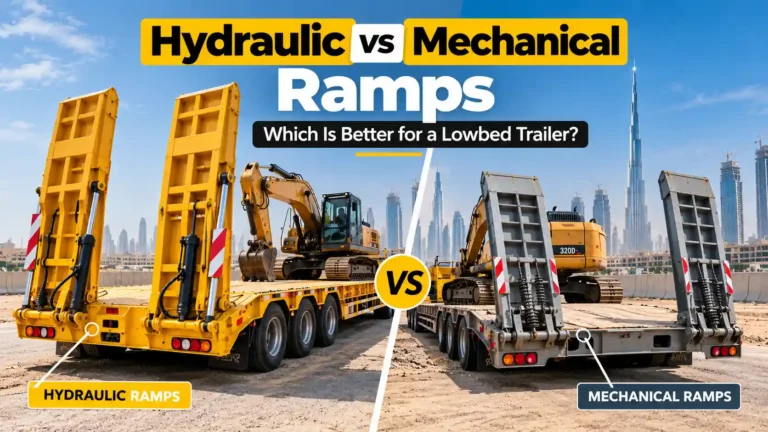
Lowbed trailers may also be configured with hydraulic or mechanical ramps, different axle layouts, deck lengths and load securing points according to the machinery being carried.
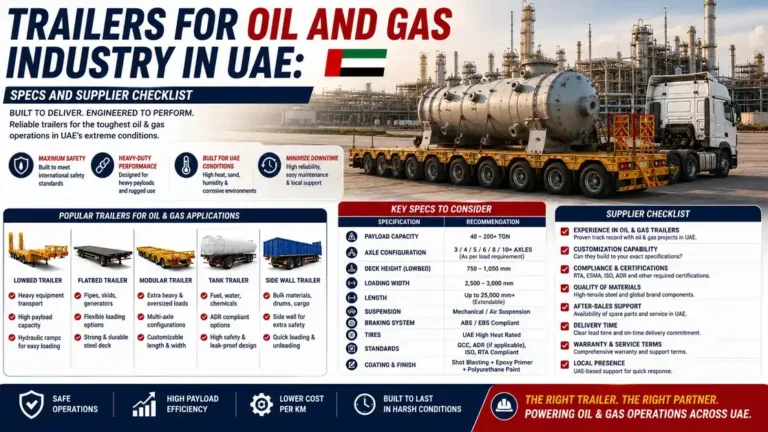
Golden Space manufactures lowbed trailers in the UAE for excavators, loaders, construction machinery and other heavy equipment, with configurations selected around payload and operating requirements.
1. How to Transport an Excavator: Check the Machine Before Selecting the Trailer
The first practical step in how to transport an excavator is to document the machine you actually intend to move.
Record:
- Operating or transport weight
- Overall width
- Transport length
- Transport height
- Track width and track length
- Weight of the bucket and other attachments
- Boom and arm transport position
- Manufacturer-designated tie-down points
Do not assume that the excavator model name tells you the final transport weight. Buckets, breakers, couplers, additional guarding and other attachments can change the total load.
Use the manufacturer’s operating manual and machine data plate where available. If attachments will travel on the same trailer, include them in the transport plan.
2. Match the Lowbed Trailer to the Excavator
The trailer should be selected around the whole transport configuration, not only the excavator’s nominal weight.
Payload Capacity
The trailer must have sufficient rated payload capacity for the machine and any attachments carried on it. Operating above the trailer’s approved capacity can overload the frame, axles, tyres, suspension and braking system.
Axle Configuration and Load Distribution
A heavier excavator may require additional axles or a different axle arrangement to distribute the load appropriately. Positioning matters because moving the excavator forward or backward on the deck changes the load transferred to the tractor and trailer axle groups.
This is why stated payload capacity alone is not enough to determine whether a trailer is suitable. Current UAE federal rules also set maximum permissible gross and axle weights according to vehicle and axle configuration.
Deck Height
A lower deck helps reduce total loaded height. Before departure, calculate the complete transport height with the excavator positioned as it will travel.
Deck Dimensions
The deck must accommodate the excavator’s tracks and transport length without unsafe overhang or positioning.
Ramp Design
Check ramp width, load rating, approach angle and compatibility with the machine’s ground clearance. Hydraulic ramps can make repeated loading easier, but the correct design depends on the excavator and operating environment.
For businesses comparing configurations, Golden Space’s lowbed trailer range provides a useful starting point for discussing deck length, payload, axle and ramp requirements.
3. How to Transport an Excavator on UAE Roads: Plan the Route First
Route planning should happen before loading.
The UAE regulates heavy vehicle weights, axle loads and dimensions. The Ministry of Energy and Infrastructure publishes maximum weights and dimensions under the federal framework, while local authorities may also control routes, operating times and permit requirements.
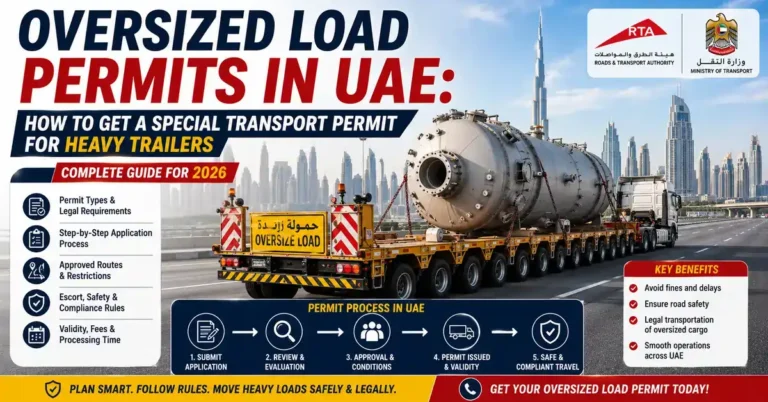
Under the federal dimensions published for heavy vehicles, a truck head and semi-trailer has maximum standard dimensions of 21 metres overall length, 2.6 metres width and 4.6 metres height. The same federal framework allows exceptional transport of certain non-divisible loads above standard limits where a special transportation permit is obtained from the relevant authority.
Before moving an excavator, confirm:
- Total vehicle and load weight
- Axle load distribution
- Overall loaded height, width and length
- Bridge and overhead clearances
- Road restrictions
- Heavy vehicle operating times
- Permit requirements for overweight or over-dimension transport
- Suitable loading and unloading access at both sites
In Dubai, RTA operates permit systems covering certain heavy vehicle movements, including restricted roads and operating times. Requirements depend on the specific vehicle and route, so operators should confirm the current rules for the actual journey rather than relying on a previous move.
4. Prepare the Loading Area
A safe loading area should be firm, level and clear of unnecessary traffic and pedestrians.
Before loading:
- Park the tractor and trailer in a straight line where possible.
- Apply the parking brake.
- Stabilise the combination according to the trailer manufacturer’s instructions.
- Check that ramps are fully deployed, locked and aligned with the tracks.
- Inspect the deck for oil, mud, loose material or damage.
- Keep people who are not involved in loading outside the work area.
- Check for overhead power lines or other obstructions.
- Use a competent spotter where visibility or alignment requires assistance.
Official workplace transport guidance recommends firm, level ground for loading and unloading because uneven surfaces can affect trailer stability. OSHA guidance for transporting equipment also recommends level loading surfaces and the use of a spotter positioned at a safe distance where appropriate.
5. How to Load an Excavator on a Trailer
Anyone learning how to transport an excavator should treat loading as one of the highest-risk stages of the job.
Only a trained and competent operator should drive the excavator onto the trailer.
Approach the ramps slowly and squarely. The tracks should remain aligned with the ramp surfaces. Avoid sudden steering corrections, sharp turns or unnecessary slewing while the machine is climbing.
Travel at low speed and follow the excavator manufacturer’s instructions for ramp loading. The machine’s orientation can depend on ramp angle and manufacturer procedure, so do not apply one loading orientation to every excavator model.
Manufacturer guidance for compact excavators commonly calls for firm, level ground, properly rated ramps, slow travel and correct machine alignment during loading.
A spotter can help the operator maintain alignment, but the spotter should remain in a safe location where they cannot be trapped between the excavator, trailer or surrounding objects.
Once the tracks reach the deck, continue slowly into the planned transport position.
6. Position the Excavator for Stable Weight Distribution
The excavator should normally be centred laterally on the trailer unless the engineered transport plan specifies otherwise.
Longitudinal position is equally important. Too much weight over the rear axle group can overload trailer axles, while moving the machine too far forward can transfer excessive load toward the tractor.
The final position should account for:
- Axle load limits
- Tractor fifth-wheel loading
- Excavator centre of gravity
- Counterweight position
- Boom and attachment position
- Required tie-down geometry
Do not reposition a heavy excavator based on appearance alone. For large machines, axle load calculations should be part of the transport planning process.
This is one of the areas where the correct lowbed trailer for excavator transport must be selected as a complete configuration rather than by payload figure alone.
7. How to Secure an Excavator on a Trailer
Correct securement is central to how to transport an excavator safely.
Once the excavator is in its transport position:
- Lower the boom, arm and bucket or attachment into the manufacturer-recommended transport position.
- Shut down the machine.
- Apply the parking brake or relevant machine securing controls.
- Remove loose items from the cab, deck and machine.
- Use the excavator’s designated transport tie-down points.
- Connect appropriately rated chains, binders or other approved securing equipment to suitable trailer anchor points.
- Tension the restraints so the machine cannot move forward, backward or sideways during braking, acceleration, cornering or road vibration.
- Secure attachments separately where required by the machine manufacturer or applicable transport rules.
- Check that chains and binders cannot contact sharp edges or components in a way that could damage them.
Do not attach transport chains to convenient but unapproved machine parts such as hydraulic cylinders, bucket pins or other components unless the manufacturer specifically identifies them as securement points.
Manufacturer guidance typically identifies dedicated tie-down locations for excavators, while general equipment transport guidance stresses that securing devices must be appropriate for the load being carried.
There is no responsible universal chain count or chain rating that can be prescribed for every excavator. The required number, working load limit and arrangement depend on machine weight, anchor-point ratings, securement equipment, applicable standards and local rules.
8. Complete a Pre-Trip Inspection
Before entering the road, perform a complete walk-around inspection.
Check:
- Chains, binders and tie-down points
- Excavator position
- Boom and attachment position
- Trailer tyres and tyre condition
- Wheel and hub condition
- Suspension
- Brakes
- Hydraulic ramps
- Kingpin and fifth-wheel connection
- Lights and indicators
- Side and rear reflectors
- Registration and required permits
- Overall dimensions and clearances
Dubai RTA highlighted worn tyres, defective rear and side lights, missing reflective markings and unsafe vehicle loading during its 2026 trailer safety campaign. It also emphasised trailer licensing, registration and valid professional permits for drivers.
RTA technical requirements also specify functioning trailer lighting, side marker lights and reflectors for relevant trailers and semi-trailers.
If anything has shifted during final positioning or securement, correct it before departure.
9. Drive for the Load, Not for an Empty Trailer
A loaded lowbed behaves differently from an empty trailer.
Allow more space for braking and lane changes. Accelerate smoothly, avoid abrupt steering inputs and approach bends conservatively. Drivers should account for the combined vehicle length, weight, turning radius and route conditions.
Road shocks, braking and cornering can affect tie-down tension. Follow the transport company’s inspection procedure and applicable requirements for checking the load during the journey.
If a chain loosens, a binder moves, the excavator shifts or the trailer shows an abnormal lean, stop in a safe location and investigate before continuing.
RTA heavy vehicle guidance stresses checking that loads are well packed, evenly distributed and securely lashed because shifting loads can create serious hazards.
10. How to Unload an Excavator Safely
The destination should be checked before the trailer arrives.
Choose a firm, level unloading area with enough space for the ramps, excavator and support personnel. Keep pedestrians and unrelated vehicles outside the work zone.
Before releasing the securement system, confirm that the trailer is stable and the machine cannot move unexpectedly.
Remove restraints according to the planned unloading sequence. Start the excavator, prepare it according to the manufacturer’s instructions and reverse the loading procedure slowly.
Keep the tracks aligned with the ramps and avoid sudden steering. Once the excavator is completely clear of the trailer, move it to a safe position before folding or raising the ramps.
Common Excavator Transport Mistakes
Choosing a Trailer Only by Tonnage
Payload rating matters, but deck dimensions, axle distribution, loaded height, ramps and securing points also determine suitability.
Ignoring Attachment Weight
Buckets, breakers and couplers add weight and can change the centre of gravity.
Loading on Sloping or Weak Ground
A poor loading surface can destabilise the trailer or alter the effective ramp angle.
Turning Sharply on the Trailer Deck
Tracked equipment can create substantial lateral forces when turning on a deck. Align the excavator before climbing whenever possible.
Guessing Tie-Down Locations
Use manufacturer-designated securing points rather than attaching chains to whichever component is convenient.
Ignoring Total Transport Height
The machine may fit the trailer but still exceed a route clearance or applicable dimension limit.
Skipping Route Planning
A legally acceptable load can still encounter restricted roads, bridges, tight turns or local heavy vehicle timing rules.
Assuming the Previous Transport Plan Still Applies
Different attachments, excavator models, trailers and routes can change the requirements.
Choosing a Lowbed Trailer for Regular Excavator Transport
Companies that move excavators frequently should specify the trailer around their normal machinery fleet rather than buying only for one maximum payload figure.
Useful questions include:
- What are the lightest and heaviest excavators you move?
- What track widths must the deck accommodate?
- Which attachments normally travel with the machines?
- What deck height is required for your routes?
- How many axles are appropriate for expected loads?
- Are hydraulic ramps needed?
- Where should lashing points be located?
- Will the trailer regularly operate in Dubai, Sharjah, Abu Dhabi or across the GCC?
- Are custom deck dimensions required?
Golden Space manufactures lowbed trailers at its Al Sajaa facility in Sharjah and can configure payload, deck length, axle arrangement and other features around the intended machinery transport application. Its current lowbed range covers heavy machinery transport applications across the UAE.
For fleets that carry a wider range of equipment and general cargo, Golden Space’s complete trailer range can also help operators compare lowbed, flatbed and other trailer configurations.
How to Transport an Excavator Safely: Final Checklist
A reliable answer to how to transport an excavator safely should end with a documented final check. Before departure, confirm all of the following:
- Excavator weight and dimensions verified
- Trailer capacity verified
- Axle distribution checked
- Deck size suitable
- Ramps rated and correctly positioned
- Loading area firm and level
- Excavator centred and correctly positioned
- Boom and attachment placed in transport position
- Approved tie-down points used
- Chains and binders correctly rated and tensioned
- Loose components secured
- Tyres, brakes, lights and reflectors inspected
- Loaded height, width and length checked
- Route restrictions reviewed
- Required permits obtained
- Final walk-around completed
Frequently Asked Questions
What Type of Trailer Is Best for Transporting an Excavator?
A lowbed trailer is commonly used for medium and heavy excavators because its lower main deck helps reduce total transport height and provides a stable platform for heavy machinery. The correct configuration depends on the excavator’s weight, dimensions, axle load distribution, route and loading method.
How Do You Load an Excavator Onto a Lowbed Trailer?
Park the trailer on firm, level ground, deploy and secure correctly rated ramps, align the excavator with the ramps and drive slowly onto the deck using the manufacturer’s prescribed loading procedure. A competent spotter can assist with alignment where needed.
How Should an Excavator Be Secured for Transport?
Use the manufacturer-designated tie-down points and appropriately rated load-securement equipment connected to suitable trailer anchors. The exact chain count, ratings and layout should be determined from the machine weight, securement points, equipment ratings and applicable transport requirements.
Can an Excavator Be Transported With the Bucket Attached?
Often yes, provided the excavator manufacturer permits the configuration and the attachment can be positioned and secured correctly without causing weight, dimension or clearance problems. The attachment weight must be included in the transport calculation.
Do I Need a Permit to Transport an Excavator in the UAE?
Not every excavator movement requires a special permit. Permit requirements depend on the vehicle, load dimensions, weights and route. Oversized, overweight or non-divisible loads can require approval from the relevant authority. Operators should check the requirements for the exact route before departure. UAE federal rules provide for special transportation permits for qualifying non-divisible loads that exceed normal limits.