40ft Skeleton Trailer: Features, Dimensions and Compatibility
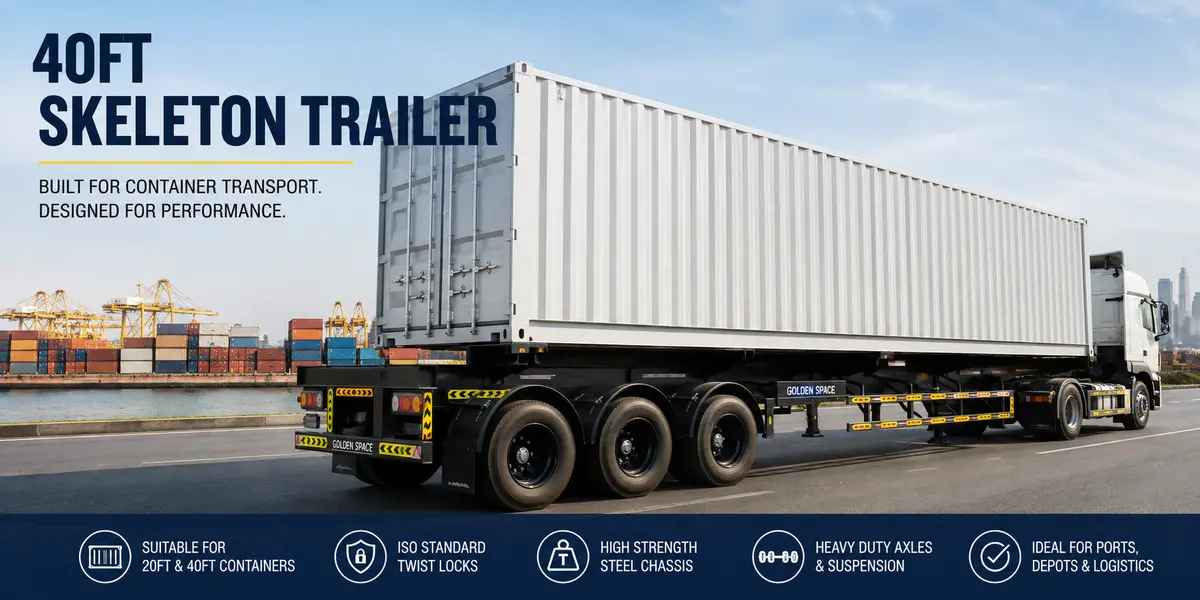
A 40ft skeleton trailer is an open-frame semi-trailer designed to transport ISO shipping containers. Unlike a flatbed, it does not use a full cargo deck. The chassis supports the container through dedicated locking points around its corner castings.
This design suits container movements between ports, depots, warehouses, free zones, and industrial facilities. It is especially useful for businesses that move containers regularly and need a trailer built around container handling rather than general cargo.
For businesses handling 20ft and 40ft containers, a Skeleton Trailer provides a purpose-built solution for regular container transport. Golden Space manufactures these trailers in Sharjah for UAE logistics and container-handling applications.
For UAE operators, choosing the right 40ft chassis involves more than trailer length. Container compatibility, axle arrangement, load distribution, dimensions, braking, suspension, and road requirements all need to be considered.
What Is a 40ft Skeleton Trailer?
A 40ft skeleton trailer, also called a skeletal trailer or container chassis, is designed specifically for shipping containers. Its open structure supports the container while leaving most of the area beneath it open.
The container sits on designated support and locking positions. Twist locks connect these points with the container’s corner castings. This creates a dedicated connection between the container and the trailer.
The design is useful for regular port and depot operations because containers can be loaded using cranes, reach stackers, or other suitable handling equipment.
A skeleton trailer is different from a general-purpose flatbed. A flatbed provides a continuous deck for many cargo types, while a skeleton trailer is built around container dimensions and locking positions.
Key Features of a 40ft Skeleton Trailer
Open Chassis Design
The open chassis is the most visible feature of a skeleton trailer. It uses a structural frame instead of a full deck.
This makes the trailer purpose-built for container transportation. The frame supports the required container positions while keeping the design focused on intermodal transport.
The chassis still needs sufficient structural strength for its intended load. Frame members, cross-members, supports, and locking locations work together as part of the complete design.
Twist-Lock System
Twist locks connect the container to the chassis. They engage with the corner castings found on standard shipping containers.
The locking layout must match the container positions supported by the trailer. Operators should confirm that the required locks are fully engaged before moving the loaded unit.
Golden Space states that its skeleton trailers use ISO-standard twist-lock positions for standard 20ft and 40ft containers.
Axles and Suspension
Axle configuration affects how the trailer carries and distributes weight. Suspension also influences how the chassis responds to the road and carried load.
Golden Space publishes BP 16-ton axle configurations for 35-ton operations and Buggy 32-ton axle configurations for 50-ton operations. These are configuration-specific figures, not universal ratings for every 40ft skeleton trailer.
The final axle arrangement should be selected according to the trailer specification, load requirements, and applicable road limits.
Kingpin and Landing Gear
The kingpin connects the semi-trailer to the tractor unit. Landing gear supports the front of the trailer when it is disconnected.
Both components need to suit the towing combination and chassis design.
Braking and Lighting
A commercial skeleton trailer also requires suitable braking and electrical systems.
The exact configuration can vary according to the trailer specification and operating requirements. Buyers should confirm the braking system, lighting arrangement, connectors, and other relevant components before ordering.
40ft Trailer Dimensions Explained
Searches for 40ft trailer dimensions can be confusing because the container length and trailer dimensions are not the same thing.
A 40ft container has a nominal container length of 40 feet. The complete trailer still has its own overall length, width, height, axle position, kingpin arrangement, and rear structure.
Overall Trailer Length
The chassis needs to position the container correctly over its locking points. The overall road length can therefore differ from the container’s nominal length.
The final measurement depends on the trailer design and tractor connection.
Width and Height
Trailer width affects road clearance and legal operation. Height becomes particularly important after the container is loaded.
The total combination height depends on the trailer, container, tyres, suspension, and loading arrangement. Operators should confirm the complete vehicle dimensions rather than relying on a generic online figure.
UAE Dimension Requirements
UAE legislation regulates heavy-vehicle dimensions and weights. Cabinet Resolution No. 138 of 2023 lists a maximum overall length of 21 metres for trailers and semi-trailers, with a maximum width of 2.6 metres and height of 4.6 metres for the listed category.
These are regulatory limits for the relevant vehicle category, not a claim about the dimensions of every 40ft skeleton trailer. The manufacturer’s approved specification should be checked before registration and deployment.
40ft Skeleton Trailer Capacity
There is no single payload figure that applies to every 40ft skeleton trailer.
Capacity depends on the chassis design, axle configuration, approved weights, suspension, tractor combination, and applicable road limits.
Golden Space currently publishes 35-ton and 50-ton axle-related configurations for its skeleton trailer range.
This should not be interpreted as a universal payload rating. The permitted operating weight depends on the complete vehicle configuration.
UAE federal requirements also distinguish total vehicle weight from axle weight. Heavy-vehicle operators must remain within the applicable limits and distribute loads correctly.
Which Containers Can a 40ft Skeleton Trailer Carry?
Container compatibility depends on the chassis configuration and its locking positions.
40ft Containers
A suitable 40ft chassis is designed around the corner positions of a 40ft ISO container.
Golden Space states that its standard skeleton trailers support 40ft ISO shipping containers.
20ft Containers
Some 40ft-capable skeleton configurations can also support 20ft containers. The available locking points determine how the container is positioned.
A buyer should confirm the exact configuration rather than assuming that every 40ft chassis supports every 20ft arrangement.
Two 20ft Containers
Carrying two 20ft containers requires suitable locking positions at both container locations.
This arrangement also changes how weight is distributed across the chassis. For this reason, operators should confirm compatibility and load limits with the manufacturer before using a dual-20ft configuration.
How Do Twist Locks Secure a Container?
Twist locks are one of the most important components on a container chassis.
The container’s corner castings are positioned over the trailer’s locking points. The twist locks then engage with those castings to hold the container in place.
Before departure, the operator should verify that the container is correctly seated and that every required locking point has engaged properly.
The locking system should also be inspected for visible damage, abnormal movement, or other issues before use.
Good locking practice does not replace correct load distribution. The complete loaded combination still needs to remain within the applicable weight and dimensional limits.
Applications of a 40ft Skeleton Trailer
A 40ft skeleton trailer is designed for recurring container movements.
Common applications include:
- Port and terminal transport
- Container depots
- Warehouse transfers
- Freight forwarding
- Free-zone logistics
- Industrial container movements
For UAE businesses, the trailer can support container movements between ports, logistics hubs, warehouses, and industrial areas.
Golden Space identifies applications around major UAE container routes, including Jebel Ali, Khalifa Port, Hamriyah Port, free zones, warehouses, and inland depots.
Businesses that need broader cargo flexibility can compare the application with a Flatbed Trailer, which provides a full open deck for general cargo.
40ft Skeleton Trailer for UAE Container Transport
UAE container operations require a trailer that works with both the cargo and the surrounding transport network.
A fleet may move containers from a port to a warehouse, between logistics facilities, or from a depot to an industrial site. Each movement can involve different loading areas, traffic conditions, and operational requirements.
This makes trailer specification important.
Businesses should consider container size, expected weights, tractor compatibility, road dimensions, axle configuration, suspension, locking positions, and maintenance requirements before ordering.
Golden Space manufactures skeleton trailers in Al Sajaa Industrial Area, Sharjah, for container transport across the UAE. Its published product information lists standard 20ft and 40ft sizes and custom configurations.
At this stage of the buying process, companies can also review the Trailer manufacturer in UAE when comparing local manufacturing capability, custom configurations, and product options.
40ft Skeleton Trailer Specifications
The following table shows the published Golden Space information relevant to this trailer category.
| Specification | Details |
| Container sizes | 20ft and 40ft |
| Standard length options | 20ft and 40ft |
| Custom size | Available |
| Axle options | BP 16T / Buggy 32T |
| Published axle-related capacity | 35-ton / 50-ton |
| Chassis | Open structural frame |
| Container locking | ISO-standard twist-lock positions |
| Manufacturing location | Al Sajaa Industrial Area, Sharjah |
Exact road dimensions, braking equipment, suspension configuration, and other component details should be confirmed for the selected build rather than assumed from another model.
40ft Skeleton Trailer vs Flatbed Trailer
A skeleton trailer is purpose-built for ISO containers. Its chassis includes dedicated container locking positions and does not require a full cargo deck.
A flatbed trailer has a continuous deck and can carry a wider range of cargo, including steel, machinery, construction materials, and fabricated components.
For a fleet focused mainly on container movements, a skeleton configuration is more specific to that task. A business carrying mixed cargo may gain more flexibility from a flatbed.
The right choice depends on the type of work the trailer performs most often.
What to Check Before Buying a 40ft Skeleton Trailer
A 40ft skeleton trailer for sale should be evaluated by its complete specification rather than its advertised length alone.
First, confirm the container sizes your fleet handles. Then check the twist-lock layout and whether the chassis supports the intended container arrangement.
Next, review axle configuration, suspension, braking, kingpin, landing gear, and overall dimensions.
The towing tractor must also be compatible with the chosen trailer. Weight and axle loading should be reviewed as part of the complete tractor-trailer combination.
For UAE operations, verify the applicable road and registration requirements before finalizing the build. The UAE’s current heavy-vehicle regulations specify limits for total and axle weights and overall dimensions.
40ft Skeleton Trailer Price: What Affects the Cost?
The 40ft skeleton trailer price varies according to its specification.
Axle configuration is one factor. Suspension, braking equipment, twist-lock arrangements, structural design, materials, and customization can also influence the final cost.
A standard chassis may have a different price from a configuration designed for a specific container mix or operating requirement.
Buyers should therefore compare complete specifications rather than choosing the lowest quoted figure.
This approach makes it easier to assess the trailer’s suitability over its working life.
New vs Used 40ft Skeleton Trailer
A 40ft skeleton trailer used can appear attractive when purchase cost is the main concern. However, condition and compatibility need careful inspection.
The frame should be checked for cracks, deformation, corrosion, and previous repairs. Twist locks, suspension, axles, brakes, landing gear, tyres, and lighting should also be inspected.
A used trailer may require refurbishment before regular container work. The cost of repairs should be considered alongside the purchase price.
A new trailer can be a better fit when the fleet needs a specific locking arrangement, axle configuration, dimensions, or custom build.
40ft Skeleton Trailer for Sale in the UAE
When comparing a 40ft skeleton trailer for sale, ask for the full technical specification.
The supplier should be able to explain container compatibility, dimensions, axle configuration, suspension, braking, locking positions, and the intended operating application.
Local manufacturing can also make specification discussions easier when custom requirements are involved.
For companies that need a container chassis designed around their operations, Golden Space provides standard and custom skeleton trailer configurations from its Sharjah facility.
Choosing the Right 40ft Skeleton Trailer Configuration
The best 40ft skeleton trailer is the one that matches the containers, routes, loads, and towing equipment used by the fleet.
Start with the container sizes. Then confirm the locking arrangement, expected operating weight, axle configuration, suspension, braking system, dimensions, and tractor compatibility.
Do not treat a manufacturer’s advertised capacity as a universal figure. The final permitted weight depends on the approved configuration and applicable regulations.
For UAE logistics companies, a purpose-built chassis can also simplify recurring container operations because its design is centered around the loads being moved.
A careful specification process helps avoid paying for features the fleet does not need while ensuring that essential equipment is included.
Frequently Asked Questions
Can a container chassis be used for both port and inland transport?
Yes, a suitable skeleton trailer can be used across different parts of a container logistics chain. The configuration must still suit the route, towing vehicle, container type, and applicable weight limits.
Does container type affect which chassis configuration is needed?
It can. Container length and placement affect the required locking positions. Businesses should confirm the chassis layout for the specific container combinations they plan to transport.
What maintenance areas are most important on a skeleton trailer?
Regular attention should be given to the frame, twist locks, axles, suspension, brakes, tyres, landing gear, and lighting. Inspection frequency should follow the manufacturer’s recommendations and operating conditions.
Can a 40ft skeleton trailer be built for a company’s specific fleet requirements?
Yes. Customization can address container positions, axle arrangements, dimensions, and other application requirements. The final design should be developed from the fleet’s actual operating needs.
Is a skeleton trailer suitable for cargo other than shipping containers?
Its primary purpose is container transport. Businesses carrying steel, machinery, or other general cargo may be better served by a flatbed or another trailer designed for that application.