Tipper Trailer Specifications: Dimensions, Parts and Compatibility
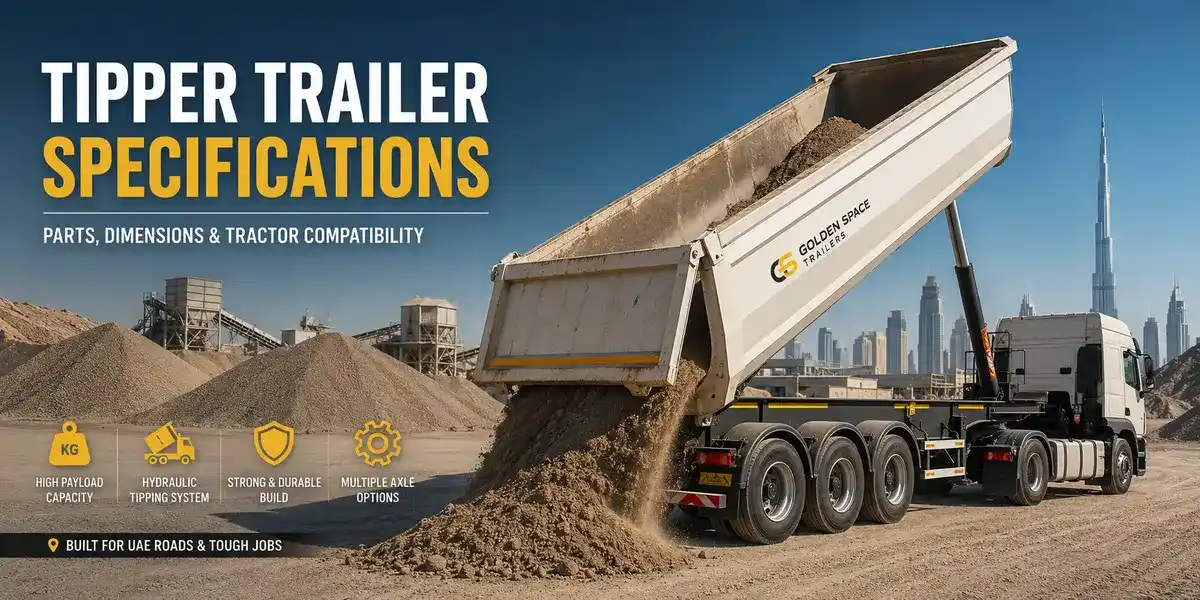
A tipper trailer is a semi-trailer designed to carry loose materials and unload them using hydraulic tipping. The body lifts from the front, allowing material to move toward the rear through gravity. This makes tipper trailers useful for construction, quarrying, aggregate transport, land development, and similar operations.
The right specification depends on payload, body volume, axle arrangement, hydraulic equipment, and tractor compatibility. Dimensions also matter when operating around construction sites, industrial areas, and public roads. UAE operators should consider applicable weight and dimensional requirements before selecting a trailer.
Businesses handling bulk materials can see the Tipper Trailer for standard and custom configurations. Its published options include 35-ton, 50-ton, and 80-ton payloads, with different axle configurations for various applications.
Tipper Trailer Specifications at a Glance
Tipper trailer specifications vary because each configuration serves a particular load and operating requirement. Important specifications include payload, body construction, axle arrangement, tipping system, suspension, braking, and dimensions. The table below summarizes the currently published Golden Space range.
| Specification | Available Configuration |
| Payload options | 35T, 50T, 80T |
| Axle options | BP 16T, Bogie 32T |
| Body construction | Reinforced structural steel |
| Tipping system | Hydraulic front lift |
| Discharge | Rear gravity discharge |
| Typical cargo | Sand, gravel, aggregate, fill, quarry material, debris |
| Build options | Standard and custom |
These figures describe published Golden Space configurations and are not universal industry standards. Final dimensions and equipment can vary between individual builds. Buyers should confirm the approved specification before production.
Tipper Trailer Dimensions
There is no single standard size for every tipper trailer. Dimensions depend on body design, payload, axle configuration, suspension, chassis arrangement, and customer requirements. Generic measurements should therefore never replace the manufacturer’s final technical drawing.
Overall Dimensions
Overall length affects maneuverability, turning space, and the complete tractor-trailer combination. Width influences road clearance and working space at construction or industrial sites. Height becomes important near bridges, facility entrances, and restricted areas.
The loaded vehicle should be assessed as a complete combination. The body, suspension, tyres, chassis, and cargo can all affect the final operating height. UAE businesses should verify the final approved dimensions before deployment.
Tipper Body Dimensions
Body length, width, and height determine available carrying volume. However, volume alone does not determine payload because different materials have different densities. Dense gravel can reach its permitted weight before the body is completely filled.
Body design should therefore match the material, loading method, expected payload, and operating frequency. A larger body is not automatically better for every application. The final dimensions should reflect the work the trailer will perform.
Tipper Trailer Parts and Components
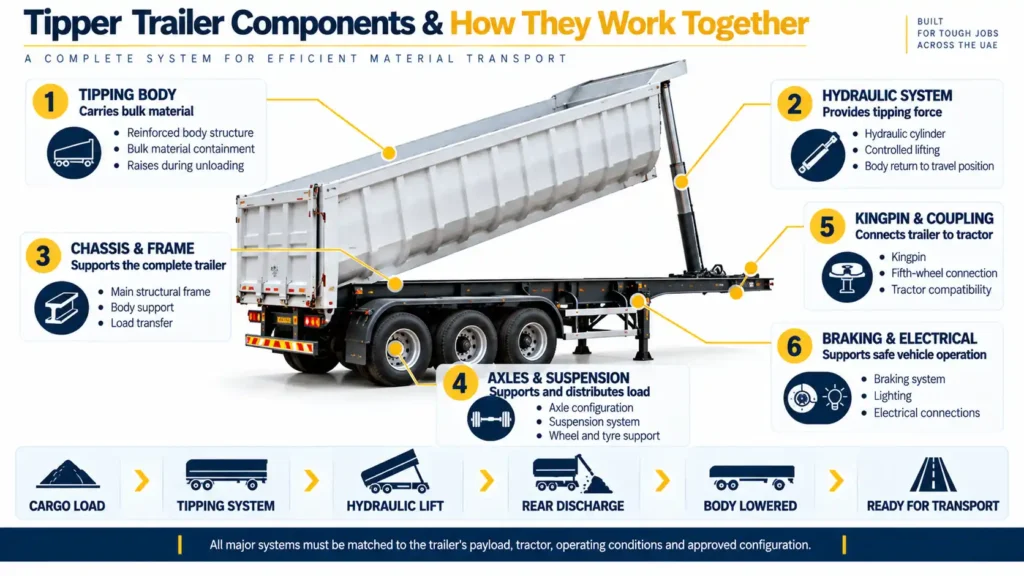
A tipper trailer contains several systems that must operate together. Understanding the main components helps buyers compare specifications and identify important features. The major parts include the tipping body, chassis, hydraulic system, running gear, coupling equipment, brakes, and electrical components.
Tipping Body
The tipping body carries material during transport and rises during unloading. Its construction should suit the cargo and expected loading conditions. Abrasive materials may require reinforced construction for repeated heavy-duty use.
Golden Space states that its tipper bodies use reinforced steel for materials such as aggregate, gravel, quarry products, and construction debris. The final body configuration should still match the selected application.
Chassis and Frame
The chassis supports the tipping body, axles, suspension, and related systems. It also transfers loads between the body and running gear during transport. Structural design must account for repeated loading, tipping, and road movement.
Accurate fabrication is important because later components depend on the completed frame. Alignment problems can affect suspension, axle installation, body positioning, and final assembly. Engineering should therefore precede fabrication.
Hydraulic System
The hydraulic system provides the force needed to raise and lower the tipping body. Its cylinder, connections, controls, and power source must suit the body and operating requirements. The system should allow controlled movement during tipping and return.
Golden Space publishes a hydraulic front-lift system with rear gravity discharge. Exact hydraulic requirements can vary according to the selected configuration and customer needs.
Axles and Suspension
Axles transfer trailer loads through the wheels and tyres. Suspension helps manage road movement and supports the trailer during operation. The selected arrangement should suit the expected load and applicable axle limits.
Golden Space publishes BP 16-ton and Bogie 32-ton axle options within its tipper range. The suitable configuration depends on payload, tractor combination, and operating requirements.
Kingpin, Brakes and Electrical Systems
The kingpin connects the semi-trailer to the tractor’s fifth wheel. Braking and electrical systems allow the trailer to work with the towing vehicle. These systems must match the complete tractor-trailer configuration.
Exact technical requirements can vary between builds. Buyers should confirm coupling, brake, electrical, and control requirements before production. This avoids compatibility problems after delivery.
How Does a Tipper Trailer Work?
The tipping process begins when the trailer reaches a suitable unloading point. The tractor and trailer should be positioned safely before the hydraulic system is activated. The unloading area should provide enough stability and clearance for the body.
The hydraulic system raises the front of the body during unloading. As the body angle increases, gravity moves material toward the rear discharge point. The operator should follow the manufacturer’s operating procedure throughout the cycle.
After discharge, the hydraulic system lowers the body into its travel position. The operator should confirm that the body is fully lowered before moving. Golden Space states that its hydraulic tipping system can unload in under two minutes, although actual time varies by conditions.
Tipper Trailer Capacity and Load Distribution
Payload and body volume are different measurements. Body volume determines how much material can physically fit, while density determines its weight. A large body can therefore reach its weight limit before it is completely full.
Axle arrangement also influences load distribution. The complete tractor and trailer combination must remain within applicable total and axle limits. Golden Space publishes 35-ton, 50-ton, and 80-ton payload configurations.
The correct option depends on cargo density, route conditions, legal limits, loading frequency, and tractor capacity. A higher published capacity does not automatically make a trailer suitable for every operation. Buyers should evaluate the complete application before choosing the payload.
Tipper Trailer and Tractor Compatibility
A tipper trailer and tractor need to function as one complete system. The kingpin, fifth wheel, brakes, electrical connections, hydraulic equipment, and weight ratings all influence compatibility. These factors should be evaluated before the trailer specification is finalized.
The tractor must provide suitable hydraulic support when the tipping system requires it. Brake and electrical systems should also match the trailer’s connections and controls. The tractor must have sufficient capacity for the intended trailer and loaded cargo.
UAE operators should check applicable total and axle limits before deciding on a payload configuration. The approved vehicle specification should remain the main technical reference.
2 Axle Trailer vs Multi-Axle Tipper Trailer
A 2 axle trailer uses fewer axles than a multi-axle configuration. This can influence load distribution, maneuverability, and permitted operating weight. The correct choice depends on the application rather than axle count alone.
Multi-axle configurations can distribute loads across additional wheel positions. They may suit heavier applications when the tractor, route, trailer, and legal limits support the arrangement. More axles do not automatically provide better performance.
Fleet operators should compare payload, route conditions, tractor capacity, and legal requirements. The final axle arrangement should follow the manufacturer’s engineering specification.
Tipper Trailer Design Considerations
Tipper trailer design begins with the material and unloading process. Engineers need to understand payload, density, body volume, tipping requirements, axle loading, tractor compatibility, and operating environment. These factors influence the chassis, body, hydraulic system, and running gear.
Custom requirements can change body length, payload, axle arrangement, and other features. Golden Space states that custom payload capacities, body lengths, and configurations are available. Early requirements analysis is important for specialized transport needs.
A balanced design should include necessary equipment without adding unnecessary complexity. This can help support practical operation, maintenance, and long-term fleet planning.
Tipper Trailer Dimensions for UAE Operations
UAE tipper trailers may operate on construction sites, quarry routes, industrial roads, and bulk material supply networks. These environments can involve heat, dust, uneven surfaces, and frequent loading cycles. Trailer selection should reflect the conditions where the unit will operate.
Golden Space identifies quarrying, aggregate supply, land reclamation, and construction debris removal among its tipper applications. Businesses comparing local manufacturing options can see Trailer Manufacturer in Sharjah when discussing custom requirements and local production.
UAE road regulations should also be reviewed before finalizing the configuration. Heavy vehicle legislation covers relevant vehicle weights and dimensions. The approved trailer specification should be checked against the requirements applying to the complete vehicle.
Standard Lorry Trailer Dimensions vs Tipper Trailer Dimensions
Standard lorry trailer dimensions cannot be applied to every trailer type. Different chassis designs, body arrangements, axle layouts, and applications create different dimensional requirements. Generic measurements can therefore lead to unsuitable specifications.
A tipper trailer needs sufficient body space for bulk material handling. A flatbed focuses on open-deck loading, while a low-bed is designed around equipment transport and reduced deck height. Each configuration should be evaluated according to its actual use.
When comparing dimensions, consider cargo, loading access, unloading space, road restrictions, and tractor compatibility. The manufacturer’s approved dimensions should always take priority over generic figures.
How to Build a Tipper Trailer
Professional tipper manufacturing begins with requirements rather than fabrication. Engineers establish cargo, payload, dimensions, axle configuration, unloading method, and tractor compatibility. These decisions become the basis of the production specification.
The chassis and tipping body are then fabricated according to the approved design. Axles, suspension, hydraulic equipment, braking systems, and electrical components are installed as required. The finished trailer then moves through finishing, inspection, and final preparation.
Building a commercial tipper trailer requires engineering knowledge and suitable fabrication facilities. It is not simply a matter of attaching a tipping body to an existing frame. Every major component must work with the complete vehicle configuration.
Choosing the Right Tipper Trailer
Start by identifying the material, expected payload, body volume, unloading frequency, and normal route. These factors establish the basic requirements before individual components are selected. Material density is especially important when deciding body volume and payload.
Next, evaluate axle arrangement, suspension, hydraulic equipment, braking, dimensions, and tractor compatibility. Each component should support the same operating objective. A mismatch between tractor and trailer can reduce the usefulness of an otherwise suitable build.
For businesses comparing local manufacturing capabilities, Trailer manufacturer in UAE provides a starting point for reviewing standard and custom trailer solutions. Golden Space states that it manufactures trailers in-house at its Sajja facility for UAE and GCC operations.
What to Check Before Buying a Tipper Trailer
Confirm the actual dimensions before placing an order. Check overall length, width, height, body volume, and ground clearance against the intended operating environment. These measurements should come from the final approved specification.
Review payload, axle configuration, suspension, hydraulic requirements, braking, electrical connections, and tractor compatibility. The body construction should also suit the material being carried. Abrasive materials may require reinforced construction for repeated heavy-duty use.
Finally, consider maintenance support and parts availability. A trailer is a long-term operating asset, so serviceability matters beyond the initial purchase. A clear specification can also reduce unexpected changes during production.
Tipper Trailer vs Flatbed Trailer
A tipper trailer is designed for bulk materials requiring controlled unloading. Its hydraulic body raises the load and allows material to discharge through the rear. This makes it suitable for operations with frequent bulk unloading.
A flatbed trailer provides an open deck for general cargo. It can suit steel, machinery, construction materials, and fabricated structures that do not require hydraulic tipping. Businesses carrying mixed cargo can compare Flatbed Trailer options when deciding between configurations.
The better choice depends on how cargo is loaded and unloaded. Tipping capability matters when discharge speed is important. A flatbed becomes more practical when flexible cargo handling is the priority.
Custom Tipper Trailer Requirements
Custom requirements can affect body length, payload, axle configuration, hydraulic equipment, and other trailer features. A quarry operator may need different body dimensions from a construction contractor. The same applies to businesses using different tractors or routes.
Golden Space states that custom payload capacities, body lengths, and configurations are available. These decisions should be made during engineering rather than after manufacturing. Early specification reduces the risk of costly changes later.
Frequently Asked Questions
Can a tipper trailer carry different bulk materials?
Suitable tipper trailers can carry several bulk materials when the body and operating limits match the application. Material density and abrasiveness can influence the required configuration. The manufacturer should confirm suitability for unusual materials.
Does a heavier payload always require more trailer axles?
A heavier payload does not automatically determine axle count. Axle selection depends on permitted weights, load distribution, trailer design, tractor capacity, and operating conditions. The complete vehicle combination should be reviewed first.
Can one tractor operate different tipper trailers?
One tractor can operate different trailers when their coupling, braking, electrical, hydraulic, and weight requirements are compatible. Each combination should be checked before regular use. Fleet operators should avoid assuming universal compatibility.
Why does body volume matter when selecting a tipper trailer?
Body volume determines how much material can physically fit inside the trailer. Material density determines how quickly the permitted weight is reached. A large body can therefore remain partly empty with dense materials.
Can tipper trailers be modified after manufacturing?
Some modifications may be possible after production, but structural and hydraulic changes require proper technical assessment. Major modifications can affect weight, stability, and system compatibility. The