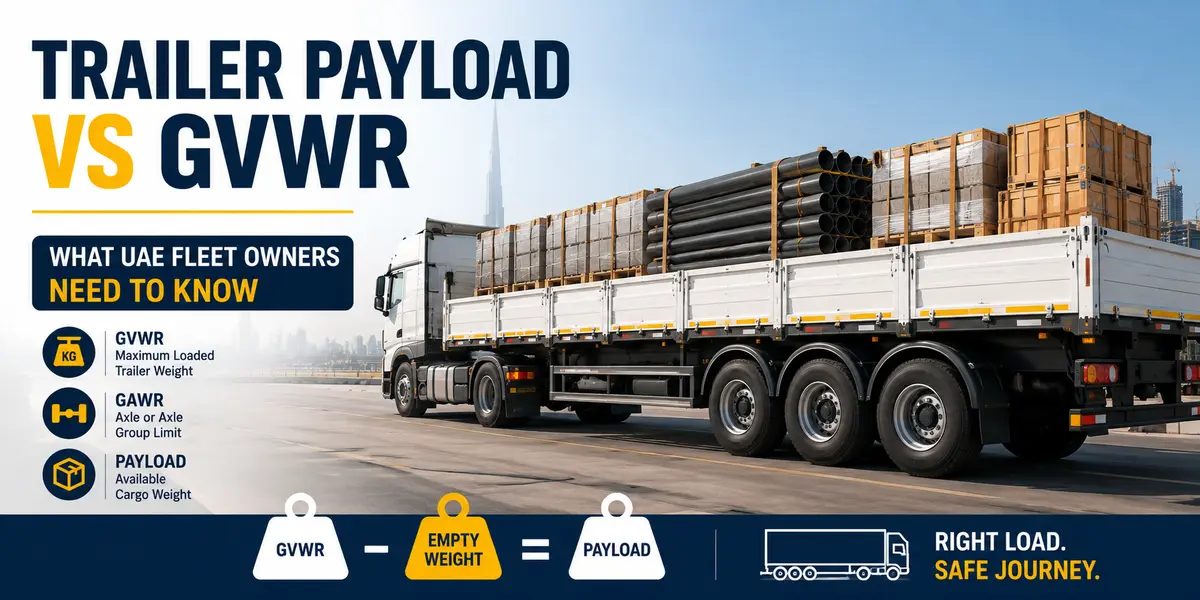
Trailer Payload vs Gross Vehicle Weight: What UAE Fleet Owners Need to Know
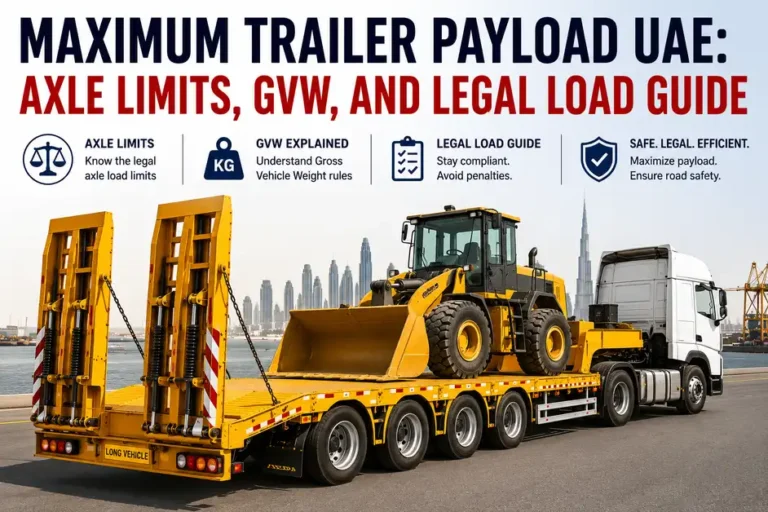
Choosing a trailer requires more than checking its advertised capacity. Fleet owners need to understand payload, GVWR, GAWR, and empty trailer weight. These figures determine how much cargo a trailer can carry within approved limits.
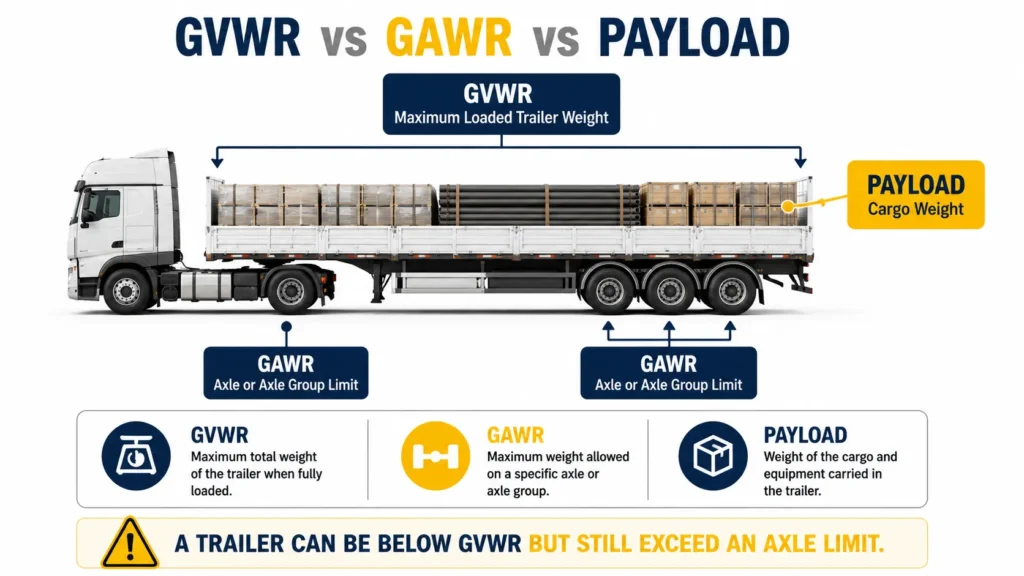
Trailer payload capacity refers to cargo weight available within rated limits. GVWR refers to maximum loaded trailer weight. GAWR applies to an individual axle or axle group.
These ratings work together during loading. The tractor, trailer, cargo, and road restrictions form one operating combination. This matters for UAE fleets moving construction, industrial, container, and bulk cargo.
Businesses comparing equipment can review Trailer options when defining capacity requirements. The final specification should match cargo weight, towing equipment, routes, and operating conditions.
What Is Trailer Payload Capacity?
Trailer payload capacity is the cargo weight a trailer can carry within approved limits. It does not represent the trailer’s total loaded weight. Empty trailer weight must be considered before determining the cargo allowance.
The basic formula is:
Payload Capacity = GVWR − Empty Trailer Weight
For example, a trailer with 40,000 kg GVWR and 10,000 kg empty weight has a calculated payload of 30,000 kg. This example explains the formula only and does not represent a specific model.
The result is only a starting point. Axle ratings, tyres, suspension, brakes, tractor capacity, equipment weight, and legal restrictions may create a lower practical limit.
Trailer Payload Capacity vs GVWR
Payload and GVWR describe different measurements. GVWR is the maximum loaded weight assigned to the trailer. Payload is the cargo weight remaining after the trailer’s own weight is considered.
Two trailers can have identical GVWR ratings but different payload capacities. A heavier trailer leaves less weight available for cargo. This makes tare weight important when comparing models.
What Does GVWR Include?
GVWR covers the trailer and its loaded contents. It includes cargo and equipment supported by the trailer. The rating belongs to the approved trailer configuration.
What Does Payload Include?
Payload is the weight available for cargo after accounting for empty trailer weight. Added equipment reduces that allowance. The final amount must remain within every applicable limit.
What Is Gross Axle Weight Rating?
Gross Axle Weight Rating, or GAWR, applies to an individual axle or axle group. It defines how much weight that running gear can support. GAWR is separate from the trailer’s overall GVWR.
A trailer can stay below GVWR while exceeding an axle limit. This can happen when heavy cargo is positioned incorrectly. Load placement therefore matters during loading.
GVWR vs GAWR
GVWR concerns the complete trailer’s rated loaded weight. GAWR concerns a specific axle or axle group. Both ratings must be respected during operation.
UAE rules also specify axle limits separately from total vehicle limits. Operators should verify requirements for their exact combination before heavy cargo movements.
How to Calculate Trailer Payload Capacity
Start with the manufacturer’s GVWR and accurate empty trailer weight. Subtract the empty weight from GVWR to obtain the basic payload calculation. Then check axle, tractor, and legal restrictions.
What Factors Affect Trailer Payload Capacity?
Trailer construction directly affects available payload. A heavier frame uses more of the permitted GVWR before cargo is added. Permanent equipment can reduce the allowance as well.
Running gear creates another limitation. Axles, suspension, tyres, wheels, and brakes need suitable ratings for the intended load. Structural design must support the approved operating weight.
Cargo distribution can change axle loading without changing total cargo weight. Dense machinery and concentrated loads therefore need careful positioning. Businesses can also review Trailer Weight Distribution for related guidance.
How Much Weight Can a 40ft Trailer Carry?
There is no universal answer to 40 ft trailer weight capacity. A 40ft designation describes a length or cargo configuration, not one fixed payload rating. Chassis design, empty weight, axle arrangement, and legal limits all affect capacity.
A 40ft container also contributes its own tare weight. Cargo inside the container adds further weight to the complete combination. The final loaded figure must remain within all applicable ratings.
Golden Space offers Skeleton Trailer configurations for 20ft and 40ft container transport. The applicable payload depends on the selected configuration.
40 Feet Trailer Capacity in Tons
Searches for 40 feet trailer capacity in tons produce different figures. Those figures may represent different chassis designs or regulatory markets. Buyers should request the rating for their exact configuration.
Double Axle Trailer Weight Capacity
Double axle trailer weight capacity cannot be determined by axle count alone. Individual axle ratings, suspension, tyres, brakes, frame design, and GVWR influence the final figure. Road limits can impose additional restrictions.
Two trailers with the same axle arrangement can have different capacities. Their structural design and component ratings may not be identical. Fleet owners should therefore compare complete specifications.
Double Axle vs Multi-Axle Trailers
Multi-axle arrangements can distribute weight across more wheel positions. They may suit heavier applications when the tractor, trailer, route, and regulations support them. More axles do not automatically create unrestricted payload.
Tractor Trailer Payload Capacity
A trailer operates as part of a complete tractor-trailer combination. The tractor must have sufficient capacity for the loaded trailer and cargo. Coupling, braking, electrical, hydraulic, and weight requirements must also match.
Tractor and Fifth-Wheel Compatibility
The kingpin and fifth-wheel arrangement should match the tractor. Fifth-wheel position can affect trailer height and weight distribution. These dimensions should be confirmed before purchase.
Braking and Hydraulic Compatibility
Brake and electrical connections must suit the towing vehicle. Hydraulic compatibility matters when the trailer uses powered tipping or other hydraulic functions. Exact requirements should be confirmed for the selected configuration.
Trailer Payload Capacity and UAE Weight Limits
UAE fleet owners must consider manufacturer ratings together with applicable road rules. Federal legislation addresses maximum total vehicle weight and axle loading. Loads must also be properly distributed and secured.
The applicable legal limit can be lower than the trailer’s own GVWR. Operators should therefore check current requirements before planning heavy loads. The manufacturer’s rating does not replace UAE regulatory limits.
What Is a Trailer Payload Capacity Chart?
A trailer payload capacity chart shows how empty weight affects available cargo. The figures below are illustrative calculations, not manufacturer specifications.
| Example GVWR | Example Empty Weight | Calculated Payload |
| 20,000 kg | 6,000 kg | 14,000 kg |
| 30,000 kg | 8,000 kg | 22,000 kg |
| 40,000 kg | 10,000 kg | 30,000 kg |
| 50,000 kg | 12,000 kg | 38,000 kg |
The chart demonstrates the basic formula only. Actual capacity must come from the specific trailer documentation. Axle, tractor, and legal limits require separate checks.
Can You Increase the Payload Capacity of a Trailer?
There is no simple modification that automatically raises payload capacity. Removing equipment can lower empty weight but does not automatically raise GVWR. Changing axles or suspension can affect the wider trailer system.
A genuine rating increase may require engineering changes across the frame, running gear, tyres, brakes, and suspension. The final configuration must then be assessed as one system.
For fleets needing greater capacity, a correctly specified trailer can be more practical than modifying an existing one. Custom manufacturing can address the intended load during the original design.
14,000 GVWR Trailer: How Much Can It Carry?
A trailer with 14,000 GVWR does not automatically carry 14,000 kg of cargo. GVWR includes the trailer and its load. Empty weight must therefore be deducted before calculating basic payload.
If the trailer weighs 4,000 kg empty, the basic payload is 10,000 kg. Equipment and other applicable restrictions can reduce that amount further.
The exact answer depends on the specific trailer’s weight and ratings. Operators should verify the manufacturer’s documentation before loading.
Trailer Payload Capacity for Different Trailer Types
Payload varies between trailer types because their designs serve different applications. Flatbeds support general open-deck cargo, while tippers handle bulk material discharge. Skeleton trailers are designed around container transportation.
Golden Space offers different configurations for these uses. Its Tipper Trailer range includes 35-ton, 50-ton, and 80-ton payload options. These ratings apply to the relevant configurations only.
The trailer type should be selected before capacity is finalized. The required payload can then be matched to the cargo and operating environment.
How to Choose the Right Trailer Payload Capacity
Start with the cargo your fleet carries most often. Identify typical weight, dimensions, density, and loading pattern. Then consider the routes and conditions where the trailer will operate.
Compare GVWR, empty weight, GAWR, suspension, tyres, brakes, and tractor capacity. Check how the cargo will distribute across the complete combination. Confirm applicable UAE requirements before finalizing the specification.
Future requirements also deserve attention. A trailer selected too close to current demand may become restrictive when loads change. Capacity should provide useful flexibility without exceeding approved ratings.
Common Payload Mistakes Fleet Owners Should Avoid
One common mistake is treating GVWR as payload. Another is forgetting equipment weight when calculating available cargo. These errors can produce unrealistic loading expectations.
Another mistake is checking total weight without checking axle loading. A concentrated load can overload one axle group before reaching GVWR. Load position should therefore be reviewed during loading.
Fleet owners should also avoid copying ratings from similar trailers. Different models can have different empty weights, axle ratings, and GVWR values. The exact manufacturer documentation should remain the reference.
Final Considerations for UAE Fleet Owners
Trailer payload capacity is only one part of a complete weight assessment. GVWR defines the trailer’s rated loaded weight, while GAWR addresses axle or axle-group limits. Empty weight determines the basic cargo allowance.
The practical limit can be lower when axle ratings, tractor capacity, or UAE regulations impose tighter restrictions. Evaluating the complete combination gives fleet owners a more reliable basis for loading decisions.
Businesses considering custom requirements can review the Trailer Manufacturing Work Gallery for locally manufactured equipment examples. The final specification should match the cargo, tractor, route, and applicable requirements.
Frequently Asked Questions
Can trailer accessories reduce available payload?
Yes, accessories and equipment add weight to the operating setup. That leaves less capacity for cargo under the same GVWR. Relevant equipment weight should be included in payload calculations.
Can cargo position affect the usable capacity?
Yes, cargo position can change the load carried by each axle group. Total cargo weight may remain unchanged while axle loading changes. Heavy items should therefore follow the approved loading arrangement.
Can a trailer reach an axle limit before reaching GVWR?
Yes, an axle group can reach its limit while total trailer weight remains below GVWR. This can occur with concentrated loads. Both total and axle ratings should be checked.
Does trailer body size determine payload?
No, physical size does not determine payload by itself. GVWR, empty weight, axle ratings, suspension, tyres, and frame design also matter. A larger trailer can have less usable payload than a lighter model.
What information should fleet owners request before buying?
Request the approved GVWR, empty weight, axle ratings, dimensions, suspension details, braking system, and towing requirements. Confirm the intended cargo and operating application with the manufacturer. This provides a better basis for comparing trailer configurations.