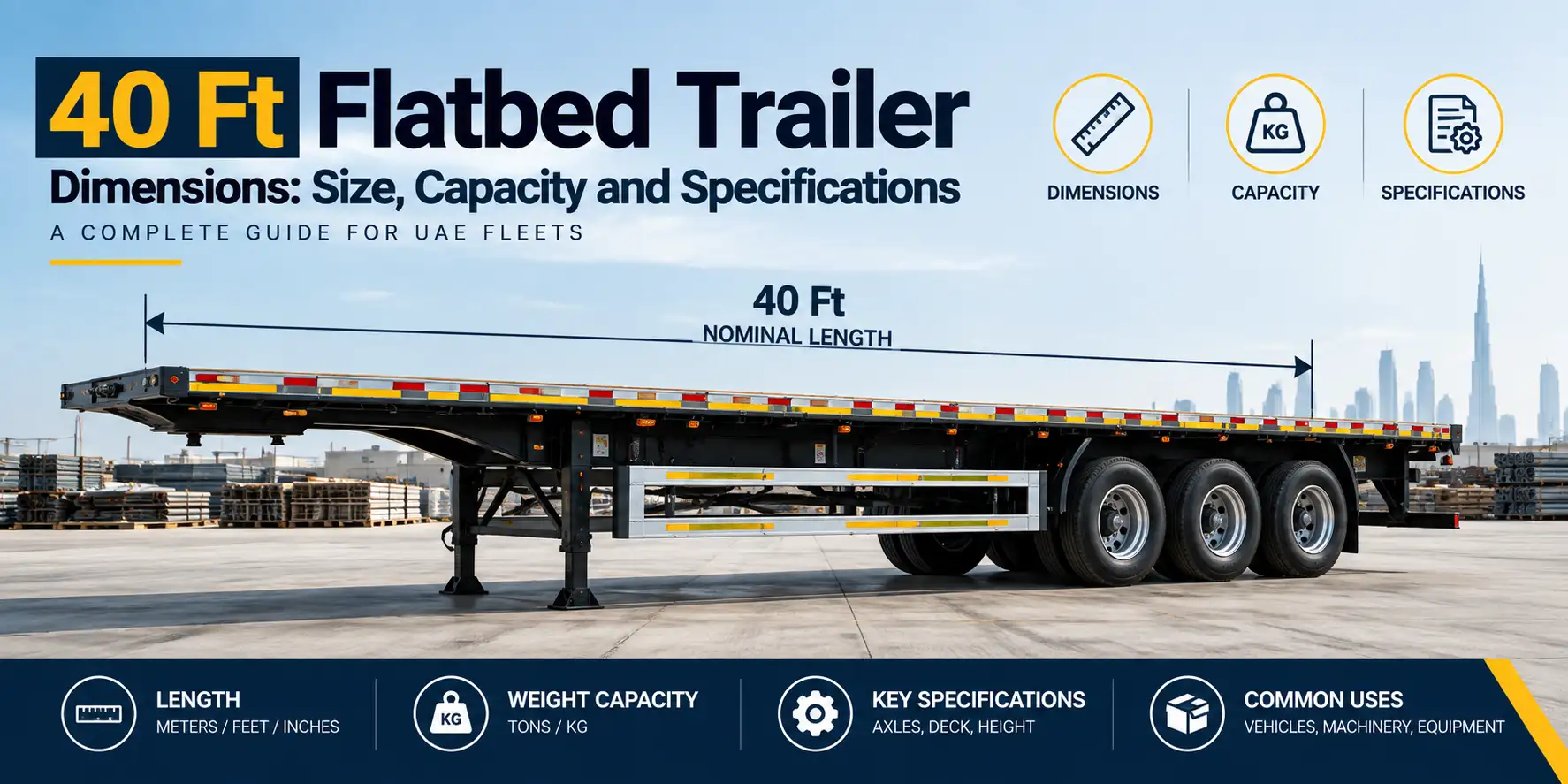
40 Ft Flatbed Trailer Dimensions: Size, Capacity and Specifications
A 40 ft flatbed trailer is widely used for transporting steel, construction materials, industrial equipment, machinery, pipes, and other long or bulky cargo. Its open deck allows loading from the rear, sides, or above with suitable lifting equipment.
However, the term “40 ft” describes the nominal length class. It does not mean every trailer has identical overall dimensions, deck height, axle arrangement, or payload capacity. Manufacturer design, suspension, axle configuration, and local operating requirements can change the final specification.
For businesses comparing options from a trailer manufacturer, understanding the difference between nominal length and actual manufactured dimensions is important before ordering.
What Are 40 Ft Flatbed Trailer Dimensions?
A 40 ft flatbed trailer belongs to a common long-deck trailer size class used for transporting steel, machinery, construction materials, pipes, and other bulky cargo. The nominal 40 ft length equals approximately 12.192 metres or 480 inches.
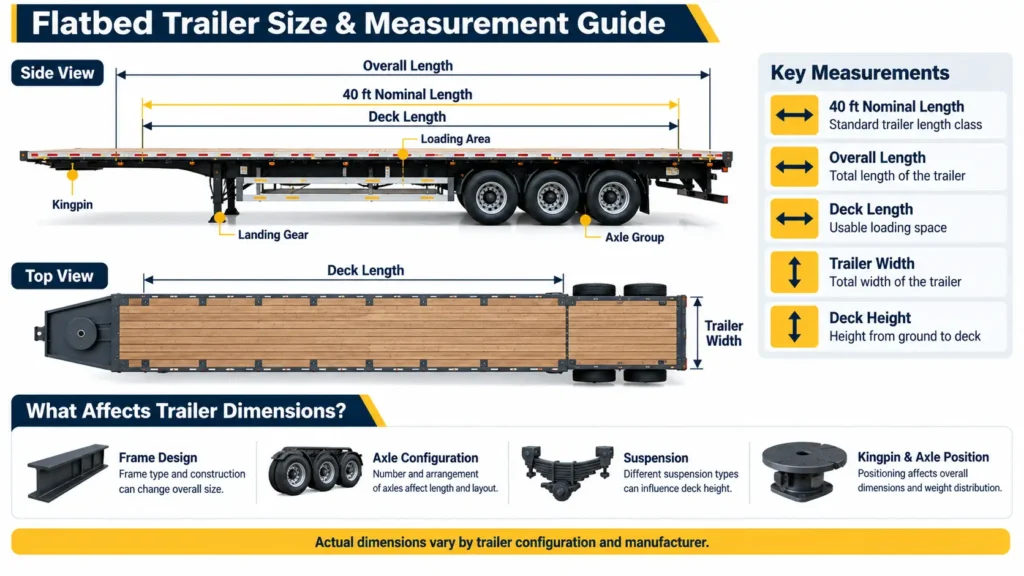
Actual dimensions can vary depending on the trailer’s frame design, deck construction, axle arrangement, kingpin position, suspension, and overall configuration. Therefore, buyers should check the complete technical drawing for the exact overall length, usable deck length, width, and deck height before selecting a trailer.
For UAE operations, these measurements are particularly important when checking cargo clearance, loading space, tractor compatibility, and the available space at yards or industrial sites.
40 Ft Flatbed Trailer Dimensions in Meters
The basic conversion is:
40 feet = 12.192 metres
A commercial 40 ft flatbed can therefore have a manufactured length close to 12.2–12.5 m, depending on its design. Width and deck height are separate specifications and should not be calculated from the 40 ft designation.
Golden Space currently manufactures flatbed trailers in 12 m, 15 m, and custom lengths. Its axle options include BP 16-ton and bogie 32-ton configurations.
This means a buyer looking for a 40 ft-class trailer should confirm the required deck length and complete dimensions with the manufacturer before production.
40 Ft Flatbed Trailer Dimensions in Feet and Inches
The nominal length is:
- 40 ft
- 480 inches
- 12.192 metres
This distinction is important when checking loading space, yard clearance, coupling position, and transport requirements.
Standard 40 Ft Flatbed Trailer Dimensions
There is no single dimension set that applies to every 40 ft flatbed trailer.
The main measurements buyers should request are:
| Dimension | What It Tells You |
| Overall length | Total trailer footprint |
| Deck length | Available cargo loading area |
| Overall width | Trailer width and clearance |
| Deck height | Platform height from the ground |
| Kingpin position | Tractor and fifth-wheel relationship |
| Axle position | Load distribution and axle loading |
| Axle spacing | Configuration and road requirements |
40 Ft Flatbed Trailer Weight Capacity
Length alone does not determine how much cargo a trailer can carry.
A 40 ft flatbed’s capacity depends on its chassis construction, axle ratings, suspension, tyres, brakes, tare weight, cargo distribution, tractor combination, and applicable road limits.
How Much Weight Can a 40 Ft Flatbed Trailer Carry?
40 ft flatbed trailer capacity can vary significantly depending on the trailer’s axle configuration, frame strength, suspension, tare weight, tyres, braking system, and cargo distribution. A higher payload rating is not determined by trailer length alone, so the exact capacity should always be confirmed from the manufacturer’s technical specifications for the selected configuration.
For UAE fleet operators, the correct approach is to match the trailer’s rated configuration with the intended cargo, tractor, axle loading, and permitted operating conditions.
For more information about the relationship between payload and vehicle ratings, see Trailer Payload vs Gross Vehicle Weight.
40 Ft Trailer Weight Capacity in Kg and Tons
Trailer capacity is commonly expressed in tonnes or kilograms.
1 tonne = 1,000 kg
For example:
- 30 tonnes = 30,000 kg
- 40 tonnes = 40,000 kg
- 45 tonnes = 45,000 kg
- 50 tonnes = 50,000 kg
These numbers should not be interpreted as the payload of every 40 ft trailer. The permitted cargo weight must be determined from the complete trailer and vehicle configuration.
What Affects 40 Ft Flatbed Trailer Dimensions?
Several engineering decisions can change the final dimensions and operating characteristics.
Axle Configuration
Axle count and arrangement influence how the trailer supports and distributes cargo. They also affect the overall chassis layout, suspension arrangement, tyre configuration, and permitted loading conditions.
A trailer designed for heavier industrial cargo may require a different axle arrangement from one intended for general freight.
See Trailer Axle Capacity for a deeper explanation of axle ratings and load capacity.
Deck and Frame Design
The deck provides the loading platform, while the chassis frame supports the cargo and transfers forces toward the axle and coupling system.
Frame height, cross-members, deck construction, and reinforcement can therefore affect the trailer’s tare weight and overall dimensions.
A lighter frame is not automatically better. The structure must be appropriate for the intended cargo and operating conditions.
Kingpin and Axle Position
The distance between the kingpin, axle group, and cargo centre of gravity affects how weight reaches the tractor and trailer axles.
Cargo length alone therefore cannot determine whether a load is suitable. The load must also be positioned correctly on the deck.
40 Ft Flatbed Trailer Specifications to Check
Before purchasing or commissioning a trailer, fleet operators should review more than length and width.
Important specifications include:
- Deck length
- Overall length
- Deck width
- Deck height
- Axle configuration
- Axle rating
- Suspension type
- Tyre specification
- Brake system
- Kingpin configuration
- Landing gear
- Cargo securing points
- Frame construction
- Tare weight
- Rated payload
Golden Space’s current flatbed range uses high-strength structural steel and offers standard 12 m and 15 m lengths, as well as custom configurations. Listed axle options include BP 16-ton and bogie 32-ton systems.
The final specification should be based on the cargo and operating requirements rather than length alone.
What Can a 40 Ft Flatbed Trailer Transport?
A 40 ft platform provides substantial open loading space for long and bulky cargo.
Steel and Structural Materials
Steel beams, pipes, plates, fabricated sections, and other long materials can be transported on an appropriately specified flatbed.
Cargo must be secured according to its shape, weight, centre of gravity, and movement risk.
Construction Equipment
Construction companies can use flatbeds for machinery, structural components, scaffolding, formwork, and other site materials.
The loading method is also important. Heavy equipment may require ramps, cranes, or other suitable loading equipment.
Industrial and Project Cargo
Industrial machinery, pipes, equipment components, and awkward-shaped freight can benefit from an open deck.
Golden Space specifically lists construction materials, industrial equipment, steel products, pipes, coils, and oversized freight among flatbed applications.
40 Ft Flatbed Trailer vs 45 Ft Flatbed Trailer
A 45 ft trailer provides additional deck length, but longer does not automatically mean higher payload.
| Factor | 40 Ft | 45 Ft |
| Nominal length | 40 ft | 45 ft |
| Loading space | Shorter deck | Longer deck |
| Payload | Configuration-dependent | Configuration-dependent |
| Axle setup | Configuration-dependent | Configuration-dependent |
| Route suitability | Depends on vehicle and route | Depends on vehicle and route |
| Best use | Based on cargo dimensions | Based on cargo dimensions |
A buyer should select the length according to the cargo footprint, loading method, route, and vehicle requirements.
40 Ft Flatbed Trailer Dimensions for UAE Operations
UAE fleet operators should consider the complete vehicle combination rather than looking only at trailer length.
The available road space, loading yard, industrial site, cargo overhang, axle loading, and tractor compatibility can all affect the practical suitability of a trailer.
This is particularly important when transporting long steel products, construction equipment, machinery, and project cargo.
Golden Space manufactures flatbeds in Sharjah and offers custom lengths, allowing the trailer configuration to be developed around specific cargo and operating requirements.
How to Choose the Right 40 Ft Flatbed Trailer
Start with the cargo rather than the trailer length.
First, measure the cargo’s length, width, height, and weight. Then determine how it will be loaded and secured.
Next, review the required axle configuration, suspension, tyres, braking system, kingpin arrangement, and tractor compatibility.
Finally, confirm the complete manufactured dimensions and applicable operating requirements before approving the build.
For container-specific applications, a Skeleton Trailer may be more appropriate than a conventional flatbed because container chassis are designed around container handling and connection requirements.
Frequently Asked Questions
Is a 40 ft trailer exactly 40 feet long?
Not necessarily. The 40 ft designation describes the nominal length class. Actual overall dimensions can be slightly longer or shorter depending on the frame, front structure, rear structure, and manufacturer configuration.
How wide is a standard 40 ft flatbed trailer?
Width varies by manufacturer and market. Listed examples commonly use dimensions around 2.5 m, but the exact width should always be confirmed from the manufacturer’s technical drawing and applicable road requirements.
Can a 40 ft flatbed trailer be custom-built?
Yes. Flatbed manufacturers can modify dimensions and configurations according to cargo, axle requirements, loading conditions, and operating needs. Golden Space currently offers 12 m, 15 m, and custom flatbed lengths.
Does a longer flatbed trailer always have a higher payload?
No. Payload depends on the complete trailer design, including chassis strength, axle ratings, suspension, tyres, tare weight, and applicable load restrictions. A longer deck primarily provides additional loading space.
How do I confirm the exact dimensions before ordering?
Ask the manufacturer for a technical drawing or specification sheet showing overall length, deck length, width, deck height, kingpin position, axle position, and other relevant dimensions. This avoids relying on a generic 40 ft measurement.