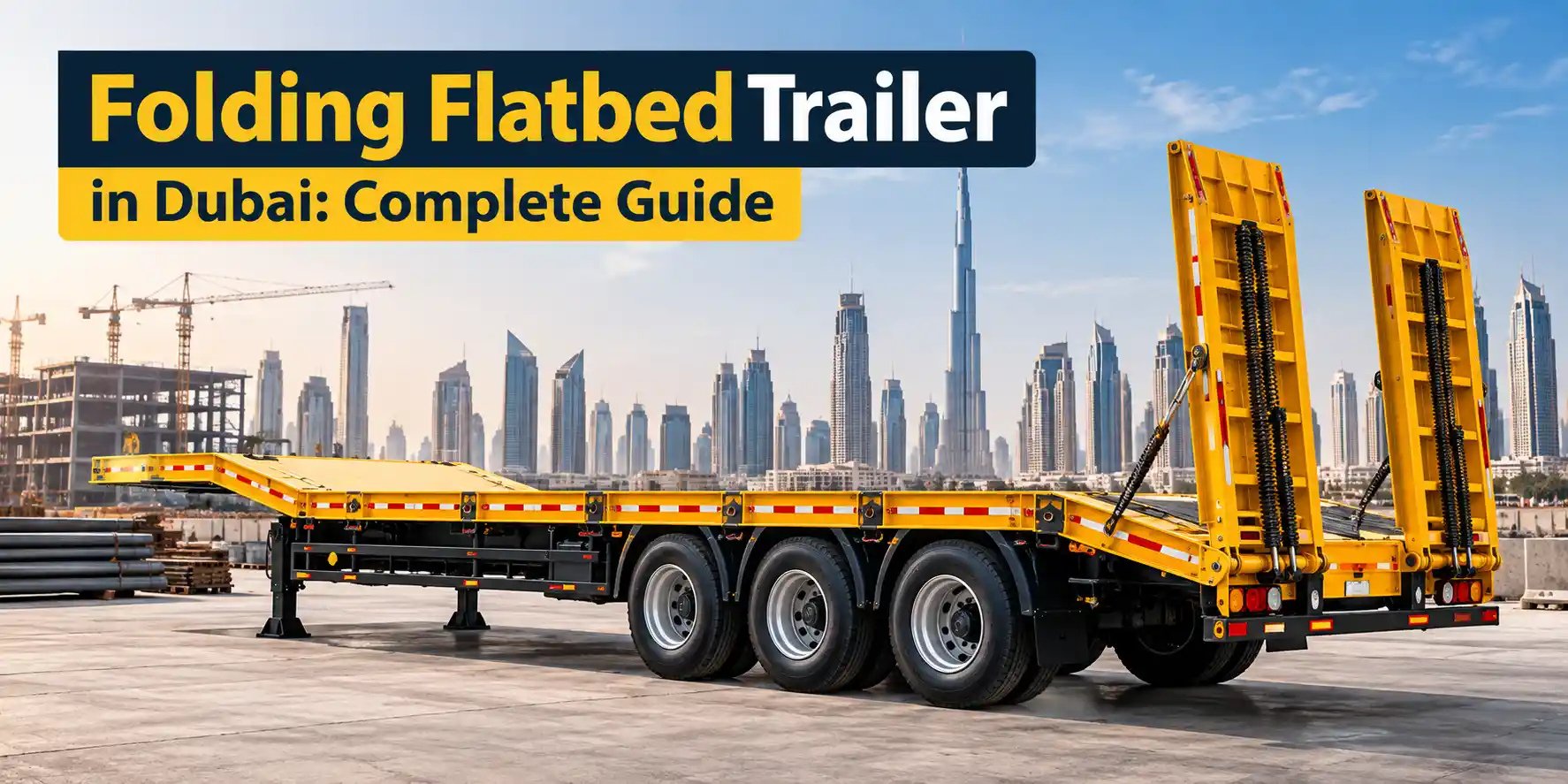
Folding Flatbed Trailer in Dubai: Complete Guide
A folding flatbed trailer in Dubai can provide a practical solution for transporting machinery, construction materials, steel products, and other bulky cargo. Its folding design can also help with storage and operational flexibility when compared with some fixed-deck configurations.
The right trailer depends on more than deck length. Cargo weight, dimensions, loading method, axle configuration, suspension, tractor compatibility, and route requirements all affect the final specification.
For businesses comparing trailer options, understanding the design and operating requirements before ordering can prevent costly specification mistakes.
What Is a Folding Flatbed Trailer?
A folding flatbed trailer is an open-deck trailer designed with a deck or structural section that can be folded or repositioned according to its configuration. The design can provide greater flexibility when the trailer is being stored, transported, or prepared for certain loading operations.
Unlike an enclosed trailer, the open platform provides access from the rear, sides, or above when suitable loading equipment is available. This makes flatbed configurations useful for cargo that is long, wide, tall, or difficult to load through a conventional enclosed body.
The exact folding mechanism varies between trailer designs. Commercial buyers should therefore review the manufacturer’s technical drawings instead of assuming that every folding flatbed uses the same system.
How Does a Folding Flatbed Trailer Work?
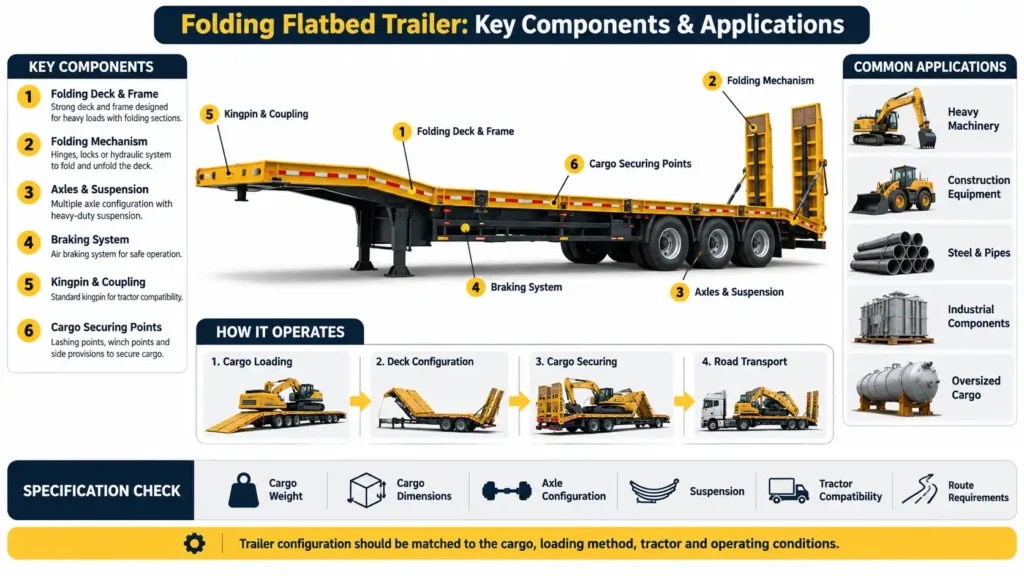
The folding mechanism allows the relevant deck section to move between its transport and folded positions. Depending on the design, this movement can involve mechanical components, hinges, locking systems, or hydraulic equipment.
Before operation, the trailer should be positioned on suitable ground and the folding system should be checked. The deck must be properly secured in its operating position before the trailer carries cargo.
Loading should then follow the trailer’s approved configuration and the manufacturer’s operating instructions. Cargo must be positioned and secured according to its weight, dimensions, centre of gravity, and movement risk.
Main Components of a Folding Flatbed Trailer
Folding Deck and Frame
The deck provides the primary cargo platform, while the frame carries structural loads through the trailer. Both must be designed around the intended cargo and operating conditions.
The folding sections also require suitable hinges, locking arrangements, and structural reinforcement. These components should be inspected regularly because movement and repeated loading can increase mechanical stress.
Axles and Suspension
Axles support the trailer and transfer cargo forces toward the wheels and road surface. Suspension helps manage wheel movement and load distribution during operation.
The correct configuration depends on the expected cargo weight and overall vehicle combination. For more information, see Trailer Axle Capacity.
Braking and Coupling Systems
A commercial folding flatbed also requires suitable braking, electrical, lighting, landing gear, and coupling systems. The kingpin and fifth-wheel connection must be compatible with the tractor.
These components should be considered as part of one complete vehicle system rather than selected independently.
Folding Flatbed Trailer Dimensions and Specifications
There is no universal dimension for every folding flatbed trailer. Overall length, deck length, width, deck height, axle position, suspension, and folding mechanism can vary between configurations.
Buyers should request a technical drawing showing the complete manufactured dimensions before approving a trailer. This is especially important when the cargo has strict dimensional requirements.
You can see our guide to 40 Ft Flatbed Trailer Dimensions that explains how nominal trailer length differs from actual manufactured dimensions.
Key Specifications to Check
Important specifications can include:
- Overall trailer length
- Usable deck length
- Overall width
- Deck height
- Axle configuration
- Axle ratings
- Suspension type
- Tyre specification
- Brake system
- Kingpin configuration
- Landing gear
- Cargo securing points
- Folding mechanism
- Tare weight
- Rated payload
The correct specification should be established from the cargo and operating requirements rather than choosing a trailer based only on its advertised size.
What Can a Folding Flatbed Trailer Carry?
A folding flatbed configuration can be considered for cargo that benefits from an open loading platform.
Heavy Machinery
Construction and industrial machinery can require open access for loading. Depending on the machine’s dimensions and weight, suitable ramps, cranes, or other loading equipment may be required.
Examples can include construction equipment, industrial machinery, fabricated equipment, and other large components.
Steel and Structural Materials
Steel beams, pipes, fabricated structures, plates, and similar materials can be transported on suitable flatbed configurations.
Cargo securing is particularly important for long or heavy materials. The load should be positioned to maintain appropriate axle loading and overall stability.
Construction and Industrial Cargo
Construction materials, equipment components, and project cargo can also benefit from an open deck. The actual trailer configuration should be selected according to cargo dimensions, weight, loading method, and route requirements.
Folding Flatbed Trailer vs Standard Flatbed
Both designs provide an open cargo platform, but their operating characteristics can differ.
A conventional flatbed generally uses a fixed deck configuration, while a folding design incorporates a mechanism that allows part of the trailer structure to fold or change position.
The appropriate choice depends on the intended application. Buyers should consider loading requirements, storage conditions, cargo dimensions, operating frequency, and maintenance requirements.
For a broader look at equipment and securing solutions used with flatbeds, see Flatbed Trailer Accessories.
Benefits of a Folding Flatbed Trailer
Flexible Storage
A folding design can provide useful storage flexibility where available space is limited. The actual storage benefit depends on the trailer’s folding configuration and folded dimensions.
Open Loading Access
The flatbed format allows cargo to be approached from multiple directions when suitable equipment and site conditions are available. This can help with machinery and bulky cargo that cannot easily be loaded through an enclosed body.
Flexible Applications
A properly specified folding flatbed can support different cargo requirements across construction, industrial, logistics, and equipment transport operations.
However, flexibility should not be confused with unlimited capacity. The trailer still has defined structural, axle, suspension, tyre, and braking limits.
Axle, Suspension and Payload Considerations
Payload should never be determined from trailer length alone. The complete vehicle configuration affects how much cargo can be carried and how the load behaves during transport.
Axle ratings, suspension, tyres, chassis construction, tare weight, tractor specifications, and cargo distribution all need to be considered.
Cargo should also be positioned so that axle loads remain within the applicable limits. Uneven loading can affect braking, steering, tyre wear, and stability.
For a deeper explanation of cargo positioning, see the Golden Space guide to trailer weight distribution.
Folding Flatbed Trailer Applications in Dubai and UAE
Dubai has extensive construction, logistics, industrial, and infrastructure activity where open-deck transport can be required. Folding flatbed configurations may therefore be considered for machinery, steel, fabricated structures, equipment, and other bulky cargo.
The route should be evaluated before selecting the trailer. Industrial sites, highways, loading yards, project locations, and restricted access areas can all create different transport requirements.
Cargo dimensions should also be checked against the complete tractor and trailer combination. Where a load exceeds applicable limits, additional regulatory requirements may apply.
What to Consider Before Buying
Start by documenting the cargo rather than selecting a trailer from a generic specification.
Record the cargo’s:
- Length
- Width
- Height
- Weight
- Centre of gravity
- Loading method
- Unloading method
Next, determine the required axle and suspension configuration. Consider how frequently the trailer will operate, what routes it will use, and what type of tractor will pull it.
You should also discuss the folding mechanism, deck construction, cargo securing points, braking system, tyres, and maintenance requirements with the manufacturer.
A suitable Trailer Manufacturing partner should be able to align the trailer design with these requirements and provide the relevant technical information before production.
Folding Flatbed Trailer Maintenance and Safety
The folding mechanism deserves particular attention because it contains moving and locking components. Hinges, locking points, hydraulic components where applicable, and structural connections should be inspected according to the manufacturer’s maintenance requirements.
The deck and frame should also be checked for visible damage, cracks, deformation, or unusual wear. Axles, suspension, tyres, brakes, lighting, and coupling components require regular inspection as part of normal trailer maintenance.
Before every loading operation, confirm that the folding sections are correctly positioned and secured. Never operate the trailer outside its approved configuration or rated limits.
Choosing a Folding Flatbed Trailer for Your Operation
The right folding flatbed configuration starts with the cargo and operating environment. A trailer designed for one application may not be appropriate for another simply because the deck dimensions appear suitable.
Consider cargo weight and dimensions first, followed by loading requirements, axle configuration, suspension, tractor compatibility, route conditions, and regulatory requirements.
For commercial operators, the complete specification should be documented before manufacturing begins. This approach reduces uncertainty and helps ensure that the finished trailer matches the intended application.
Frequently Asked Questions
Can a folding flatbed trailer carry oversized cargo?
It can be designed for suitable bulky cargo, but carrying oversized loads depends on the trailer’s approved configuration, cargo dimensions, axle loading, route, and applicable regulations. The complete combination should be assessed before transport.
Does a folding mechanism increase trailer maintenance requirements?
A folding mechanism introduces additional moving and locking components that require inspection. Maintenance needs depend on the mechanism, operating frequency, environment, and manufacturer’s maintenance instructions.
Can a folding flatbed trailer be customized for different cargo?
Commercial trailer configurations can be developed around specific cargo requirements. Possible considerations include deck dimensions, axle arrangement, suspension, cargo securing points, and other structural requirements.
How should cargo be positioned on a folding flatbed?
Cargo should be positioned according to its weight, dimensions, centre of gravity, and the trailer’s axle configuration. The objective is to maintain appropriate load distribution and avoid excessive loading on individual axles.
Is a folding flatbed suitable for every type of heavy cargo?
No. Trailer suitability depends on the cargo’s weight, dimensions, loading method, route, and required configuration. Some heavy or tall equipment may require a lowbed or another specialized trailer instead.