Motorcycle Recovery Trailer: Features, Uses and Buying Considerations
A motorcycle recovery trailer is designed to load, secure, and transport motorcycles that cannot continue under their own power. Unlike a basic motorcycle trailer intended for recreation, a recovery-focused setup needs practical features for repeated loading and controlled transport. The right specification depends on motorcycle weight, loading method, towing vehicle, recovery workload, and operating conditions.
For recovery operators, workshops, dealerships, and roadside assistance teams, the trailer forms part of a wider recovery system. Ramps, wheel support, securing points, brakes, lighting, deck layout, and payload all affect daily use. Choosing these features around actual recovery work can make loading more controlled and reduce the risk of movement during transport.
What Is a Motorcycle Recovery Trailer?
A motorcycle recovery trailer provides a dedicated platform for moving motorcycles after breakdowns, collisions, or mechanical failures. It can be used when riding the motorcycle away from the location is impractical or unsafe. The trailer should provide a stable loading surface and suitable points for securing the motorcycle.
A recovery-focused design also needs to work efficiently during repeated callouts. Operators may handle motorcycles of different sizes, weights, and conditions. The equipment therefore needs enough flexibility for common recovery situations without becoming unnecessarily complex.
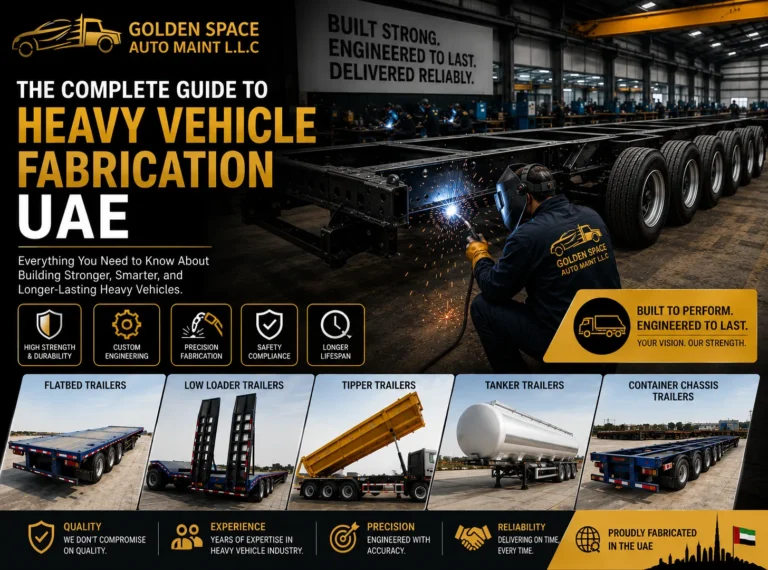
Golden Space manufactures recovery trailers in the UAE with reinforced loading ramps, multiple tie-down points, and heavy-duty winch systems for vehicle recovery. Its published recovery range includes 16 ft and 18 ft standard lengths, with custom lengths available. A Recovery Trailer can be specified around the recovery vehicle, motorcycle type, and intended workload.
Key Features to Look For
The most useful features are those that simplify loading and keep a motorcycle stable during transport. Recovery work can involve damaged or non-running motorcycles, so the trailer should support controlled handling rather than depend on the bike’s own power.
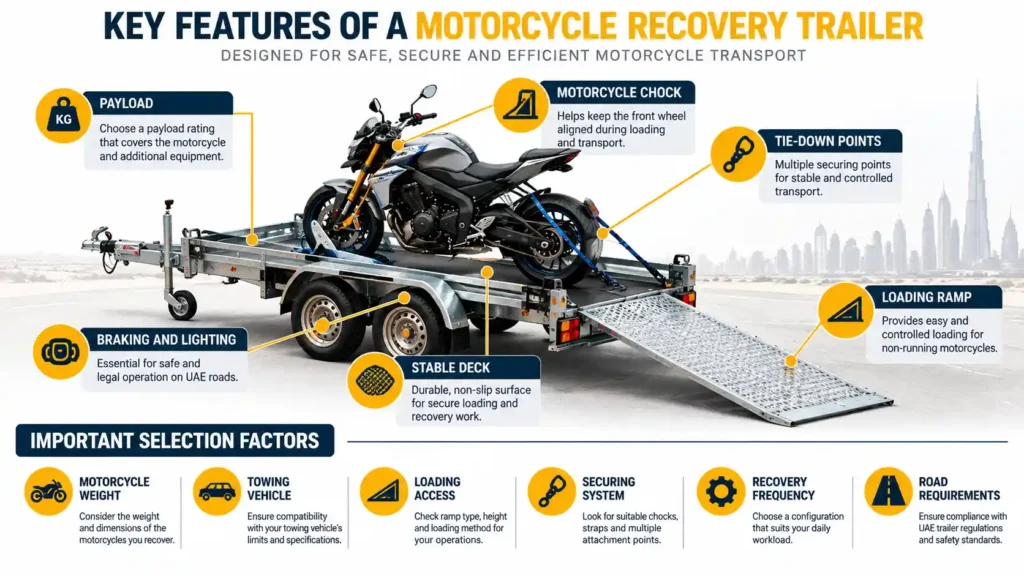
Important features include:
- Reinforced loading ramp
- Motorcycle wheel support or chock
- Multiple tie-down points
- Suitable deck surface
- Appropriate payload rating
- Compatible braking and lighting
- Winch or pulling equipment where required
- Suspension suited to the intended load
A professional recovery setup should be specified as one system. Ramps, wheel supports, securing points, and other equipment need suitable positions on the deck. Planning these details during manufacturing can avoid awkward modifications later.
Motorcycle Chock for Trailer
A motorcycle chock for trailer helps position and support the front wheel during loading. It can keep the motorcycle aligned while the operator prepares the restraint system. The chock should suit the wheel and tyre dimensions of the motorcycles expected in the fleet.
A chock does not replace proper restraint equipment. It works with appropriate tie-down points to help limit movement during transport. For operators handling several motorcycle types, the selected chock should accommodate the expected range of wheel sizes.
The mounting arrangement also matters. A recovery business may prefer fixed positions for predictable loading or adjustable positions for different motorcycles. The choice should reflect how frequently the trailer handles varied loads.
Loading and Securing a Motorcycle
Loading should begin with the trailer positioned securely and the ramp correctly placed. The motorcycle is then moved onto the deck and positioned according to the trailer’s loading arrangement. A suitable front wheel support can help maintain alignment during this stage.
After positioning, the motorcycle should be secured using suitable restraints and designated attachment points. Straps should follow the motorcycle and trailer manufacturer’s guidance, with care taken around painted surfaces, cables, controls, and other vulnerable components. Before departure, the operator should verify that the motorcycle remains stable.
Can You Strap a Motorcycle Without a Wheel Chock?
A motorcycle may be secured without a wheel chock in some circumstances, but the restraint arrangement becomes more important. A wheel chock or equivalent support generally makes positioning easier and helps control unwanted front-wheel movement.
Where no chock is available, operators should use the securing method approved for the specific motorcycle and trailer. The complete system must control movement during acceleration, braking, turning, and road vibration. A strap-only method should not be assumed suitable for every motorcycle.
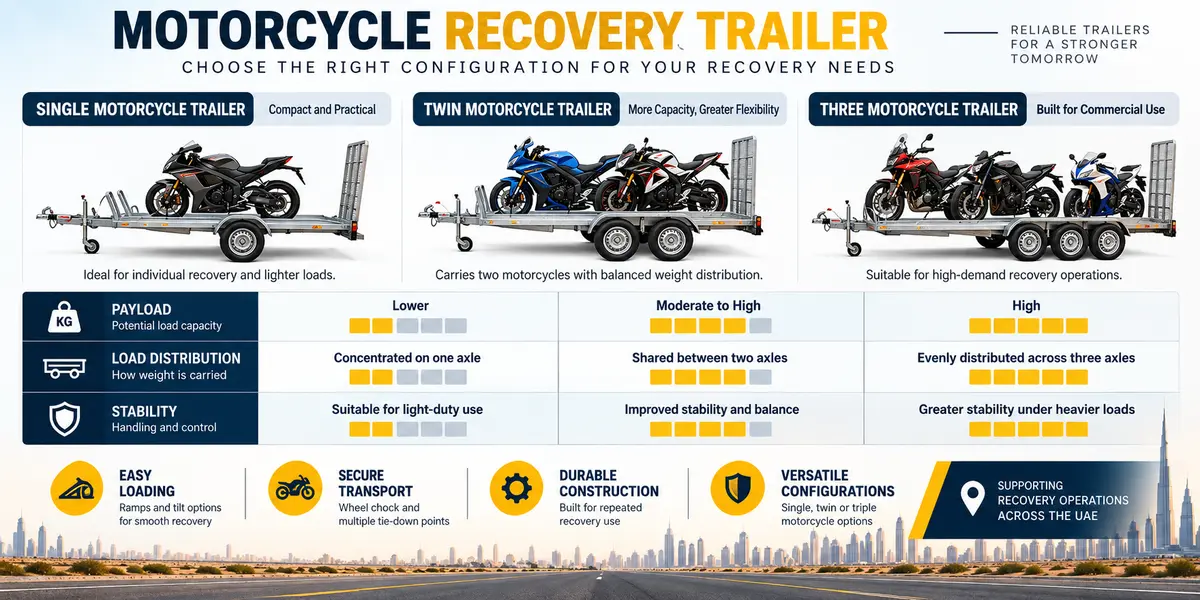
Motorcycle Recovery Trailer Configurations
Different layouts suit different operating requirements. A fixed platform can work well for recovery teams that value straightforward loading and repeated daily use. Folding and tilting arrangements may be considered when storage space or loading access has a higher priority.
Foldable Motorcycle Trailer
A motorcycle trailer foldable design can reduce storage demands when the trailer is parked. This can benefit workshops or smaller operators with limited yard space. The folding mechanism still needs to provide appropriate strength when the trailer is deployed.
Tilting Motorcycle Trailer
A tilting motorcycle trailer changes the deck angle to support easier loading or unloading. Its usefulness depends on motorcycle ground clearance, ramp arrangement, and operating conditions. Buyers should evaluate the actual loading process rather than selecting a tilt feature simply because it is available.
Stand-Up Motorcycle Trailer
A standup motorcycle trailer is mainly designed around compact storage. This can suit users with restricted parking or storage space. For professional recovery work, however, storage convenience should be balanced against payload, loading speed, restraint layout, and frequency of use.
Motorcycle Recovery Trailer Applications
A recovery trailer can support businesses that need to move motorcycles without relying on the motorcycle’s own power. Typical applications include:
- Roadside breakdown recovery
- Accident-damaged motorcycle transport
- Workshop collection and delivery
- Dealer-to-workshop movement
- Fleet motorcycle relocation
- Event and motorsport support
Roadside operators may prioritize rapid loading and reliable securing. Workshops may value easy access and repeatable loading. Dealerships and fleet operators may place greater emphasis on capacity, protection, and predictable transport between locations.
Capacity, Towing and Compatibility
Capacity should cover the motorcycle and any recovery equipment carried during the trip. Operators also need to consider trailer weight and the towing vehicle’s permitted limits. A trailer suitable for one large motorcycle may not provide enough practical capacity for multiple bikes or additional equipment.
Compatibility includes more than towing weight. Coupling, braking, electrical connections, suspension, dimensions, and loading height should also suit the towing vehicle. These requirements are best confirmed before manufacturing or purchasing the trailer.
Golden Space lists recovery trailer configurations with 3-tonne and 10-tonne payload options for different vehicle recovery applications. These are broader vehicle-recovery ratings, so a motorcycle-focused configuration should still be matched to the actual motorcycle and equipment load.
Safety and UAE Operating Requirements
A recovery trailer used on public roads needs more than a strong deck and loading ramp. Dubai’s Roads and Transport Authority states that trailers and semi-trailers must meet technical conditions covering dimensions, lighting, reflectors, towing-related construction, parking brakes, and other safety equipment. The current guidance also specifies maximum dimensions for trailers and semi-trailers in Dubai.
RTA’s 2026 trailer safety campaign highlighted worn tyres, defective lights, missing reflective markings, and unsafe loading among trailer defects found during inspections. These points make routine checks important for professional recovery operators.
For UAE work, heat, dust, traffic, and frequent loading cycles can also influence the specification. The trailer should be selected around real operating conditions rather than copied from a recreational motorcycle setup.
How to Choose the Best Motorcycle Recovery Trailer
The best motorcycle recovery trailer is not necessarily the largest or most heavily equipped model. It should match the motorcycles recovered, the number carried per trip, the towing vehicle, and the frequency of recovery work.
Before selecting a trailer, review:
- Motorcycle weights and dimensions
- Loading height and ramp arrangement
- Chock and tie-down layout
- Payload requirement
- Braking and lighting
- Towing vehicle compatibility
- Storage requirements
- Expected recovery frequency
- Local road requirements
Businesses comparing wider trailer configurations can also explore UAE Trailers and discuss standard or custom solutions around their operational needs.
The objective is to select equipment that supports predictable loading and secure transport without adding features that have little value for the actual recovery workflow.
Price and Buying Considerations
The price of a motorcycle recovery trailer depends on its configuration. Payload, dimensions, structural materials, loading equipment, braking, suspension, securing points, and optional features can all influence the final cost.
Comparing quotations by price alone can be misleading. Two trailers may look similar while using different ramp construction, axle arrangements, securing systems, or payload ratings. Specifications should therefore be compared on an equivalent basis.
New equipment can be designed around a fleet’s actual recovery needs. A used trailer may have a lower purchase price, but buyers should inspect its chassis, deck, ramps, tyres, brakes, suspension, coupling, and securing points before committing.
Maintenance and Daily Checks
Recovery trailers can experience frequent loading cycles, road vibration, dust, and weather exposure. Regular checks should cover tyres, brakes, lights, wheel assemblies, ramps, tie-down points, and the deck. Any hydraulic or winch equipment should also be inspected where fitted.
Operators should look for loose hardware, damaged welds, corrosion, worn securing points, and visible deformation. Problems found during routine inspection are easier to address before a recovery call. Maintenance intervals should follow the trailer and component manufacturer’s recommendations.
Keeping inspection records can also help fleet managers identify recurring wear. This makes it easier to schedule servicing before a minor issue becomes an operational problem.
When Custom Design Makes Sense
A custom trailer can be useful when standard layouts do not match the motorcycles or recovery workflow. Operators may need different deck arrangements, loading access, securing-point positions, or payload requirements. Customization should solve a practical operating need rather than add complexity without a clear benefit.
Golden Space states that its recovery trailers can be built with custom lengths in addition to standard 16 ft and 18 ft configurations.
Businesses evaluating local manufacturing can review Trailer Manufacturer in Sharjah when discussing configuration requirements, intended use, and production options.
Final Buying Checklist
A practical selection process starts with the motorcycle rather than the trailer catalogue. Identify the heaviest motorcycle expected, how it will be loaded, how often recoveries occur, and which towing vehicle will be used.
Then compare the trailer against these requirements:
- Loading method and ramp access
- Wheel support and securing points
- Payload and dimensions
- Brakes, lighting, and suspension
- Storage and manoeuvrability
- Manufacturer support and customization
A suitable Flatbed Trailer may also be worth considering when the recovery workflow requires a more general open-deck arrangement. The choice should follow the recovery task, not simply the trailer name.
Frequently Asked Questions
Can a motorcycle recovery trailer be used overnight at roadside locations?
It can remain in service during extended recovery operations, but parking and securing requirements still apply. The trailer should be left in a safe, controlled position and protected from unauthorized movement.
Does motorcycle fuel level affect transport planning?
Fuel adds weight, so it forms part of the motorcycle’s transported mass. Recovery operators should account for the actual motorcycle condition when checking payload and towing limits.
Can damaged handlebars or bodywork change the securing method?
Yes. Damage can make some normal attachment positions unsuitable. The restraint method should avoid placing force on damaged components and should follow appropriate manufacturer or professional recovery guidance.
Can one trailer layout work for motorcycles with very different wheelbases?
It can depend on the deck design and securing arrangement. Adjustable or multiple attachment positions can provide more flexibility where different motorcycle sizes are regularly handled.
Does trailer storage location affect maintenance?
Yes. Exposure to moisture, dust, heat, and contaminants can influence wear and corrosion. Suitable storage and regular inspections can help maintain the trailer’s condition between recovery jobs.