Trailer Suspension Types Explained: Leaf Spring, Air and Heavy-Duty Systems
Trailer suspension connects the chassis and axle system while managing forces from the road and cargo. Trailer Suspension Types determine how a commercial trailer handles load transfer, wheel movement, stability, and changing road conditions. When comparing UAE Trailers, fleet owners should consider suspension alongside payload, cargo, axle configuration, routes, and operating conditions.
Suspension should never be selected independently from the rest of the trailer. Axles, tyres, brakes, chassis construction, and overall vehicle ratings must work together. A suitable system can also reduce unnecessary maintenance when it matches the trailer’s actual duty cycle.
How Does Trailer Suspension Work?
Load Transfer and Shock Absorption
When a loaded trailer travels across an uneven surface, suspension manages forces between the wheels and chassis. Springs or air components allow controlled movement instead of passing every road impact directly into the frame. This helps the running gear handle changing surface conditions.
Suspension also plays a role in distributing loads across the axle group. Its performance depends on the load, axle arrangement, tyres, road conditions, and suspension design.
Wheel Movement and Road Contact
Suspension allows the wheels to react to bumps while keeping the trailer supported. Maintaining consistent tyre contact is important for handling, braking, and stability. The amount of wheel movement depends on the suspension architecture and its adjustment.
Suspension cannot compensate for an overloaded or poorly loaded trailer. Cargo distribution, tyre condition, and approved weight limits remain equally important.
Main Types of Trailer Suspension
Leaf Spring Suspension
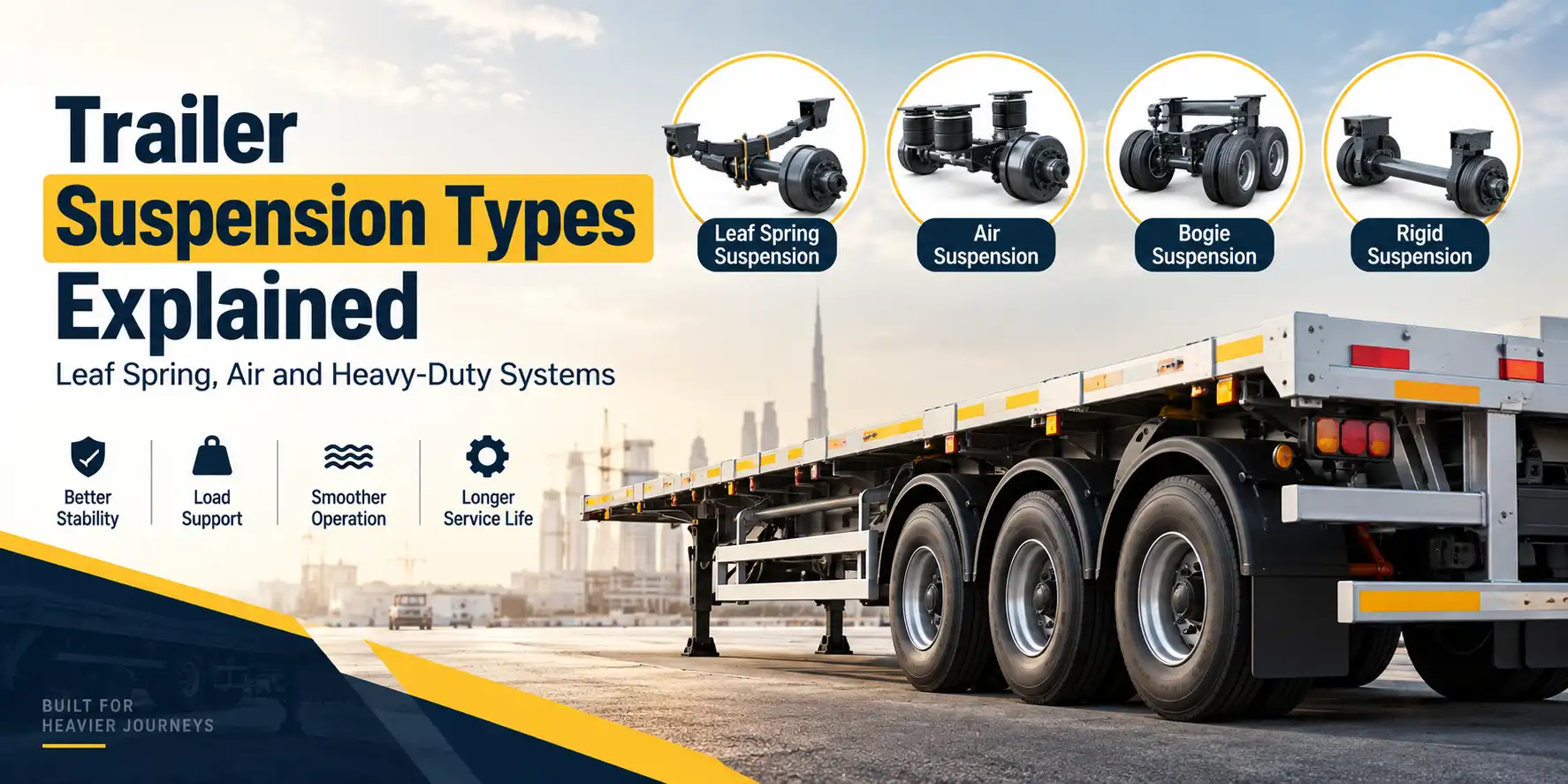
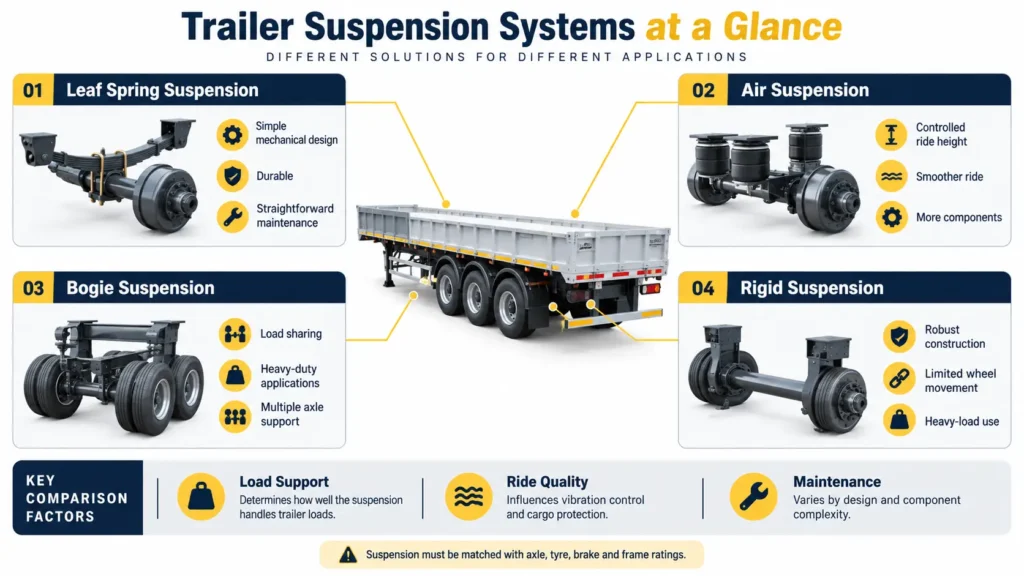
Leaf spring suspension uses stacked steel leaves to support an axle and absorb road forces. It is a proven mechanical design with relatively straightforward components. This makes it practical for many commercial trailers operating under demanding conditions.
Leaf springs are commonly associated with heavy-duty applications because of their simple construction and serviceability. They can work well where durability and predictable load support are more important than maximum ride comfort.
Air Suspension
Air suspension uses air springs or airbags to support the trailer. Controlled air pressure allows the suspension to respond to changing loads while maintaining a more consistent ride height. This can make air systems useful for highway transport and cargo that benefits from reduced vibration.
Air suspension includes additional components such as valves, air lines, bags, and controls. Maintenance therefore requires attention to both the mechanical and pneumatic parts of the system.
Bogie Suspension
Bogie suspension groups multiple axles so that loads can be distributed across the axle arrangement. It is commonly associated with heavy-duty trailer applications where substantial payloads need to be supported.
The system can improve load sharing across the axle group, but the final capability depends on the axle, frame, tyres, brakes, and suspension ratings. Bogie arrangements should therefore be selected as part of the complete trailer design.
Rigid Suspension
Rigid suspension uses a more fixed mechanical arrangement with limited independent movement between the wheels. Its straightforward construction can suit heavy-load applications where simplicity and structural strength are priorities.
Because wheel movement is more restricted, ride quality can be firmer on uneven surfaces. It should therefore be matched to the trailer’s operating speed, route, and intended duty.
Leaf Spring vs Air Suspension
Initial Cost and Maintenance
Leaf spring systems generally use fewer specialized components and can be comparatively straightforward to maintain. Air suspension contains additional components that require inspection and can increase system complexity.
However, purchase cost should not decide the choice by itself. Maintenance frequency, cargo type, operating distance, and annual utilization can make one system more economical for a particular fleet.
Ride Quality and Cargo Protection
Air suspension can provide controlled movement and smoother ride characteristics. This may be valuable when cargo is sensitive to vibration or when trailers spend substantial time on paved highways.
Leaf springs generally provide a firmer mechanical response. They remain useful for many heavy-duty applications where robust load support and simpler construction are priorities.
Golden Space offers air-balloon suspension on its container box trailer configuration, supporting applications where controlled ride performance can be valuable.
Suitability for Heavy-Duty Use
Leaf spring suspension can be practical for demanding construction and industrial applications where durability and straightforward maintenance are important. Air suspension can suit long-distance transport where ride characteristics and ride-height control are more valuable.
Neither system is universally better. The choice should reflect payload, cargo sensitivity, route conditions, operating frequency, and the complete trailer specification.
How Suspension Affects Trailer Payload
Suspension and Axle Ratings
Suspension contributes to the trailer’s load-support system but does not determine payload by itself. Axle rating, tyres, wheels, brakes, frame strength, and the trailer’s overall approved rating also establish limits.
A high-rated axle cannot automatically create a higher-capacity trailer if another component has a lower rating. The running gear should therefore be engineered as one complete system.
For more information about this relationship, see Trailer Axle Capacity, which explains axle ratings, load distribution, and capacity limits.
Payload and Overall Trailer Ratings
Payload is the cargo weight a trailer can carry within its approved limits. Suspension supports that load, while the overall trailer rating establishes the broader operating boundary.
Permanent equipment also contributes to trailer weight. Fleet operators should therefore consider the empty trailer, cargo, axle ratings, suspension, and other components before determining practical loading capacity.
How Suspension Affects Trailer Stability
Weight Distribution
Suspension works most effectively when the cargo is distributed according to the trailer’s intended loading arrangement. Uneven loading can place excessive forces on individual axle groups and affect handling.
A balanced load helps spread forces across the trailer. Suspension should therefore be evaluated together with axle positioning and the location of heavy cargo.
Centre of Gravity
Cargo height and position influence the trailer’s centre of gravity. A higher centre of gravity can change how the trailer reacts during turns and braking.
Suspension characteristics interact with this load position, but they cannot remove the risks created by poorly positioned or unsecured cargo. The trailer should be loaded according to its approved design.
Braking and Cornering
During braking and cornering, the suspension works with tyres, axles, and braking components to control the trailer. Excessive movement or uneven loading can affect the vehicle’s response.
Commercial fleets should therefore assess suspension as part of the complete handling system rather than as an isolated component.
Suspension Choices by Trailer Application
Flatbed and Skeleton Trailers
Flatbeds and skeleton trailers often carry steel, containers, machinery, and other commercial loads. Their suspension needs to support the expected weight while working with the axle and chassis arrangement.
A Skeleton Trailer requires suspension compatible with container-focused load distribution and axle placement. The selection should also consider route conditions and expected utilization.
Lowbed and Heavy-Haul Trailers
Lowbed trailers transport heavy machinery and oversized equipment, making load distribution especially important. Suspension must support substantial weights while maintaining the intended platform height.
A Low Bed Trailer therefore needs a suspension configuration matched to the machinery, axle arrangement, road conditions, and required payload.
Tipper Trailers
Tipper trailers experience repeated loading and unloading cycles. Their suspension must support heavy bulk materials while handling changing loads during transport and tipping operations.
Material density, payload, axle arrangement, and site conditions should all be considered. Suspension should remain compatible with the trailer’s frame, hydraulics, tyres, and braking system.
Container and Recovery Trailers
Container trailers require stable load support for standardized container weights. Recovery trailers face more varied loads because the weight and position of recovered vehicles can change between jobs.
The suspension choice should therefore reflect the actual recovery or container operation. A configuration designed for one application should not automatically be transferred to another.
Lift Axle Suspension
When Lift Axles Are Used
A lift axle can be raised when its load-bearing role is not required, depending on the approved system. When lowered, it becomes part of the working axle group and shares the load.
Lift axles can provide flexibility for trailers whose operating conditions change between loaded and lightly loaded journeys. Their use should follow the manufacturer’s approved operating instructions.
Advantages and Limitations
A lift axle can help adapt the trailer to different loading conditions and may reduce unnecessary tyre contact when the additional axle is not required. However, it adds components and control requirements.
It should not be treated as a simple way to increase legal payload. The complete trailer rating and applicable weight limits still govern operation.
Trailer Suspension Maintenance
Leaf Spring Components to Inspect
Inspect spring leaves, bushes, shackles, hangers, equalizers, U-bolts, and mounting points for cracks, deformation, and excessive wear. Uneven ride height can also indicate a problem with the suspension system.
Regular inspection is particularly important for trailers that operate with high loads or on rough access roads. Damaged components should be assessed before continued heavy operation.
Air Suspension Components to Inspect
Air suspension should be checked for leaking air bags, damaged air lines, worn fittings, and abnormal ride height. Mounting points and control components also need inspection.
A sudden change in ride height can indicate a pneumatic or mechanical fault. Early diagnosis can help prevent further component damage.
Signs of Suspension Wear
Warning signs can include uneven tyre wear, unusual movement, abnormal ride height, visible component damage, or changes in handling. These symptoms should not be ignored.
Routine checks allow fleet operators to identify wear before it affects other components. Maintenance intervals should follow the manufacturer’s recommendations.
Choosing Suspension for a Commercial Trailer
Match Suspension to Payload and Cargo
Begin with the expected cargo weight and characteristics. Heavy industrial loads may prioritize robust mechanical support, while sensitive cargo may benefit more from controlled ride performance.
The suspension should also match axle ratings and the trailer structure. A system that works for one payload or cargo type may not suit another.
Consider Route and Duty Cycle
Highway trailers can have different suspension priorities from trailers working regularly on construction sites or industrial access roads. Surface quality, operating distance, speed, and loading frequency all influence the selection.
Frequent daily use also increases the importance of durability and accessible maintenance.
Evaluate Long-Term Operating Costs
Compare purchase cost with maintenance, downtime, tyre wear, component replacement, and expected service life. A higher initial cost may be justified when the suspension provides operational advantages that match the fleet’s needs.
The cheapest suspension is not automatically the lowest-cost solution over its working life.
Trailer Suspension for UAE Fleet Operations
Heat, Dust and Road Conditions
UAE trailers can operate in high temperatures, dusty environments, and demanding industrial areas. Suspension components should therefore be inspected regularly for wear, contamination, damage, and changes in ride height.
Heavy construction and quarry work can place additional demands on the running gear. The suspension should be selected around actual site conditions rather than a generic specification.
Long-Distance and Industrial Use
Long-distance logistics operations can benefit from suspension selected for consistent highway performance. Industrial and construction fleets may place more emphasis on load support and durability across varied surfaces.
Fleet managers should assess how many hours and kilometres the trailer will operate each year before selecting the final system.
Applicable Weight and Safety Requirements
Suspension is only one part of trailer compliance. Axle ratings, tyres, brakes, GVWR, coupling systems, and applicable road requirements must also be checked.
The final configuration should come from the trailer manufacturer’s approved specification rather than from a suspension rating alone.
Specifying Suspension for a Custom Trailer
Cargo and Operating Requirements
A manufacturer should receive information about cargo weight, material type, loading method, route, operating speed, and expected utilization. These details help determine a suitable suspension and axle configuration.
For example, a trailer carrying machinery on highways may have different priorities from one transporting aggregate on construction roads.
Axle and Wheel Configuration
Suspension, axles, wheels, and tyres should be engineered together. Changing one element can affect load support and the balance of the complete running gear.
Fleet managers should therefore provide the intended payload and operating conditions before the suspension is finalized.
Loading Frequency and Usage Pattern
A trailer operating throughout the day may require a different component and maintenance strategy from equipment used occasionally. Duty cycle affects wear and the expected workload on the suspension.
This information helps manufacturers avoid under-specifying the trailer or adding unnecessary components.
Common Trailer Suspension Mistakes
Selecting Only by Initial Cost
Choosing solely on purchase price can overlook maintenance and downtime. A slightly higher initial investment may be more practical when it matches the workload better.
Assuming Axle Rating Defines Suspension Capacity
Axle capacity alone does not define total trailer capacity. Suspension, tyres, wheels, brakes, frame, and GVWR must all support the intended load.
Ignoring Uneven Loading
Uneven cargo can increase forces on particular axle groups and suspension components. Operators should follow the trailer’s approved loading arrangement.
Overlooking Early Signs of Wear
Visible cracks, uneven ride height, tyre wear, air leaks, or abnormal movement can indicate suspension problems. Early inspection can prevent a minor issue from becoming a larger failure.
Frequently Asked Questions
Can changing a trailer’s suspension change its ride height?
Yes. Suspension geometry and ride-height settings can affect the distance between the chassis and road. Any change should be engineered around the complete trailer and its coupling arrangement.
How does suspension affect trailer ground clearance?
Suspension position and travel influence available ground clearance. The required clearance depends on the trailer’s design, axle layout, and operating environment.
Can suspension modifications affect coupling height?
They can. Changing ride height or suspension geometry may alter the trailer’s position relative to the towing vehicle. Compatibility should be assessed before any modification is made.
What happens when suspension components are mismatched?
Mismatched components can affect ride height, load support, handling, and wear. Suspension parts should be selected as a compatible system rather than mixed solely by size.