
Knowing how to secure steel beams on a flatbed trailer is critical because structural steel combines high weight, long dimensions, hard edges and relatively low friction when steel surfaces contact each other. A load that looks stable while parked can move under braking, cornering, vibration or emergency manoeuvres if the beams are not properly supported and restrained.
Safe securement starts with the trailer and load plan, not with adding chains after loading. Operators need to confirm beam weight and dimensions, trailer capacity, axle distribution, dunnage, beam orientation, approved anchor points, tie-down ratings and the route requirements that apply to the loaded vehicle.
This guide explains the complete process for I-beams, H-beams and similar structural steel carried on flatbed trailers, with specific attention to UAE operating conditions.
Table of Contents
- Why steel beams are difficult to secure
- What to check before loading
- Choosing the right flatbed trailer
- Why dunnage and blocking matter
- How to position beams on the deck
- Choosing chains, binders and tie-down points
- How to secure single-layer and stacked beams
- Working load limits and restraint capacity
- Weight distribution and axle loading
- UAE load-securement requirements
- In-transit inspections
- Common mistakes
- Securement checklist
- FAQs
Why Are Steel Beams Difficult to Secure on a Flatbed?
Structural steel is challenging because the load can be long, dense and difficult to restrain against movement in several directions.
Common issues include:
- Steel-on-steel contact with low friction
- Narrow contact points
- Sharp flange edges
- Long overhangs
- Uneven beam sizes within one load
- High concentrated weight
- Multiple stacked layers
- Limited space for effective tie-down angles
I-beams and H-beams also have flanges and webs that create spaces where blocking can be used, but those shapes can allow movement if the stack is poorly arranged.
The goal of flatbed load securement is not simply to stop the cargo from falling off. The system should control forward, rearward, lateral and vertical movement throughout the journey.
What Should Be Checked Before Loading Steel Beams?
Before deciding how to secure steel beams on a flatbed trailer, document the actual load.
Confirm:
- Number of beams
- Individual beam weight
- Total cargo weight
- Beam length
- Flange width
- Beam depth
- Whether all beams are the same section size
- Planned stack height
- Centre of gravity of the complete load
- Available trailer deck length
- Trailer payload rating
- Axle and kingpin limits
- Tie-down anchor locations and ratings
Long structural sections should not be loaded first and measured afterward. Their dimensions affect trailer selection, axle loading, overhang and route planning.
A mixed bundle also needs more planning than a uniform stack. Beams with different flange widths or depths may require additional blocking so one section cannot shift into the space beside another.
Choose a Flatbed That Matches the Load
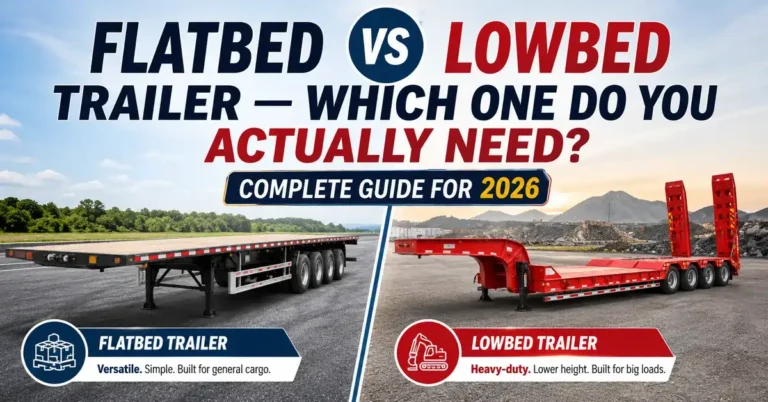
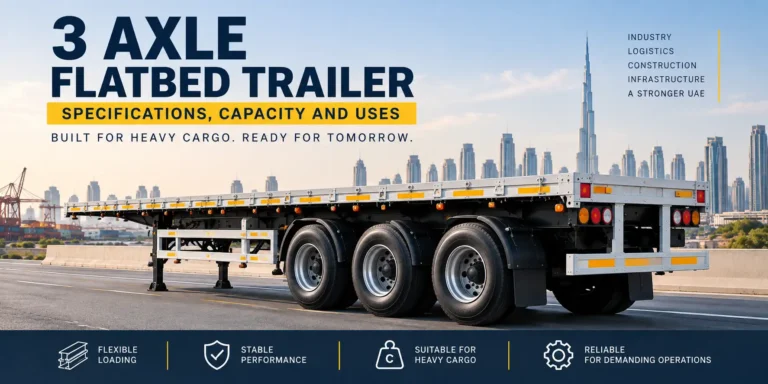
Flatbed trailers are well suited to structural steel because the open deck provides crane and forklift access from the sides and top.
However, trailer suitability depends on more than total payload.
Check:
- Usable deck length
- Deck width
- Deck condition
- Frame capacity
- Axle arrangement
- Rated payload
- Kingpin loading
- Tie-down points
- Anchor ratings
- Stake pockets or other approved restraint features where fitted
For trailer configuration and cargo applications, review the Golden Space flatbed trailer specifications.
Why Dunnage Matters When Learning How to Secure Steel Beams on a Flatbed Trailer
Dunnage is one of the most important parts of steel beam transport.
Timber or another suitable engineered packing material separates the steel from the trailer deck and can increase friction, create access for lifting equipment and provide defined support points.
Dubai RTA heavy-vehicle guidance advises avoiding metal-to-metal contact and using timber or rubber between metal surfaces to improve friction. It also states that packing should be selected and secured so it cannot move.
Good dunnage should:
- Be strong enough for the load
- Be in sound condition
- Extend sufficiently to support the beam stack
- Be positioned consistently across the load
- Remain stable during transport
- Avoid creating concentrated unsupported points
Crushed, split or unstable packing should not be treated as reliable load support.
Why Steel-on-Steel Contact Is a Problem
Steel surfaces can slide against each other more easily than many operators expect.
This becomes especially important during hard braking or cornering. A chain may provide vertical clamping force, but if the beam layers can slide relative to each other, the load can still change shape.
Structural-steel securement guidance also recommends avoiding direct steel-on-steel loading and using blocking within beam webs and between flanges where appropriate to the load configuration.
Dunnage, blocking and restraint should therefore work together as one system.
How Should Steel Beams Be Positioned on the Trailer?
Correct positioning is part of how to secure steel beams on a flatbed trailer because a badly positioned load can create axle overloads even when the securement itself is strong.
Place the load so that:
- Weight is centred left to right
- The centre of mass produces acceptable kingpin and axle loads
- The beams have adequate deck support
- Tie-downs can be installed at useful angles
- Overhang is controlled
- The load remains within route and permit requirements
Do not position a heavy beam bundle only by eye.
Long beams can create large differences in axle loading when the same load is moved forward or rearward.
For this reason, trailer weight distribution should be checked separately from cargo securement.
For more detail on cargo position and axle loading, see the Golden Space weight-distribution guide.
How Should I-Beams and H-Beams Be Stacked?
A stable stack normally starts with the widest and most stable arrangement at the bottom.
When multiple layers are used:
- Keep compatible beam sizes together where practical.
- Use suitable dunnage between layers when required by the loading plan.
- Align support points vertically where possible.
- Block spaces that could allow beams to roll or shift laterally.
- Keep the stack symmetrical around the trailer centreline.
- Avoid placing small sections loosely on top of a wide stack.
Industry structural-steel guidance recommends blocking I-beams and H-beams in the web and using wedges between flanges where the load configuration requires it.
Chains and Binders: How to Secure Steel Beams on a Flatbed Trailer
Steel beams are heavy, hard-edged cargo. Chains and load binders are commonly used because they can provide high restraint capacity and tolerate conditions that can damage ordinary webbing.
A securement system can include:
- Rated transport chain
- Ratchet or lever binders
- Rated trailer anchor points
- Dunnage
- Blocking
- Edge or contact protection where necessary
- Additional straps where suitable and approved
Check Every Component Rating
The chain is only as useful as the rest of the securement path.
Check the working load limit of:
- Chain
- Binder
- Hook
- Connector
- Trailer anchor point
- Any intermediate fitting
The system should be evaluated according to its weakest rated component.
Do not assume a heavy-looking chain is suitable simply because of its diameter.
How to Secure Steel Beams on a Flatbed Trailer Step by Step
A practical how to secure steel beams on a flatbed trailer procedure should follow the load plan for the actual beam dimensions and weights.
1. Prepare the Trailer Deck
Remove loose debris, oil, grease and other contamination.
Inspect the deck, dunnage, anchors and securement equipment before the crane or forklift starts loading.
2. Place the First Dunnage Layer
Set suitable dunnage at planned support positions.
The supports should be stable, aligned and capable of carrying the concentrated weight of the beam stack.
3. Load the Bottom Layer
Place the widest or most stable sections in the lower part of the stack where practical.
Keep the load centred across the trailer.
4. Add Blocking Where Movement Is Possible
Use suitable blocking or wedges where the beam profile creates space for lateral movement.
Blocking should restrain the load rather than simply fill empty space.
5. Add Additional Layers Carefully
If beams are stacked, keep each layer stable and supported.
Do not rely on the weight of upper beams alone to prevent movement in the lower layers.
6. Install Chains at Planned Securement Points
Place chains so they restrain the load effectively and connect only to suitable rated trailer anchors.
Avoid poor angles that provide little useful restraint.
7. Tension the Chains With Rated Binders
Apply tension evenly.
A chain should be tight enough to perform its restraint function without being used in a way that damages the cargo, trailer or securement hardware.
8. Control Forward and Rearward Movement
Do not rely only on chains passing vertically over the load if the configuration can slide longitudinally.
Blocking, direct restraints or another engineered method may be necessary to control forward and rearward movement.
9. Check Lateral Restraint
Beams should not be able to roll, tip or slide sideways as the vehicle corners.
The web and flange geometry can be combined with suitable blocking where appropriate.
10. Perform a Second Inspection
A second competent person should verify the load where the operator’s procedure requires it.
Check the complete restraint path, not simply whether each binder appears tight.
How Many Chains Are Needed for Steel Beams?
There is no responsible universal answer such as “use four chains” for every beam load.
The required securement depends on:
- Total cargo weight
- Beam length
- Number of beams
- Stack configuration
- Whether the load is blocked
- Chain working load limit
- Anchor-point ratings
- Tie-down geometry
- Applicable regulations
- Approved company procedures
As a technical reference, U.S. FMCSA general cargo rules require the aggregate working load limit of a cargo-securement system to be at least one-half the weight of the article or group being secured. FMCSA also recognizes fabricated structural items such as steel beams as cargo that can require special securement methods.
Why Working Load Limit Matters
Working load limit, or WLL, is the rated load that a securement component is designed to handle in service.
Do not confuse WLL with breaking strength.
A securement system should be designed using rated working limits, not the force at which a component might eventually fail.
When calculating restraint capacity, consider the entire system rather than simply adding chain ratings without checking how each tie-down is arranged.
Anchor strength also matters. A strong chain connected to an anchor with an inadequate rating does not produce a secure system.
Protect Chains, Straps and Beam Surfaces
Structural steel can have sharp edges, mill scale or fabricated details that affect securement equipment.
Where webbing is used as part of an approved arrangement, edge protection is especially important because sharp steel can cut or abrade the material.
British Steel’s transport guidance treats chains, tensioners, webbing, edge protection, anti-slip material, dunnage and methods such as belly wrapping as parts of an integrated steel load-restraint system.
Chains may also require suitable protection where the steel surface or coating must be protected.
Weight Distribution Must Be Checked Separately
Proper load securement does not correct poor weight distribution.
A perfectly restrained steel bundle can still overload:
- The trailer axle group
- Tractor axles
- Tyres
- Suspension
- Fifth-wheel or kingpin loading
After loading, verify:
- Gross combination weight
- Trailer axle-group load
- Tractor axle loads
- Kingpin or fifth-wheel load
- Left-to-right balance
Use an appropriate weighbridge or axle-weighing method where required.
Securement and weight distribution are related, but they are not interchangeable.
UAE Requirements for Securing Flatbed Loads
UAE federal law places explicit obligations on heavy-vehicle operators.
Federal Decree by Law No. 12 of 2023 requires operators to ensure that loads are properly distributed and fixed on heavy vehicles. It also requires operators to establish administrative, training and operational procedures for controlling total and axle weights, maximum dimensions, load distribution and load stabilization.
This matters directly when deciding how to secure steel beams on a flatbed trailer in the UAE.
The requirement is not satisfied merely because chains are visible on the trailer. The complete load must be properly distributed and stabilized.
RTA guidance also highlights practical principles such as:
- Keeping load and deck surfaces clean
- Avoiding slippery metal-to-metal contact
- Using suitable timber or rubber packing
- Securing packing against movement
- Selecting restraint equipment according to the load
Operators should separately check emirate-specific road restrictions, dimension limits and permit conditions for the actual journey.
What About Steel Beam Overhang?
Steel beams can exceed the usable deck length.
Do not assume that overhang is acceptable simply because the beam is well restrained.
Check:
- Complete loaded length
- Front projection
- Rear projection
- Visibility
- Lighting and marking requirements
- Turning clearance
- Route restrictions
- Permit requirements
A beam may be practical on one route but unsuitable on another because of roundabouts, site entrances, bridge geometry or local road restrictions.
How to Secure Steel Beams on a Flatbed Trailer Before Departure
Before the vehicle moves, inspect:
- Beam position
- Dunnage condition
- Blocking
- Chain placement
- Binder tension
- Hooks and connectors
- Anchor points
- Edge protection
- Stack stability
- Overall dimensions
- Axle loads
- Overhang
- Lights and markings
- Permit documentation where required
Walk around the complete trailer.
A load should be judged by whether it can resist expected transport forces, not by whether it looks neat from one side.
Recheck Securement During the Journey
Vibration and load settling can change chain tension after departure.
A transport procedure should define when the driver needs to stop and inspect the load.
Recheck:
- Chain tension
- Binder position
- Dunnage movement
- Blocking
- Beam alignment
- Evidence of sliding
- Trailer lean
- Abnormal suspension position
Cargo-securement guidance also recommends periodic inspection of tie-down chains and load binders during transport and retensioning where necessary.
If the beams have shifted, do not simply tighten one loose chain and continue without investigating why the movement occurred.
The cause may be poor blocking, damaged dunnage, incorrect load positioning or an unsuitable restraint arrangement.
Common Mistakes When Learning How to Secure Steel Beams on a Flatbed Trailer
Allowing Uncontrolled Steel-to-Steel Contact
Low friction can allow beam layers to slide.
Use suitable dunnage or another approved interface where required.
Using Damaged Dunnage
Crushed, split or unstable timber should not be assumed to provide reliable support.
Relying Only on Vertical Clamping
Vertical chains can increase clamping force, but they may not provide adequate direct longitudinal restraint in every configuration.
Selecting Chains by Appearance
Chain grade, WLL, binder rating, hook rating and anchor rating matter.
Using Weak or Poorly Positioned Anchors
A high-capacity chain attached to an unsuitable anchor does not create a high-capacity securement system.
Loading Mixed Beam Sizes Without Blocking
Different flange widths and beam depths can create gaps that allow movement within the stack.
Ignoring Axle Distribution
Correct securement does not compensate for an overloaded axle group.
Failing to Reinspect the Load
Steel loads can settle after the vehicle begins moving.
Steel Beam Securement Checklist
Before dispatch, confirm the following.
Load Data
- Beam quantity verified
- Individual weights known
- Total weight known
- Lengths confirmed
- Section sizes confirmed
- Stack arrangement planned
Trailer
- Payload capacity suitable
- Deck length suitable
- Axle configuration checked
- Anchor points inspected
- Deck clean and in good condition
Dunnage and Blocking
- Suitable material selected
- Dunnage undamaged
- Supports positioned correctly
- Blocking installed where necessary
- Steel-to-steel sliding risk controlled
Securement
- Rated chains selected
- Binders inspected
- Hooks and connectors checked
- Anchor ratings suitable
- Forward movement controlled
- Rearward movement controlled
- Lateral movement controlled
- Stack movement controlled
- Edge or contact protection fitted where needed
Final Checks
- Weight distribution verified
- Axle loads checked where required
- Overall dimensions confirmed
- Overhang assessed
- Permit requirements checked
- Final inspection completed
- In-transit inspection procedure established
Frequently Asked Questions
What Is the Best Way to Secure Steel Beams on a Flatbed Trailer?
The correct method depends on beam weight, length, section profile and stack arrangement.
A typical system combines suitable dunnage, blocking, rated chains or other approved restraints, binders and rated trailer anchor points.
Should Steel Beams Sit Directly on a Flatbed Deck?
Direct metal-to-metal contact can provide poor friction.
RTA heavy-vehicle guidance recommends avoiding metal-to-metal contact and using suitable timber or rubber between metal surfaces where appropriate.
Should Chains or Straps Be Used for Steel Beams?
Chains are commonly used for heavy structural steel because of their restraint capacity and durability.
Webbing may have a role in some approved arrangements, but sharp steel edges can damage straps. Correct ratings and suitable edge protection are therefore important.
How Do You Stop I-Beams From Sliding Sideways?
Use a stable stack combined with suitable dunnage, blocking and rated restraints.
Blocking in the beam web or between flanges can help control movement where appropriate to the profile and loading arrangement.
How Many Tie-Downs Are Needed for Steel Beam Transport?
There is no universal number.
The correct number depends on cargo weight, length, blocking, securement-equipment WLL, anchor ratings, tie-down geometry and applicable requirements.