Trailer Weight Distribution: Why It Matters for Heavy Cargo in the UAE
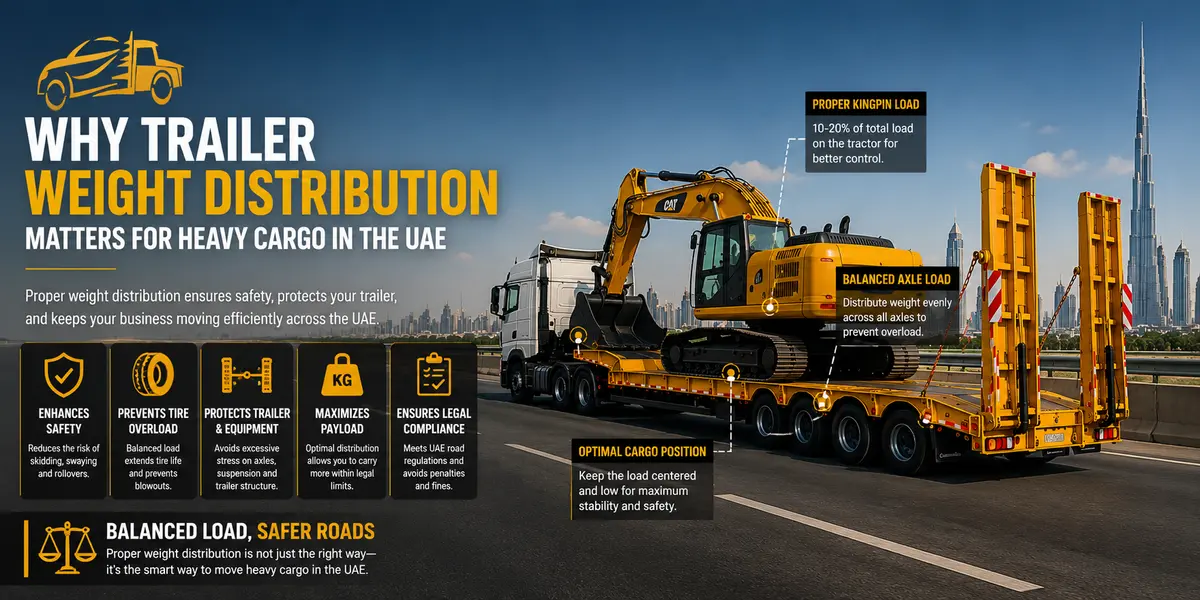
Construction firms, logistics operators, and plant hire companies across the UAE share one compliance blind spot that causes more fines, accidents, and mechanical failures than almost any other loading error. A trailer can sit within its rated payload, carry valid registration papers, and still fail a UAE smart gate inspection because the load is in the wrong position on the deck. Trailer weight distribution controls how cargo mass is spread across axles, from front to rear, and side to side. When that distribution is wrong, the consequences are immediate: sway at highway speed, per-axle violations, tyre failures, and structural damage that accumulates silently across every trip. This guide gives fleet managers and logistics supervisors a clear, practical framework for loading heavy cargo correctly every single time on UAE roads.
What Trailer Weight Distribution Means in Practice
Most operators think about total payload. Authorities check something different.
The Roads and Transport Authority and the Ministry of Energy and Infrastructure enforce weight per axle group, not just gross vehicle weight. A truck and trailer combination within its total weight limit can still generate a violation if individual axle groups are carrying unequal shares of the load.
Three measurements define how well a trailer is balanced.
Gross Trailer Weight is the combined mass of the trailer plus its cargo. This must stay within the trailer’s rated capacity and the UAE’s gross vehicle weight limits by axle count.
Axle group weight is the portion of the total load that each axle or pair of axles carries. This is what smart gate sensors measure independently, regardless of the gross total.
Tongue weight is the downward force at the coupling point between the trailer and the towing vehicle. The safe target is 10 to 15 percent of the total loaded trailer weight. Below that, the trailer sways. Above it, the tow vehicle’s rear suspension and coupling are overloaded.
Getting all three right simultaneously is what proper trailer weight distribution looks like in practice.
How UAE Axle Weight Limits Work Under Federal Law
Under Cabinet Resolution No. 138 of 2023, which implements Federal Decree No. 12 of 2023, gross vehicle weight limits are tied directly to axle count. Two-axle combinations are capped at 21 tonnes. Three axles allow 34 tonnes. Four axles allow 45 tonnes. Five axles allow 56 tonnes. Six axles carry the 65-tonne maximum for standard commercial operations on UAE federal roads.
These are gross combination limits. Per-axle compliance is a separate test, and failing it generates separate fines even when the gross weight figure is correct.
UAE Fine Structure for Axle and Weight Violations
The fine structure under the current federal framework is graduated and cumulative.
| Violation | Fine |
| Exceeding gross weight by less than 10% | AED 400 per tonne per trip |
| Exceeding gross weight by 10 to 20% | AED 500 per tonne per trip |
| Exceeding gross weight by more than 20% | AED 600 per tonne per trip, capped at AED 15,000 |
| Individual axle or tandem group over limit | AED 1,500 per axle group per trip |
| Exceeding height, width, or length limits | AED 3,000 per trip |
| Bypassing a smart gate or weigh station | AED 5,000 per trip |
| Repeated violations or unpaid fines over AED 45,000 | Vehicle impounded up to 30 days |
Twenty-four smart electronic gates operate on UAE national roads. They measure both gross weight and per-axle load simultaneously on every passing vehicle. A load balanced correctly in total but unevenly across axle groups does not escape detection.
The 60/40 Rule: Where Weight Should Sit on a Trailer
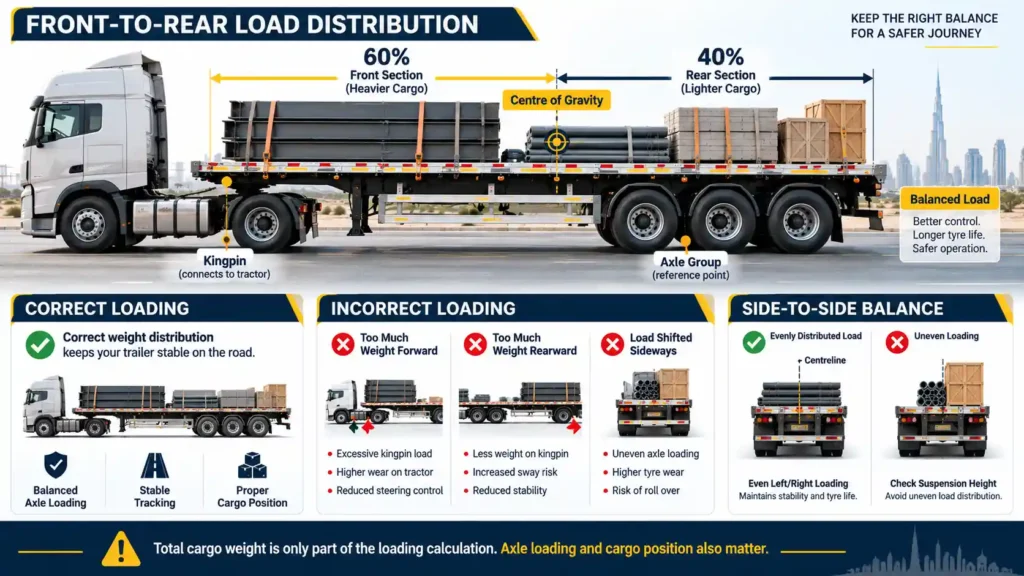
The loading guideline that experienced heavy transport operators apply consistently is the 60/40 rule. Sixty percent of total cargo weight should be positioned in the front half of the trailer, ahead of the axle or ahead of the midpoint between axles on tandem configurations. Forty percent sits in the rear half behind the axle.
This split produces tongue weight in the correct 10 to 15 percent range, which keeps the trailer tracking straight behind the towing vehicle at UAE highway speeds. Think of it like a seesaw with the axle at the pivot point. Weight forward of the axle presses the kingpin down onto the tractor’s fifth wheel. Weight behind the axle lifts the front and reduces steering contact. Too much rear weight and the trailer develops sway that worsens with speed. Too much forward weight and the tractor’s rear axle is overloaded.
Applying the 60/40 Rule to Different Load Types
The principle is consistent, but how you reach the correct split depends on what you are loading.
Structural steel and beams: Position the heavy end of each piece forward of the axle midpoint. On a standard flatbed, the first two-thirds of the deck length measured from the kingpin is the target zone for concentrated mass.
Aggregate and bulk materials in tipper trailers: Load from front to rear rather than dropping material toward the rear gate first. Hydraulic tipping shifts weight rearward during unloading, so a rear-heavy loaded configuration starts the trip already unbalanced.
Construction plant on lowbed trailers: Position the machine so its centre of gravity sits within the deck well, the lowered section between the gooseneck and rear axle group. Most tracked excavators are heaviest over the undercarriage, so the undercarriage should sit within the well, not overhanging toward the rear ramps.
Palletised goods on enclosed trailers: Distribute heavy pallets across the first 60 percent of floor space from the front of the trailer. Lighter cartons fill the rear section. Never stack heavy items only on one side.
Side-to-Side Balance: The Dimension Most Operators Overlook
Front-to-rear distribution gets most of the attention. Lateral balance causes equally serious problems and receives far less.
A load shifted even 200 mm off centre adds disproportionate stress to one side of each axle. The overloaded side wears tyres faster, generates asymmetric braking force, and puts torsional stress on the trailer frame that the design does not account for. On UAE highways where summer road surface temperatures exceed 55 degrees Celsius, tyre degradation on an overloaded side accelerates dramatically.
The practical rule is straightforward. Every item loaded onto a trailer deck must be centred left to right before it is secured. On multi-piece loads, the combined centre of mass should sit on the trailer’s longitudinal centreline, not offset to either side.
How to Check Lateral Balance Before Departure
Stand behind the loaded trailer and observe the suspension height on both sides. A significant visible difference indicates lateral imbalance. On trailers with air suspension, pressure readings on each side provide a more precise check. If the trailer is sitting lower on one side, redistribute cargo before departure. A trailer that visibly lists to one side at the yard is likely to generate an inspection at the first smart gate on the route.
Step-by-Step: How to Load a Trailer for Correct Weight Distribution
Step: Know Your Trailer’s Weight Ratings Before Loading
Every trailer has three key figures stamped on its compliance plate or available in its manufacturer documentation. Gross Vehicle Weight Rating is the maximum total loaded weight the trailer structure is built to carry. Gross Axle Weight Rating is the maximum weight per axle or axle group. Tongue weight rating is the maximum downward force the coupling can safely accept.
These are the upper boundaries. Your load must satisfy all three simultaneously, not just the gross total.
Step 2: Place the Heaviest Items First, Low and Centred
Heavy cargo goes onto the trailer floor first, as close to the axle group as practical, centred left to right. Low placement lowers the centre of gravity and reduces the tendency to tip on bends and emergency steering inputs. Never place the heaviest single item last because it is convenient to crane in at the end. That approach consistently produces rear-heavy, high-centre-of-gravity loads that create sway and axle violations.
Step 3: Build Forward to Reach the 60/40 Split
Once the main heavy item is positioned, add remaining cargo so that approximately 60 percent of total weight sits ahead of the axle midpoint. Lighter items fill the rear section to bring the rear share to 40 percent. On a tandem-axle trailer, the dividing line is the point midway between the two axles. On a single-axle trailer, it falls directly below the axle tube.
Step 4: Verify Axle Loads at a Weighbridge Before Departure
Portable axle scales or a yard weighbridge check catches distribution errors before the vehicle reaches a public road. A load that was correctly placed during loading can shift slightly as securing straps tighten and the trailer is hitched. The weighbridge shows what the smart gate will measure. Correcting an imbalance in the yard takes minutes. Correcting it after a violation has been recorded costs AED 1,500 per axle group.
Step 5: Recheck After the First 50 Kilometres
Cargo shifts during the first section of any trip, particularly as securing chains and straps settle under load movement. On long inter-emirate hauls for example, from Sharjah’s Sajaa Industrial Area to an Abu Dhabi infrastructure site a mid-journey check at a rest point catches any shift before it accumulates into a significant distribution problem. This is especially important for loads that include compressible materials or items secured with ratchet straps rather than chain binders.
Trailer Weight Distribution by Configuration
Semi-Trailer and Tractor Combinations
The kingpin load on a semi-trailer configuration transfers weight from the trailer to the tractor’s fifth wheel and ultimately to the tractor’s rear drive axle. A load positioned too far forward increases kingpin load and can push the tractor’s rear axle over its limit even when the trailer’s own axle group is within compliance. A load positioned too far back reduces kingpin load to the point where it also reduces tractor front-axle contact, affecting steering. The balance point between these two extremes sits at the 60 percent forward threshold.
Single-Axle Trailers
On a single-axle configuration, the 60/40 rule is even more critical because there is no second axle group to absorb any imbalance. All weight transfer from a rear-heavy load is felt directly at the coupling point. Single-axle trailers used for lighter construction deliveries in UAE urban and industrial zones are particularly prone to sway if operators load heavy items at the rear for access convenience.
Tandem and Multi-Axle Trailers
Multi-axle configurations distribute total load across more road contact points, which is why UAE regulations permit higher gross weights with additional axles. But axle spacing matters here. Closely spaced tandem axles share load between them naturally, but the combined group still has a maximum rating that a front-to-rear imbalance can push past. Ensure axle weights remain within 10 percent of each other across the group. Significant differences between axle readings on a tandem pair indicate the load is not centred over the midpoint of the group.
Common Loading Mistakes That Create Weight Distribution Problems
Measuring cargo weight without accounting for trailer tare weight. A 3-axle lowbed with a 10-tonne tare weight carrying a 30-tonne excavator presents a 40-tonne gross to the smart gate. Operators who calculate only against cargo weight consistently miscalculate their axle loading. For more on how axle count and trailer specs interact with UAE road rules, the full breakdown is available in the guide on UAE trailer regulations every fleet owner must know.
Relying on visual estimation instead of measurement. A machine that looks centred on the deck is not always centred. Asymmetric machinery like backhoe loaders or certain crane configurations carry more mass on one side by design. Only a weighbridge reading confirms lateral balance.
Using the rear of the trailer as a staging area during loading. Operators frequently set heavy items at the rear of the deck temporarily while positioning other cargo, then forget to redistribute. The result is a loaded configuration that was never planned, only accumulated.
Not accounting for load shift on sloped approach roads. Driving a loaded trailer onto a sloped ramp or across uneven ground at a construction site shifts cargo forward or rearward relative to the axle. A distribution check should always happen on level ground.
Confusing payload capacity with axle capacity. A trailer may be rated for 50 tonnes total but have axle groups rated at 20 tonnes each on a 3-axle configuration. Concentrating 35 tonnes of load over the rear two axles while only 15 tonnes sits over the front group violates the per-axle rating even though the gross total is within the trailer’s payload rating.
If the trailer configuration itself is limiting your ability to distribute loads correctly for example, because axle spacing is wrong for your typical cargo position the team that manufactures heavy-duty trailers for UAE operations can specify axle placement that suits your actual loading patterns.
Tools That Support Correct Trailer Weight Distribution
Weighbridges and portable axle scales are the most direct tools. They give the measurement that smart gate sensors will read. Every major industrial zone in the UAE has access to at least one commercial weighbridge, and portable scale pads are increasingly common in larger fleet yards.
Onboard weighing systems integrated into air suspension provide real-time axle load readings in the cab. These allow drivers to adjust load position or redistribute before leaving the yard rather than relying on a separate weighbridge stop.
Digital load planning software creates a virtual model of the trailer and cargo before physical loading begins. For complex multi-piece loads on flatbed or lowbed configurations, this prevents the situation where physical loading reveals a weight distribution problem that requires reloading the entire deck.
The Ministry of Energy and Infrastructure publishes the current federal regulations governing weight and dimension compliance for all heavy vehicles on UAE roads, including the latest smart gate enforcement protocols.
Frequently Asked Questions
Where should weight be on a trailer?
Sixty percent of total cargo weight should sit in the front half of the trailer, ahead of the axle. The remaining 40 percent goes in the rear half. This split keeps tongue weight in the stable 10 to 15 percent range and prevents sway at speed.
What is the 60/40 rule for trailer loading?
The 60/40 rule means placing 60 percent of your cargo weight forward of the trailer axle and 40 percent behind it. This balance produces correct tongue weight and keeps the trailer tracking straight behind the towing vehicle at highway speeds.
What happens if trailer weight distribution is wrong in UAE?
Per-axle violations cost AED 1,500 per axle group per trip. Gross weight overloading costs AED 400 to 600 per tonne depending on how far over the limit the vehicle is running. Smart gates on UAE federal roads detect both simultaneously on every vehicle that passes through.
How do I check if my trailer is loaded correctly?
Use a portable axle scale or a weighbridge before departure. Visually check that the trailer sits level side-to-side. Verify that tongue weight falls between 10 and 15 percent of total loaded trailer weight. Recheck after the first 50 kilometres on long hauls.
What is proper trailer weight distribution for a semi-trailer?
On a semi-trailer, keep the load’s centre of mass positioned so that kingpin load stays within the tractor’s fifth-wheel rating. Apply the 60/40 rule from the kingpin forward across the trailer deck. Ensure no individual axle group on the trailer carries a disproportionate share by checking each group’s reading separately at a weighbridge.
Conclusion
Trailer weight distribution is the loading decision that determines whether a cargo movement is safe, legal, and commercially efficient or a fine, a mechanical failure, and a project delay waiting to happen on a UAE federal highway.
The 60/40 rule is the foundation. Heavy items forward of the axle, centred left to right, verified at a weighbridge before the vehicle leaves the yard. Apply that consistently and the most common causes of UAE axle violations, trailer sway, and premature tyre failure do not appear in your fleet’s record.
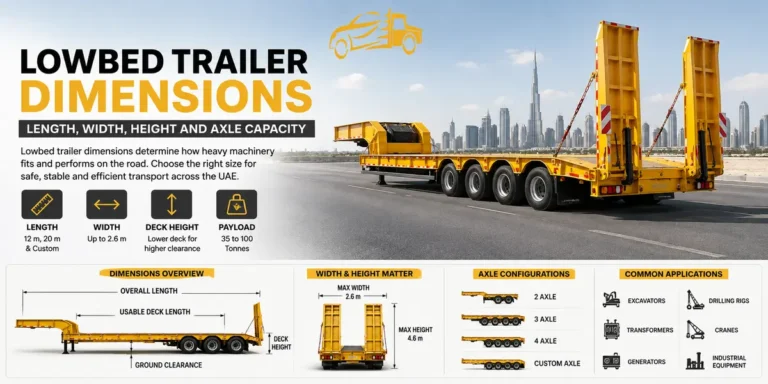
The right trailer configuration also makes this easier. Axle spacing, deck length, and suspension type all affect how naturally the 60/40 split is achievable for your specific cargo. For a practical look at how different trailer configurations handle load placement differently, the guide on lowbed trailer dimensions covers the technical detail by configuration.